


The Product Design Process: What Actually Matters Before Manufacturing
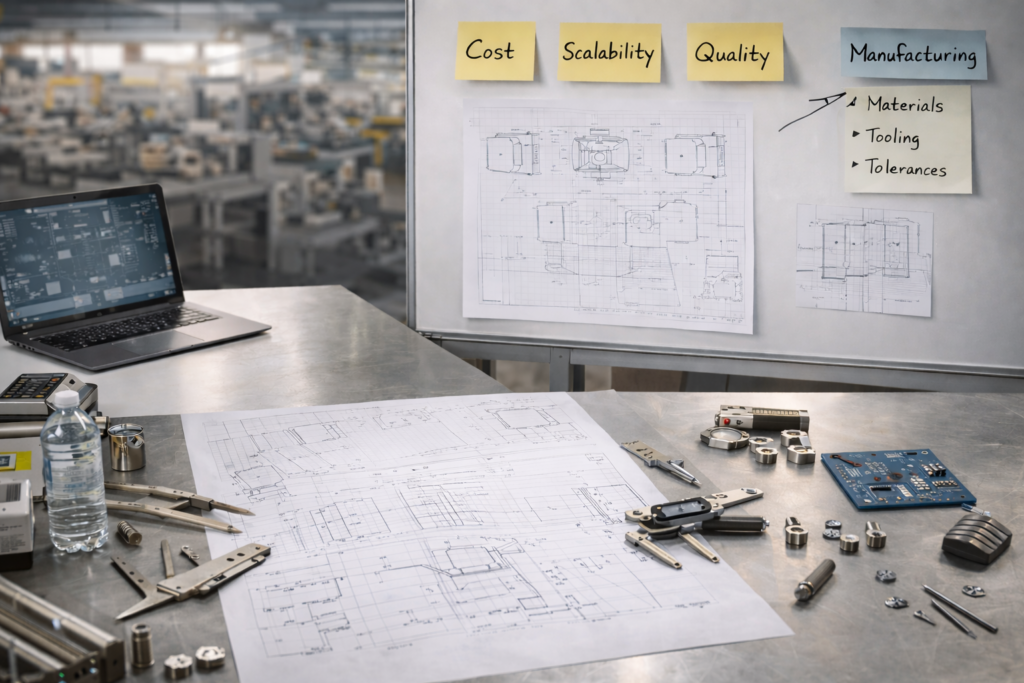
Key Takeaways
- The product design process locks in cost, quality, and scalability earlier than most teams expect.
- Manufacturing decisions should be treated as core design inputs, not downstream fixes.
- Product designers and product managers must align user needs, business goals, and production constraints early.
- Brands that integrate manufacturing into the design process avoid costly redesigns and delays later.
Many product design process guides focus on ideation and aesthetics, but often underestimate the manufacturing decisions that determine whether a product actually succeeds in production. A product can look strong on paper and still struggle if cost, quality, or scalability are addressed too late.
This guide focuses on what truly impacts product success once manufacturing enters the picture. At Linton, the product design process is informed by real-world experience across product design, engineering, sourcing, manufacturing, quality control, and logistics. Product designers, product managers, and manufacturing teams work together to align user needs, business goals, and production constraints early, ensuring the final product can be manufactured consistently and at scale.
Explore Product Design & Development
Step 1: Define the Product Problem and Business Constraints
The product design process begins by clearly defining the problem the product is meant to solve. This requires more than listing features. Teams must understand how the product fits into a real-world use case and why it matters to the customer.
Key inputs at this stage include:
- The primary customer pain points the product addresses
- The intended use case and environment
- The core user needs the product must satisfy
Alongside the product problem, business constraints must be defined early and treated as non-negotiable inputs that shape design, cost structure, and manufacturing feasibility. These include target price point, margin expectations, and distribution channel such as direct-to-consumer, Amazon, or retail. Early user research and user feedback help validate assumptions and ensure the product problem reflects real market demand rather than internal preferences.
Ignoring business constraints at this stage often leads to redesigns later, when cost and feasibility issues become harder to fix.
Step 2: Competitive Research and Market Reality Check
Competitive research grounds the product design process in market reality. It helps teams understand what already exists and where opportunities for differentiation truly lie.
Effective competitive research evaluates:
- Materials used in competing physical products
- Durability and performance over time
- Pricing and perceived value
- Quality issues revealed in customer reviews
This research informs more than surface-level design choices. It influences material selection, cost positioning, and manufacturing strategy. The goal is to identify gaps where original design decisions can support differentiation, cost feasibility, and manufacturability.
Step 3: Concept Development With Manufacturing in Mind
Concept development translates insights and requirements into early product concepts. At this stage, originality must be balanced with feasibility.
Design concepts should be evaluated through a manufacturing lens. Product design, engineering feasibility, factory capabilities, and production planning must work together as one integrated system rather than sequential handoffs.
A common failure point occurs when concepts prioritize visual appeal without considering how the product will be produced. Designs that ignore manufacturing constraints often require significant rework once feasibility issues surface, adding cost and delaying timelines.
Step 4: Engineering, Materials, and Feasibility Analysis
Engineering and feasibility analysis determine whether a concept can be produced reliably at scale. This step validates that design decisions align with manufacturing realities.
Material selection is evaluated based on:
- Cost and long-term availability
- Durability under real-world use
- Manufacturing complexity and tooling requirements
Engineering decisions also define tolerances, structural integrity, and finish quality. These choices directly affect unit cost, defect risk, lead times, and the ability to maintain consistent quality at scale. Validating feasibility at this stage protects the broader product development process from costly surprises later.
Step 5: Prototyping, Testing, and Iteration
Prototyping plays a critical role in the product design process, but prototypes are not final products. They are tools for validation and learning.
Prototypes are used to test:
- Functional performance
- Fit and ergonomics
- Material behavior and durability
Testing during this phase focuses on validating how the physical product performs under real-world conditions before committing to mass production. User feedback and performance data guide iteration and refinement. Changes at this stage can impact cost and timeline, which is why iteration should be driven by feasibility and production goals rather than assumptions alone.
Step 6: Factory Evaluation and Manufacturing Planning
Factory evaluation is a strategic part of the product design process, not a transactional sourcing afterthought. The factory chosen will influence scalability, quality consistency, and long-term production success.
Key evaluation factors include:
- Manufacturing capabilities and equipment
- Quality systems and inspection processes
- Experience producing similar physical products
Step 7: Quality Control Planning Before Production
Quality control planning begins before mass production starts. Quality must be built into the product through early design and engineering decisions.
This stage includes:
- Defining measurable quality standards
- Setting inspection criteria
- Reducing defect risk through material and tolerance choices
Quality assurance is not limited to inspection at the end of the line, but is designed into the product through materials, tolerances, and production standards. It is the result of thoughtful design, engineering, and production standards working together to support repeatable manufacturing.
Step 8: Preparing for Manufacturing, Product Launch, and Scale
As the product design process nears completion, teams finalize specifications and prepare for manufacturing and product launch.
This includes:
- Locking materials, dimensions, and tolerances
- Finalizing production workflows and timelines
- Addressing packaging, logistics, and shipping requirements
Early design decisions strongly influence cost stability, launch timing, and the ability to scale production without disruption. A well-executed product design process supports consistent production and smoother growth over time.
Common Mistakes in the Product Design Process
Several recurring mistakes undermine long-term product success:
- Designing without understanding manufacturing constraints
- Prioritizing aesthetics over feasibility
- Delaying cost analysis until design feels complete
- Treating manufacturing as a separate phase rather than an integrated process
These mistakes are expensive to fix once production begins and often result in delays, redesigns, or margin erosion.
Why the Product Design Process Determines Long-Term Success
The product design process sets the foundation for everything that follows. Early decisions compound over time, shaping cost structure, quality outcomes, lead times, and scalability.
When treated as a strategic business function rather than a purely creative exercise, the product design process becomes a powerful driver of long-term success. Mistakes made at this stage are far more expensive to correct later.
Manufacturing-Integrated Product Design With Linton
The product design process is most effective when manufacturing is considered from the start. Linton supports the full product design and manufacturing lifecycle, helping brands move from early concepts to production-ready products through a shared-success model where Linton only wins when the product succeeds.
By integrating product design, engineering, factory evaluation, quality control, and logistics, Linton helps brands reduce risk and deliver physical products that perform reliably in real manufacturing environments. The focus is not just on design deliverables, but on long-term product success in the market.
Reviewed by the Linton Team
Linton is an end-to-end product development and manufacturing partner with 1,200+ projects delivered across 200+ product categories. Our team helps consumer brands design, source, and manufacture products through a network of 700+ vetted factories.
Wondering if your product could be built better, faster, or at a lower cost?
Related Posts

Most product development firms design first and figure out manufacturing later. That sequence is the most expensive mistake a brand can make. When design and manufacturing are treated as separate phases, problems surface at the worst possible time: during tooling, during factory validation, or worse, during mass production. By then, fixing them costs 5 to […]
Read More
Key Takeaways Consumer product design impacts manufacturing cost, quality, and scalability, not just aesthetics or market fit. Early design decisions influence tooling, materials, defect risk, and production efficiency. Products designed without manufacturing constraints often face margin erosion, delays, or costly redesigns. Manufacturing-integrated design helps brands launch faster, reduce risk, and scale more predictably. Many consumer […]
Read More