


Toy Manufacturing Process: From Concept to Retail Shelf

Key Takeaways
- Toy manufacturing combines engineering, compliance, and quality control, and each requires active oversight, not assumptions
- A creative concept and a manufacturing-ready design are not the same thing
- Tooling is one of the largest upfront capital commitments in toy production, making design accuracy critical before it begins
- Safety compliance (ASTM F963, CPSC, EN71) must be integrated into manufacturing decisions, not managed as a final step
- Factory selection is a long-term brand decision, not a pricing exercise
- The golden sample defines the production standard for every run that follows
- Most toy manufacturing failures stem from treating production as a fragmented process rather than a single integrated system
Bringing a toy to market requires more than a strong product concept. The toy manufacturing process demands coordinated execution across product design, engineering feasibility, material selection, factory management, safety compliance, and quality control, with each decision affecting the one that follows.
This guide is written for brand owners, product inventors, and Amazon sellers who have a toy or game concept and need a realistic, structured path from design to scalable production. It assumes you are past ideation. The goal here is to understand what professional toy manufacturing actually involves before those decisions become expensive to reverse.
What Makes Toy Manufacturing Uniquely Complex
Toys are regulated consumer products. That distinction shapes every decision in the manufacturing process.
Unlike most physical product categories, toys are subject to mandatory safety standards that govern materials, construction methods, age-grading, warning labels, and testing documentation:
- ASTM F963 — the primary toy safety standard in the United States
- CPSC testing requirements — mandatory testing and Children’s Product Certificate documentation for products intended for children under 12
- EN71 — the applicable standard across the European Union
These requirements apply before a product is imported, not after a quality issue surfaces at retail. Brands entering toy manufacturing without experience in these requirements frequently encounter the same pattern: production moves forward, compliance gaps surface late, and the cost of resolving them after tooling and manufacturing investment is significantly higher than addressing them at the design stage.
Validate Your Concept and Feasibility Before Production Begins
Before factory engagement begins, a concept must be evaluated against the manufacturing realities that will determine whether it can be produced profitably and at scale. A proper feasibility analysis covers:
- Unit economics at target volume
- Estimated tooling costs
- Material availability and pricing
- Lead time requirements
- Preliminary compliance mapping against applicable standards
Brands that skip this stage regularly discover that a product concept that works in theory does not work at the cost structure required for sustainable margins. Identifying this before committing to suppliers and tooling protects both the timeline and the budget. Linton’s product design and development program begins with exactly this kind of feasibility review, before any factory or tooling commitment is made.
Finalize Product Design for Manufacturing
A creative concept and a manufacturing-ready design are different things. This gap is where a significant portion of toy manufacturing cost gets generated.
A manufacturing-ready toy design accounts for:
- Material specifications that can be sourced consistently at production volume
- Tolerances that align with the selected production method, since injection molding, blow molding, rotational molding, and soft goods construction each have different requirements
- Assembly steps that minimize defect risk at scale
- All relevant safety restrictions on materials and components
Changes made after tooling is cut carry a cost that most brands underestimate until they are in the middle of it. Designs that do not account for real factory conditions go through expensive revision cycles, often after tooling is already in progress.
Prototype Development and Iteration
Prototyping exists to surface problems before they become tooling or production problems. The toy manufacturing process typically moves through three distinct stages:
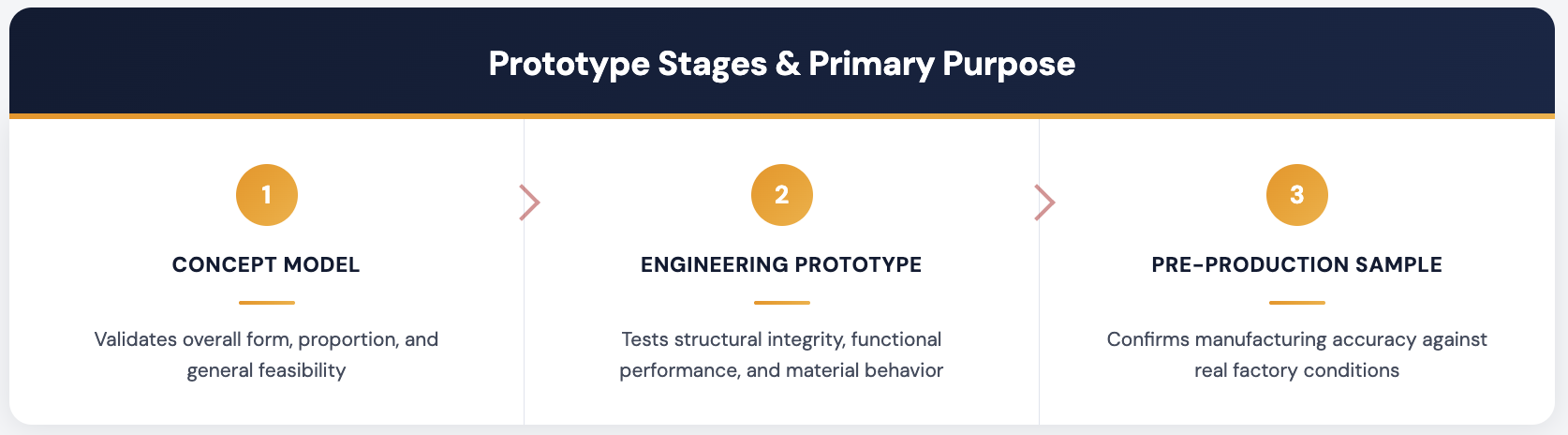
Brands that compress or eliminate prototype iterations in the interest of speed routinely discover the costs they avoided on the front end are paid back, with interest, in tooling revisions or production rework. This is a particular risk in the toy category, where plastic toys, plush toys, soft toys, and educational toys each carry different durability and compliance requirements.
Tooling and Mold Development
Tooling is one of the most significant capital decisions in the toy manufacturing process, and it is largely irreversible once committed.
For plastic toys, injection molding tooling involves manufacturing steel molds built to the exact specifications of the approved product design. What most brands do not fully plan for:
- First-off-tool parts must be evaluated against design specs before full production is approved
- Any design changes after tooling is cut generate additional cost and delay proportional to the scope of the change
- Molds are built to the design they receive, not the design the brand intended
This is the most concrete reason why a fully validated, manufacturing-ready design must be in place before tooling begins. Brands working with Linton on product design and development go through a complete design-for-manufacturability review before any tooling investment is made.
Factory Selection and Vetting
Finding a toy factory is not the same as vetting one. Professional toy factory evaluation looks beyond unit price to assess:
- Experience manufacturing the specific product type, since plastic toys, plush toys, action figures, and educational toys are not interchangeable manufacturing categories
- Safety certification status and compliance history
- Quality control infrastructure and in-line inspection processes
- Communication reliability and responsiveness
- Production capacity at scale
Online platform sourcing does not provide reliable visibility into most of these factors. Linton’s toys and games manufacturing program draws from a network of 700-plus vetted factories, each assessed against category-specific standards rather than pricing alone.
Establishing a Golden Sample and Production Standard
Once a pre-production sample is approved, it becomes the golden sample: the shared, quantifiable production standard that governs every manufacturing run that follows.
The golden sample defines the objective benchmark for tooling accuracy, material consistency, finish quality, and assembly standards. It protects both the brand and the factory by removing subjectivity from the quality control process. Every inspection is measured against it, not against informal memory of what the product was supposed to look like.
Linton’s in-house QC team follows ANSI/ASQ Z1.4 2018 and uses the approved golden sample as the benchmark for all inspections across production runs, creating consistent, repeatable output as order volumes scale.
Quality Control Across the Production Run
Quality control in toy manufacturing is not a final inspection. It is a structured system embedded throughout production. A complete QC program covers four stages:
- Pre-production checks — material and component verification before production begins
- First-off-tool evaluation — confirms tooling accuracy and process conformance once initial parts are produced
- In-line inspections — ongoing checks during the active production run for assembly accuracy and finish quality
- Final pre-shipment audit — structured sampling of finished goods against the approved golden sample before shipment approval
The stakes for QC failures in toy manufacturing are higher than in most product categories. A defective toy reaching a consumer carries safety liability, not just a return cost, making embedded and continuous quality control a structural requirement of professional toy production.
If you are evaluating your current QC setup or approaching a first production run, schedule a consultation to understand what a complete quality system should look like for your product.
Safety Compliance and Certification
Compliance in toy manufacturing must be planned at the design stage. Managing it as a final step is one of the most expensive mistakes a brand can make. ASTM F963, CPSC requirements, and EN71 each specify requirements at the material, component, and finished-product level, which means:
- Material selection must be validated against restricted substance lists before sourcing
- Production processes must align with applicable construction and safety standards
- Packaging and labeling must meet age-grading and documentation requirements before import
Import rejections, product liability exposure, and retail compliance failures are the practical consequence of treating safety certification as a post-production checklist item.
Logistics, Packaging, and Import Coordination
Packaging requirements, HTS classification, import documentation, and shipping decisions are part of the toy manufacturing process, not a separate downstream task. Getting this wrong after production is complete means absorbing the consequences in margin, not just in time. Early coordination covers:
- Carton dimensions and packaging specifications that affect FBA compliance and import cost
- Certification documentation required for customs clearance
- HTS classification and applicable duty rates
- Shipping method decisions that affect landed cost and delivery reliability
Common Mistakes Toy Brands Make in Manufacturing
The most consistent pattern in toy manufacturing failures is not one bad decision. It is the absence of centralized oversight across the full production system. The gaps that appear most frequently:
- Selecting toy factories based on unit price without category-specific vetting
- Finalizing product design before completing a manufacturing feasibility review
- Treating compliance as an end-of-process checklist rather than a design-stage input
- Relying on final-stage inspection rather than embedded quality control across the full run
Any one of these can be costly. In combination, they tend to produce the kind of production problems that become structural issues rather than one-time corrections, including rising COGS, inconsistent quality, and import complications. Brands dealing with rising costs on existing products often find that Linton’s manufacturing cost reduction program identifies and resolves the specific gaps driving those outcomes.
How Linton Supports End-to-End Toy Manufacturing
Linton manages the complete toy manufacturing lifecycle as one integrated system: concept validation, engineering feasibility, factory sourcing, prototyping, in-house quality control following ANSI/ASQ Z1.4 2018, safety compliance management, and global logistics. Unlike traditional suppliers or sourcing agents, Linton operates as a full lifecycle manufacturing partner, with a shared success model where we only win when the product succeeds in market.
With 700-plus vetted factories across Asia and Africa, in-house QC teams operating from overseas offices, and production experience across 200-plus product categories, Linton gives toy brands the manufacturing infrastructure that would otherwise require building a full internal team. Whether you are launching a new toy line through product design and development or optimizing costs on an existing product through manufacturing cost reduction, every engagement includes active factory management, embedded quality control, and production accountability tied to the brand’s results.
Linton is not a factory broker. Learn more about the full scope of toys and games manufacturing support.
When to Work With a Manufacturing Partner
The right time to engage a manufacturing partner is before tooling, supplier commitments, and production costs are locked in, not after they surface as problems. The decisions made at the design and factory selection stage shape product quality, production cost, and brand credibility at retail for years.
If your toy or game concept is moving toward production, the decisions made in the next 90 days will determine whether manufacturing is a competitive advantage or a constraint. Schedule a consultation to get a clear-eyed assessment of where things stand and what the right path forward looks like.
Ben Kong
CEO | Linton Group
Ben brings over 26 years of experience in product design and overseas manufacturing. Having lived and operated businesses across China and North America, he founded Linton to help brands design and develop production-ready products through practical engineering and strong factory partnerships.
View Author PageWondering if your product could be built better, faster, or at a lower cost?
Related Posts
Key Takeaways Injection molding cost splits into a one-time mold and a per-part price, and the mold is usually the largest upfront expense. Mold cost ranges from about $3,000 for simple molds, per Icomold, to $100,000 or more for hardened steel production tools, per Linton’s rapid molding guide. A $20,000 tool adds $2.00 to each […]
Read More
Key Takeaways Design for manufacturing (DFM) is not a final engineering check. Cost, materials, process, tooling, tolerance, and appearance are linked from the first design decision, and treating DFM as a late gate is how expensive tooling and unsourceable materials get locked in. A design is the combined result of competitor products, end-user experience, trends, […]
Read More
Key Takeaways A go-to-market checklist belongs in the same weekly meeting as the engineering review, not after it. By the time the product is on a vessel, most launch decisions are already locked. The checklist exists to hit 3 numbers: strong first-order demand, a stable average selling price, and a reorder placed before the first […]
Read More