


Product Development Costs: What Actually Drives What You Pay to Manufacture

Most product development cost guides focus on design fees and engineering hours. Those are real expenses, but they are rarely where budgets break down. The variables that actually determine what you pay to bring a new product to market are manufacturing decisions: tooling structure, material selection, factory type, and quality control setup. Linton has delivered over 1,200 product development projects across 200+ product categories with a 99% project success rate. This guide explains where development costs actually come from and how early manufacturing decisions shape everything that follows.
Key Takeaways
- Product development costs are not fixed figures. They are a direct function of manufacturing decisions made in the first half of the process.
- The largest cost variables are tooling complexity, prototype iterations, factory selection, material choices, and quality control structure.
- Decisions made early in development are difficult and expensive to reverse. Getting them right the first time is the most reliable cost-control strategy available.
Why Product Development Costs Are So Hard to Predict
Ask three design agencies for a development cost estimate and you will get three different answers built on different assumptions. The reason is not that any of them are wrong. It is that design scope is only one part of the cost equation, and often not the largest part.
The variables that are hardest to predict in advance are manufacturing-driven. Tooling costs depend on complexity, material, and factory capability. MOQ commitments lock in cost structures that are difficult to renegotiate after supplier relationships are established. Factory selection determines unit cost, defect risk, and lead times simultaneously, none of which show up in a design quote.
The most common sources of budget overrun are scope changes after tooling begins, design revisions that require retooling, and factory mismatches that force re-sourcing mid-project. Each of these is preventable with better technical feasibility input before development commits to a direction.
Brands preparing to move into development can schedule a consultation to get a realistic cost picture before any factory or tooling investment is made.
The Key Cost Drivers in Product Development
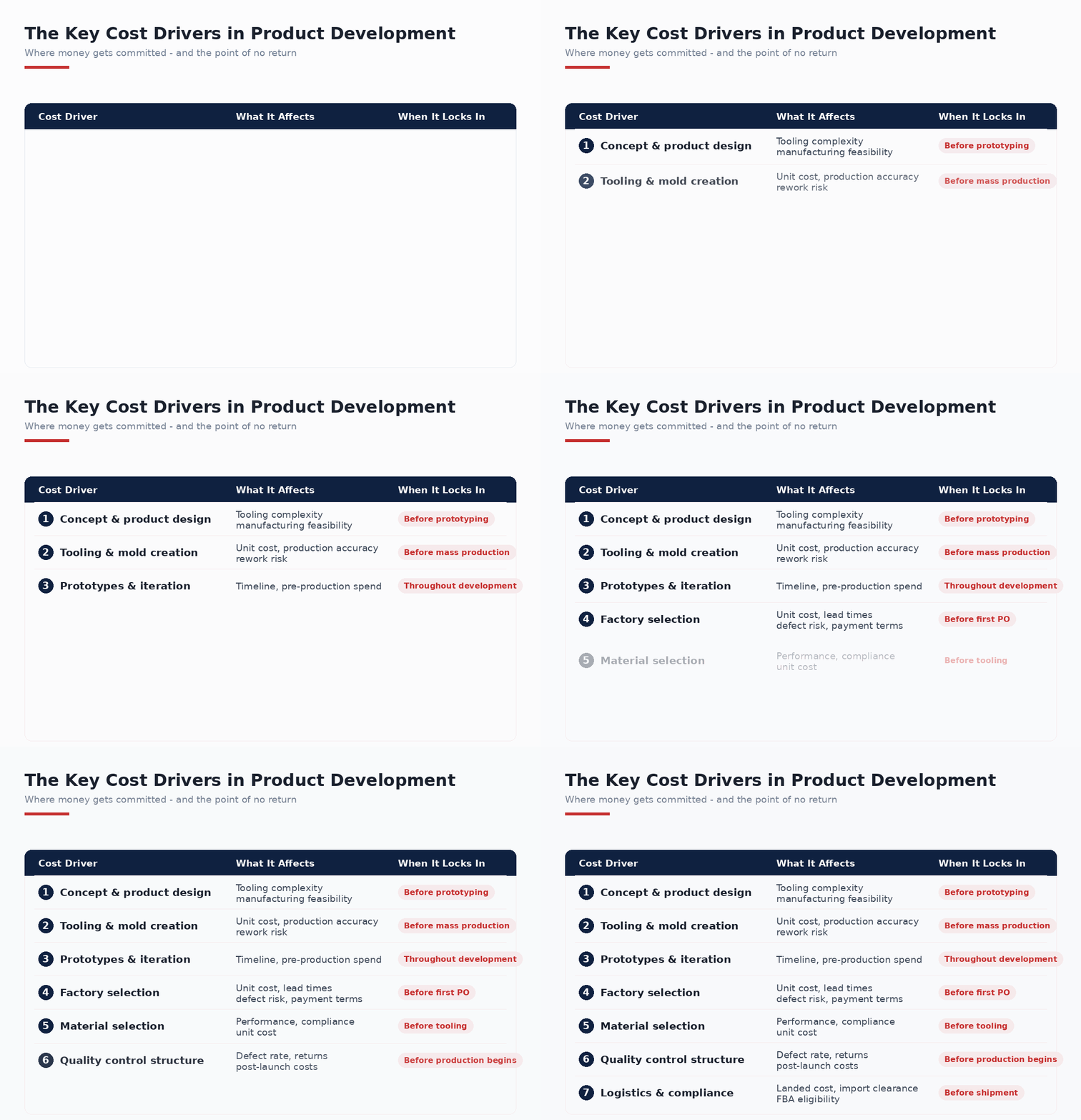
Concept and Product Design
Competitive research, 3D modeling, and initial concept work form the foundation of any development project. The cost of this phase is real, but more important is how product design decisions made here propagate forward into every decision made from that point forward. A design that does not account for tooling constraints or manufacturing feasibility creates a secondary cost wave when those problems surface during production setup.
Designing for manufacturability from the start is the single most reliable way to reduce total development costs. It is not a separate phase. It is a discipline that needs to be embedded in every design decision from the first sketch.
Tooling and Mold Creation
For most consumer products, tooling is the largest single upfront capital expense in the development process. Depending on product complexity, material, and factory capability, injection mold tooling can range from a few thousand dollars to well over fifty thousand. These costs are largely irreversible once committed.
Tooling mistakes do not announce themselves early. First-off-tool parts often reveal design issues that looked fine on screen. Any design change after tooling is cut generates additional cost and delay proportional to the scope of the revision. This is why validating manufacturing feasibility before tooling begins is a cost-control decision, not just a technical one.
Prototypes and Iteration
Most new products require multiple prototype rounds before reaching a manufacturing-ready design. Each revision cycle adds both cost and time. Brands that enter prototyping with unresolved design questions or unclear specifications consistently spend more before reaching a golden sample than those who invest in proper feasibility work upfront.
Prototypes are not a sign of poor design. Iteration is a normal part of development. The problem is entering that process before the fundamental manufacturing and material decisions are resolved, because those revisions are significantly more expensive than iterating on form.
Factory Selection and MOQ Structure
Factory selection determines far more than production price. It shapes unit cost, lead times, payment terms, production capacity, and defect risk simultaneously. A factory with strong category experience and a proven QC infrastructure costs differently than a generic low-cost option, and the difference in total project cost often favors the former once rework, rejected shipments, and production delays are factored in.
MOQ structure compounds this dynamic. High minimum order quantities lock in inventory risk early. Factories with flexible MOQ terms, earned through accumulated order volume and relationship depth, give brands more room to manage cash flow and protect revenue through the early production phase.
Materials and Components
Material selection affects unit cost, product performance, and compliance requirements at the same time. Choosing a material early for cost reasons, without validating its behavior under real-world use conditions, is one of the most common sources of post-launch quality problems. Reformulating materials after tooling is cut is expensive. Reformulating them after a product launch is more expensive still.
Linton’s sourcing teams carry over 100 years of combined experience in matching material specifications to manufacturing realities across metals, plastics, silicone, composites, and electromechanical components.
Quality Control
In-house quality control conducted throughout production prevents defect-related costs from reaching the finished goods stage. The alternative, outsourced or final-inspection-only QC, consistently costs more in the long run through rejected inventory, rework, compliance failures, and customer returns.
A structured QC program is not overhead. It is a cost-containment mechanism embedded in production. The brands that treat it as optional tend to encounter its value after the fact, at a price point that would have paid for multiple inspection programs.
Logistics and Compliance
Packaging dimensions, HTS classification, certification requirements, and shipping method decisions all affect landed cost. These are not downstream considerations. A packaging structure that triggers FBA non-compliance or a certification gap that delays import clearance is a direct expense at a point in the process when cash flow is already under pressure.
Building logistics and compliance requirements into the development budget from the start is the accurate way to understand what a product actually costs to bring to market.
How Manufacturing Decisions Shape Your Total Cost
The most reliable cost-reduction strategy in product development is evaluating product design, engineering, sourcing, and manufacturing as one integrated system rather than a sequential hand-off. When each phase makes decisions in isolation, cost problems tend to accumulate at the transitions: design changes that require tooling revisions, material specs that create sourcing complications, factory selections that require requalification.
Brands that treat design and manufacturing as separate disciplines consistently overspend on tooling revisions, factory transitions, and delayed launches. The correction is not more oversight after decisions are made. It is manufacturing integration before they are made.
Linton’s product design and development program addresses cost across every phase from unit economics and tooling to defect risk and logistics, before production begins.
What a Realistic Product Development Budget Looks Like
A meaningful cost estimate has to be built by phase. The actual numbers vary widely based on product complexity, category, and target volume, but the structure is consistent across product types.
- Concept and design: Competitive research, 3D modeling, initial feasibility review
- Tooling and mold creation: Often the single largest upfront expense; costs vary significantly by complexity and material
- Prototypes and iteration: Budget for multiple rounds; compressed iteration cycles tend to cost more, not less
- Manufacturing setup: Factory onboarding, golden sample approval, first-run coordination
- Quality control: In-house QC structure across pre-production, in-line, and pre-shipment stages
- Logistics and compliance: Packaging specs, certification requirements, HTS classification, shipping method decisions
Trying to estimate total cost from design scope alone is where most budgets go wrong. Total development cost is a function of manufacturing strategy, not creative scope. Whether a brand is self-funding development or working with outside funding, a realistic budget requires manufacturing feasibility input at the concept stage, before any significant capital is committed.
How to Reduce Product Development Costs Without Sacrificing Quality
The most consistent cost-reduction opportunities in product development share a common characteristic: they are available before production begins, and they disappear after it starts.
- Design for manufacturability from the first concept to prevent tooling revision cycles
- Lock in factory relationships early to access better pricing, more favorable payment terms, and prioritized production scheduling
- Validate tooling and prototypes before committing to mass production
- Use a manufacturing partner with vetted factory relationships to avoid the cost of factory mismatches
- Build logistics and compliance requirements into the budget before production begins, not after
Brands that manage this well tend to carry a meaningful competitive advantage in their category because their product cost structure is built correctly from the start, not patched after launch. For brands with existing product lines, Linton’s manufacturing cost reduction program has delivered an average 22.6% reduction in COGS by identifying the specific cost drivers in current production and addressing them systematically.
When to Work With a Product Development Partner
For brands without in-house manufacturing expertise, the cost of a full-lifecycle development partner is largely offset by the cost of the mistakes it prevents. The value is not primarily in negotiating lower prices. It is in building a development process where the expensive errors do not happen.
Linton operates on a shared-success model. The fee structure is aligned to the product’s revenue outcome in market, not to billable hours regardless of result. That alignment shapes how development decisions get made.
If you are preparing to move a product concept into development or evaluating the cost structure of an existing product line, start a conversation with Linton before committing to a factory or tooling investment.
Curt Williams
Sr Product Executive | Linton Group
Curt works directly with brands at Linton Group to turn product ideas into production ready realities. With a background rooted in operations, execution, and a Shark Tank appearance (!) he specializes in keeping projects moving, bridging the gap between vision and what actually gets made. He partners closely with founders to navigate sourcing, solve problems before they become expensive, and bring clarity to the chaos of manufacturing. His focus is simple: execute efficiently, communicate clearly, and deliver products that brands can stand behind.
View Author PageWondering if your product could be built better, faster, or at a lower cost?
Related Posts
Private label tool manufacturing carries more risk than most product categories. Material failures, safety standards, and durability expectations are more demanding than soft goods or accessories, and the consequences of factory mismatches tend to show up at scale rather than on the first sample. Linton has built and managed tool and home improvement product lines […]
Read More
Key Takeaways Most consumer brand COGS erosion comes from the same four structural leaks, regardless of product category or production volume. The four leaks are intermediary markup, material and tooling waste, defects and rework, and freight and packaging bloat. Each absorbs measurable margin in nearly every overseas production setup. Brands cannot see these leaks because […]
Read More
Key Takeaways Private label pet products enable fast market entry but prevent brands from owning the product design, tooling, or production standard The same supplier often provides identical or near-identical products to multiple competing brands simultaneously Quality inconsistency across production runs is common because the brand does not control the production benchmark Transitioning away from […]
Read More