Contract Manufacturing vs Private Label: How to Choose

Key Takeaways

  • Private label enables fast launches but limits long-term brand control
  • Contract manufacturing supports brand-owned products and scalable execution
  • Many brands outgrow private labeling as margins tighten and competition increases
  • Early model choices directly affect product quality, pricing power, and growth
  • The right approach depends on brand maturity, volume, and long-term goals


Choosing between contract manufacturing and private label is a long-term brand decision, not just a production choice. Private label can enable fast launches and early validation, while contract manufacturing requires more upfront planning, but these models lead to very different outcomes as brands scale.

This guide explains when private label works, and when it stops working, so consumer brands can choose an approach that supports sustainable growth. Here, contract manufacturing refers to brand-owned product production supported by vetted factories, manufacturing-integrated oversight, in-house quality control, and logistics coordination, not transactional, hands-off factory relationships.


Schedule a Consultation

Why Manufacturing Model Choice Impacts Brand Growth

The model a brand chooses shapes far more than how products are produced.

It determines how much control a brand has over product design, packaging, branding, pricing, and quality standards. Early “easy” decisions can quietly cap long-term growth by limiting differentiation and margin flexibility.

As brands scale, production decisions become a strategic inflection point. The right model enables consistency, leverage, and control. The wrong one can lock brands into shrinking margins, uneven quality, and increased exposure to competitors.

What Is Private Label Manufacturing?

Private label allows a brand to sell products based on pre-existing designs produced by a third-party supplier and sold under the brand’s name.

This approach is often used because it enables:

  • Faster time to market
  • Lower upfront development costs
  • Simplified production setup

In most cases, private labeling includes branding, packaging, and labeling customization, but the underlying product design and specifications are shared, limiting long-term differentiation and control. This can be effective for testing demand or launching a limited product offering quickly.

Where Private Label Starts to Break Down

As brands grow, private labels often introduce structural constraints.

Because products are not truly owned, brands may face:

  • Limited differentiation from competitors selling similar items
  • Margin pressure as pricing becomes harder to defend
  • Inconsistent quality across production runs
  • Reduced control over materials and specifications

Over time, these challenges make it harder to protect brand identity and maintain consistent quality. What once felt efficient can become a bottleneck to growth.

What Is Contract Manufacturing?

Contract manufacturing enables brands to produce products they fully own while working with specialized partners to execute production.

Unlike private label, this approach allows brand owners to control:

  • Product design and specifications
  • Materials and components
  • Quality standards and inspections
  • Production workflows and timelines

In Linton’s model, contract manufacturing is not a hands-off arrangement. It includes design finalization, engineering feasibility, factory vetting, in-house quality control, and active production management. While this requires more upfront coordination, it creates long-term stability and leverage.

Contract Manufacturing vs Private Label: Key Differences

The table below compares private label and contract manufacturing across the factors that matter most to growing brands.
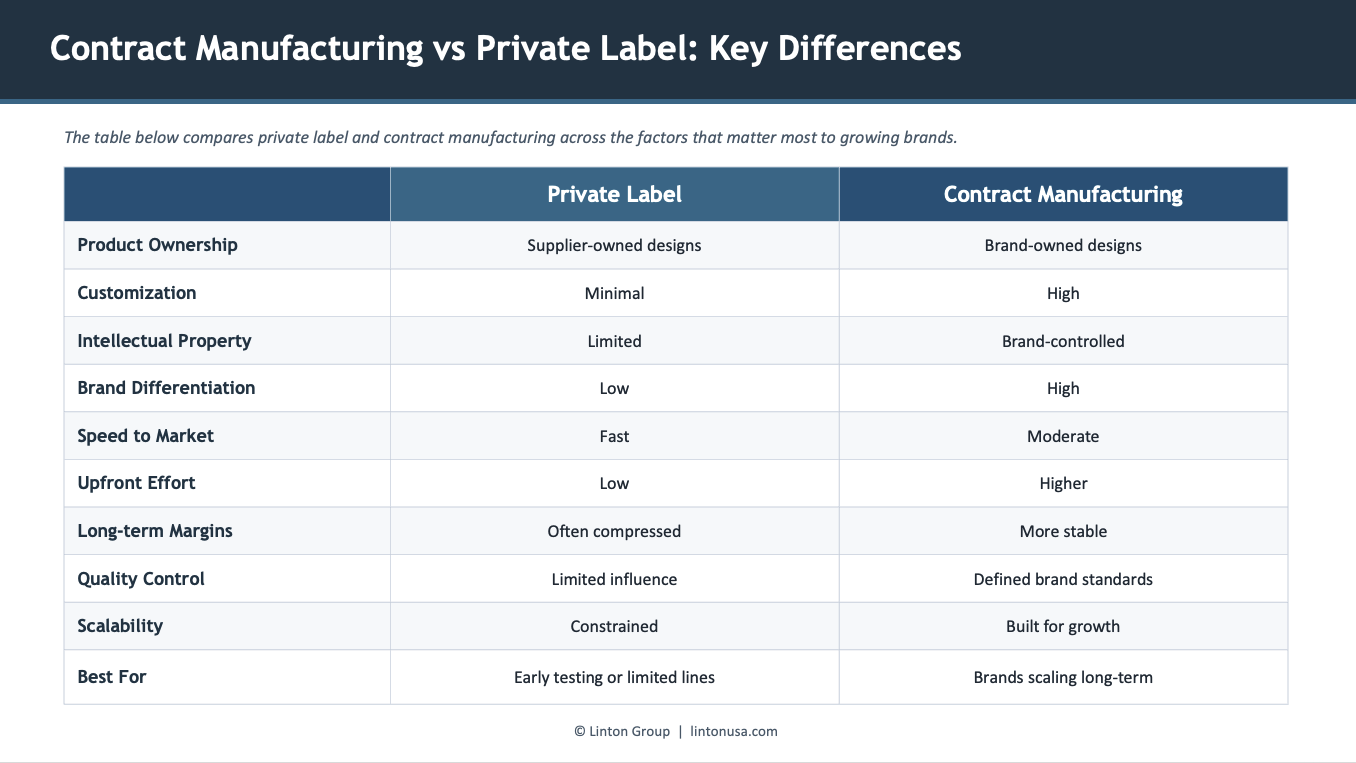


The right choice depends less on convenience and more on how well the model supports differentiation, margin stability, and repeatable execution over time.

When Private Label Makes Sense

Private label can be a reasonable short-term strategy in specific scenarios.

It often works best when brands are:

  • Testing a new product idea or category
  • Launching a limited product line
  • Validating demand before investing in custom development

For early validation, this approach can reduce risk and speed up launch timelines. However, it is rarely suited for brands pursuing long-term differentiation or category leadership.

When Brands Outgrow Private Label

Most successful consumer brands eventually outgrow private label.

Common signals include:

  • Margin pressure despite increasing volume
  • Quality variability across suppliers
  • Difficulty standing out in crowded categories
  • Limited control over product specifications

Outgrowing private label is not a failure, it’s a natural evolution as brands mature, expand product lines, and demand greater control over outcomes.

How Contract Manufacturing Supports Long-Term Brand Control

Contract manufacturing enables original product development and long-term brand ownership.

By controlling design, materials, quality standards, and production processes, brands can:

  • Standardize quality across runs
  • Reduce defect risk as volume increases
  • Protect intellectual property
  • Maintain pricing power

This level of control supports consistent execution as brands scale.

How Linton Helps Brands Transition Beyond Private Label

Linton helps consumer brands move beyond private label by managing the transition to brand-owned, managed contract manufacturing.

Their approach integrates:

  • Product design and engineering feasibility
  • Factory and partner vetting
  • In-house quality control
  • Active production management and logistics

Rather than acting as a factory broker, Linton operates as a long-term manufacturing partner — responsible for execution, cost control, and repeatable success.

Choosing the Right Manufacturing Model for Your Brand

The right model depends on your brand’s goals, volume, differentiation needs, and internal resources.

What works early may not support long-term growth. Evaluating contract manufacturing vs private label objectively, with experienced guidance, helps brands avoid costly pivots and choose an approach that scales with them.

Ready to Choose the Right Manufacturing Model?

If you’re deciding between private label and contract manufacturing, the choices you make now will shape your margins, product quality, and brand strength for years to come.


Ready to bring your product to market — or reduce your manufacturing costs? Linton Group provides end-to-end product design & development and manufacturing cost reduction services for consumer brands. Let’s talk.

Reviewed by the Linton Team

Linton is an end-to-end product development and manufacturing partner with 1,200+ projects delivered across 200+ product categories. Our team helps consumer brands design, source, and manufacture products through a network of 700+ vetted factories.
OEM vs. ODM vs. Contract Manufacturing: Which Model Fits Consumer Product Brands?

Key Takeaways

  • Choosing the wrong manufacturing model can limit control and compress margins
  • OEM, ODM, and contract manufacturing differ most in ownership, customization, and scalability
  • Speed-focused decisions often create long-term product and margin risk
  • Switching manufacturing models later is expensive and disruptive
  • The best model depends on volume, complexity, and growth goals


Once a brand moves from product development into production, choosing a manufacturing model becomes a critical strategic decision. OEM, ODM, and contract manufacturing are often treated as definitions, but they function as fundamentally different execution models that shape product ownership, margins, quality control, and scalability.

This article breaks down OEM vs. ODM vs. contract manufacturing for brand-owned consumer products (not catalog-based private label or transactional sourcing) and explains how each model impacts control, risk, and long-term growth, before those decisions become expensive to reverse.


Schedule a Consultation

Why Choosing the Right Manufacturing Model Matters

Your manufacturing model determines far more than where your product is made.

It affects who owns the design, who controls specifications, how quality is enforced, and how easily production can scale. Brands that choose a model based on speed or upfront cost alone often face hidden tradeoffs later, including margin pressure, inconsistent quality, and weakened differentiation.

The wrong manufacturing model can lock brands into:

  • Limited product and specification control
  • Weak intellectual property protection
  • Compressed margins as competitors sell similar products
  • Costly pivots once production workflows are established

These risks compound as production volume grows, making early decisions foundational to long-term success.

What Is OEM Manufacturing?

OEM (Original Equipment Manufacturing) allows brands to manufacture products they fully own, using custom designs, specifications, and materials while leveraging specialized manufacturers for production.

Under the OEM model, the brand owns the product design and intellectual property. The manufacturer produces the product according to the brand’s specifications but does not own the design itself.

OEM manufacturing is typically used when brands:

  • Want to build a unique, defensible product
  • Require full control over materials, specifications, and product quality
  • Are planning long-term growth with repeat production

Because OEM products are built from the ground up, successful execution depends on early alignment between design, engineering, sourcing, manufacturing feasibility, and quality control.

OEM offers the highest level of ownership and customization, but it also requires more upfront coordination around engineering, tooling, quality control, and production management.

Linton enables OEM-style ownership by managing engineering feasibility, factory execution, in-house quality control, and global logistics, without requiring brands to build internal manufacturing teams.

What Is ODM Manufacturing?

ODM (Original Design Manufacturing) involves selecting from a manufacturer’s pre-existing product designs and making limited modifications before branding and selling the product.

In this model, the manufacturer typically owns the base design. Brands may customize surface-level elements such as branding, colors, or minor features, but the underlying product is not exclusive. ODM can be appropriate for short-term validation or low-risk testing, but it is rarely a sustainable foundation for brands seeking long-term differentiation, defensibility, and margin control.

ODM manufacturing is often chosen when brands:

While ODM can reduce development time, it introduces long-term tradeoffs. Limited differentiation, weaker intellectual property ownership, and exposure to copycat competition often lead to margin compression and commoditization as more brands sell similar products.

What Is Contract Manufacturing?

Contract manufacturing focuses on how production is executed, rather than who owns the product design.

In this model, brands own the product design and specifications, while a contract manufacturing partner manages tooling and factory execution, with quality control and logistics oversight structured to protect brand standards at scale. Contract manufacturing is commonly used once designs are finalized and production volume is established.

Rather than competing with OEM or ODM, contract manufacturing often acts as the execution layer that enables those models to scale.

For many growing brands, contract manufacturing provides OEM-style ownership without requiring:

  • Internal manufacturing teams
  • Overseas offices
  • Direct factory management

This allows brands to maintain control while scaling production efficiently.

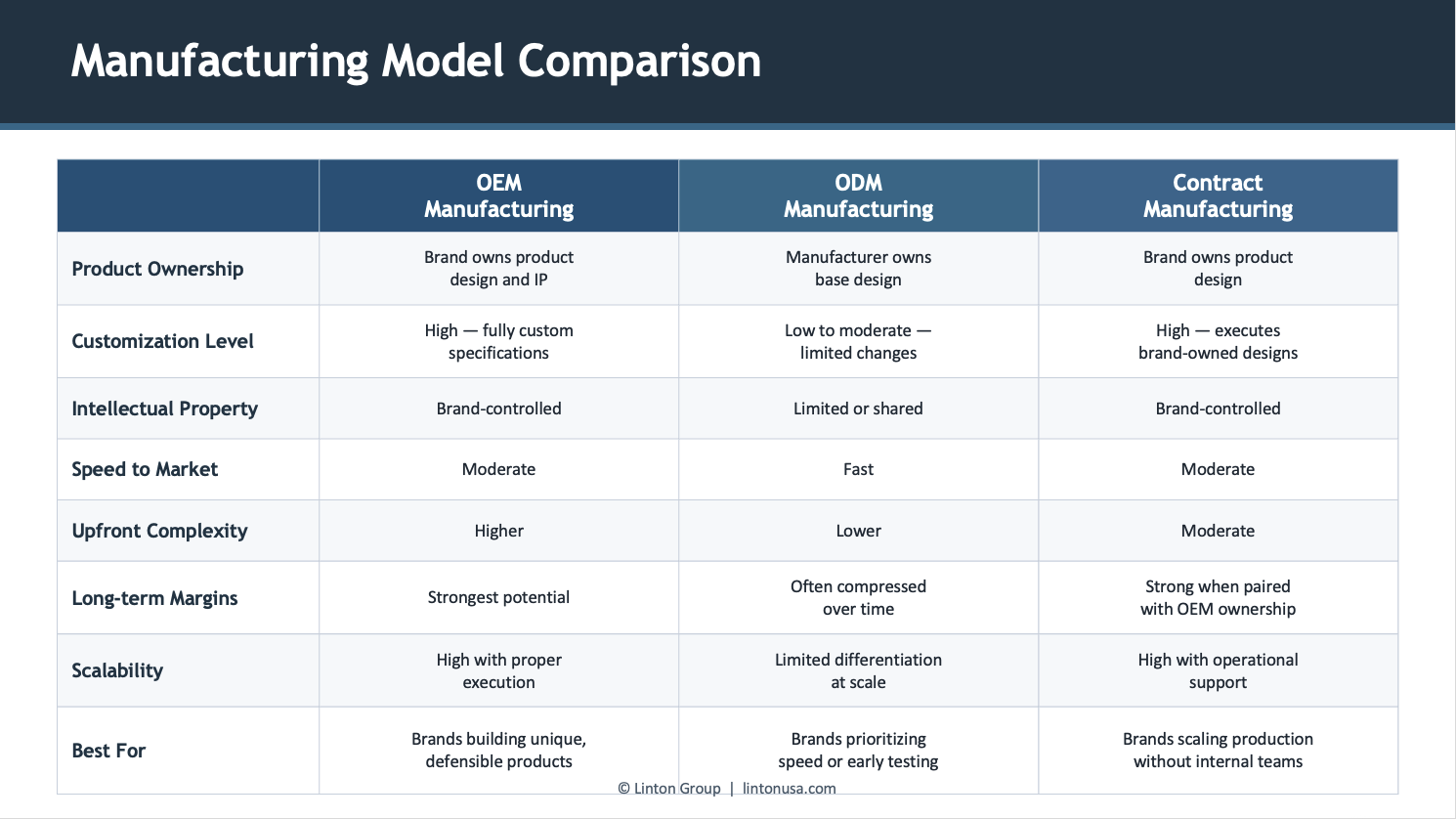
OEM vs. ODM vs. Contract Manufacturing: Key Differences

To make the differences clearer, the table below compares OEM, ODM, and contract manufacturing across the factors that most directly impact control, cost, and scalability.


Important: These models are not mutually exclusive. Many successful brands combine OEM ownership with contract manufacturing execution to preserve control while scaling efficiently.

Which Manufacturing Model Is Best for Consumer Product Brands?

There is no universal “best” manufacturing model.

The right choice depends on product category, production volume, customization needs, and long-term growth goals. Brands planning repeat production and long-term differentiation often prioritize models that preserve ownership and control, even if they require more upfront coordination.

OEM-style ownership is typically favored by brands protecting intellectual property and planning to scale. ODM may work for early market testing, but it often limits defensibility as competition increases.

Common Mistakes Brands Make When Choosing a Manufacturing Model

Many brands choose manufacturing models based on short-term convenience without fully understanding the long-term implications.

Common mistakes include:

  • Confusing ODM speed with sustainable product ownership
  • Underestimating how quickly ODM products become commoditized
  • Choosing manufacturers based on price alone
  • Assuming switching models later will be easy

Once tooling, suppliers, and production workflows are in place, changing manufacturing models often requires expensive redesigns and operational disruption.

How Linton Helps Brands Choose and Execute the Right Manufacturing Model

Linton helps consumer product brands evaluate OEM, ODM, and contract manufacturing models through a manufacturing-integrated approach that prioritizes ownership, feasibility, and scalability from the start.

Rather than treating design, engineering, sourcing, manufacturing, quality control, and logistics as separate steps, Linton evaluates them together as one system. This allows brands to choose the right model, then execute it reliably at scale.

Linton is not a factory broker or a design-only firm. They manage the full production system, aligning decisions across every stage to reduce risk, control costs, and support repeatable success.

When to Work With a Manufacturing Partner

Brands typically need expert manufacturing guidance when:

  • Production volume begins to scale
  • Margins come under pressure
  • Quality issues emerge
  • Internal teams reach operational limitsAt this stage, manufacturing becomes a strategic growth function, not a tactical sourcing task. A manufacturing partner acts as an extension of the brand’s operations — protecting product quality, margins, and long-term success.

Ready to Choose the Right Manufacturing Model?

If you’re evaluating OEM vs. ODM vs. contract manufacturing, the decisions you make now will shape your product’s success for years to come.


Ready to bring your product to market — or reduce your manufacturing costs? Linton Group provides end-to-end product design & development and manufacturing cost reduction services for consumer brands. Let’s talk.

Reviewed by the Linton Team

Linton is an end-to-end product development and manufacturing partner with 1,200+ projects delivered across 200+ product categories. Our team helps consumer brands design, source, and manufacture products through a network of 700+ vetted factories.
How to Manufacture a Product Once Your Design Is Finalized

Key Takeaways

  • Manufacturing is an execution, cost, and quality challenge — not a creative one
  • A finalized design must be validated for real-world product manufacturing
  • Early manufacturing decisions directly affect production costs and timelines
  • The right manufacturing process depends on volume, customization, and target market
  • Quality control must be embedded throughout production, not added at the end
  • Brands that treat manufacturing as an integrated system reduce long-term risk

Once your product design is finalized, manufacturing becomes the most critical phase of execution. At this stage, the biggest risks are no longer creative; they’re operational. How a product is manufactured determines whether it can be produced reliably, at the right cost, and at scale, with early decisions around tooling, suppliers, and processes often becoming the most expensive mistakes to fix later.

At Linton, manufacturing is never treated as a downstream step. Every product is evaluated as one integrated system, design, engineering, sourcing, and manufacturing, so feasibility, cost, quality, and scalability are addressed before production begins. This manufacturing-first approach reduces risk, protects margins, and ensures products are built to scale, not just to launch.

Explore Product Design & Development

Make Sure Your Product Design Is Manufacturing-Ready

A finalized design does not automatically mean your product is ready for manufacturing.

Before production begins, a finalized product design must be validated against real manufacturing constraints, including how it will be sourced, tooled, assembled, inspected, and scaled in a live factory environment. This includes material selection, tolerances, finishes, tooling requirements, and assembly methods, all evaluated in the context of the actual manufacturing process.

A manufacturing-ready design accounts for:

  • Raw materials that can be sourced consistently at scale
  • Tolerances that align with the selected manufacturing method
  • Tooling requirements that won’t inflate manufacturing costs
  • Assembly steps that minimize defect risk

Skipping this validation often leads to rework once production starts, increasing production costs and delaying launch.

Validate Manufacturing Feasibility Before Production

Manufacturing feasibility determines whether your product can be produced profitably and reliably, and whether unit costs, tooling investments, and supplier decisions will support long-term margins once production is locked in.

Before engaging manufacturers, brands should evaluate feasibility across unit economics, tooling costs, material availability, and lead times. This step ensures the product manufacturing plan aligns with margin targets and production goals.

Key feasibility checks include:

  • Estimated manufacturing cost per unit at target volumes
  • Tooling and upfront production expenses
  • Lead times for raw materials and finished goods
  • Risk factors that could affect production timelines

Identifying these issues early allows brands to adjust before committing to suppliers or locking in production costs.

Choose the Right Manufacturing Process for Your Product and Target Market

There is no single manufacturing process that works for every product.

The right approach depends on your target market, order volume, level of customization, and how quickly you plan to scale. Some products require fully custom manufacturing with brand-owned tooling and IP, while others benefit from controlled made-to-order or scalable mass production models depending on demand, margins, and operational complexity

Common manufacturing approaches include:

  • Custom manufacturing for differentiated, brand-owned products
  • Made-to-order manufacturing to reduce inventory risk
  • Mass production for standardized products with predictable demand

Choosing the wrong approach can limit flexibility, inflate costs, or restrict growth as demand increases.

Identify and Vet the Right Manufacturers

Selecting the right manufacturers is about more than pricing.

Strong manufacturing partners bring experience with similar products, reliable capacity, clear communication, and established quality systems, and must be actively managed through production oversight, in-house quality control, and ongoing factory performance monitoring. Whether you work with a local manufacturer or an overseas manufacturer, alignment matters more than geography alone.

When evaluating potential manufacturers, brands should assess:

  • Experience producing similar physical products
  • Ability to scale production without sacrificing quality
  • Quality control processes and inspection standards
  • Communication and production transparency

Manufacturer selection should be treated as a long-term partnership decision, not a one-off transaction.

Develop and Approve Production Samples

Production samples bridge the gap between design intent and manufacturing reality.

Through sampling, brands validate raw materials, finishes, tolerances, and assembly methods under real production conditions. Once approved, the final golden sample becomes the benchmark for all future production.

The golden sample:

  • Defines acceptable material and finish standards
  • Establishes tooling accuracy and tolerances
  • Serves as the reference for quality control
  • Ensures repeatability as production scales

This standard protects both the brand and the manufacturer.

Implement Quality Control Throughout Production

Quality control must be embedded throughout the manufacturing process, not treated as a final checkpoint.

Effective quality systems include pre-production checks, in-line inspections, and final audits conducted by an in-house quality control team following ANSI/ASQ Standard Z1.4 (2018), ensuring consistent repeatability and defect prevention as volumes scale.This approach reduces defects, prevents rework, and protects manufacturing cost as volumes increase.

Quality control is a system, not a single step, and it plays a critical role in consistent product manufacturing.

Manage Production Costs, Timelines, and Inventory

Once production begins, active management is required to control production costs and maintain timelines.

Cost optimization often comes from material selection, process refinement, tooling efficiencies, and volume negotiation, not from sacrificing product quality. Managing production also requires aligning output with inventory management and launch plans.

Plan Logistics and Shipping Early

Logistics planning should be integrated into manufacturing decisions, not handled after production.

Packaging requirements, certifications, shipping methods, and customs considerations all affect landed cost and delivery speed. Early planning helps brands avoid delays, unexpected fees, and margin erosion as production scales.

Common Manufacturing Mistakes Brands Make

Many manufacturing issues arise when brands treat manufacturing as a fragmented process.

Common mistakes include:

  • Managing multiple manufacturers without centralized oversight
  • Choosing suppliers based on price alone
  • Failing to plan for production timelines and inventory needs
  • Treating quality control as an afterthought

These issues compound quickly as production volume grows.

How Linton Supports End-to-End Product Manufacturing

Linton supports brands across the full product manufacturing lifecycle, from design validation through scaled production and logistics.

By managing manufacturing readiness, factory evaluation, production management, in-house quality control, and global logistics as one integrated system, Linton reduces operational risk, protects margins, and takes responsibility for the final success of the product.

Real-World Manufacturing Results

Linton has supported brands across sports equipment, home goods, and personalized products by reducing defect rates, improving unit economics, and scaling production reliably, including optimizing materials and QC processes for a pickleball paddle brand that improved consistency while reducing manufacturing costs.

When to Work With a Manufacturing Partner

Brands typically benefit from a manufacturing partner once production complexity increases, margins tighten, or internal teams reach operational limits. At this stage, manufacturing becomes a strategic growth function — not just an operational task.


Ready to bring your product to market — or reduce your manufacturing costs? Linton Group provides end-to-end product design & development and manufacturing cost reduction services for consumer brands. Let’s talk.

Reviewed by the Linton Team

Linton is an end-to-end product development and manufacturing partner with 1,200+ projects delivered across 200+ product categories. Our team helps consumer brands design, source, and manufacture products through a network of 700+ vetted factories.