Why Private Label Pet Products Cost You More in the Long Run

Key Takeaways

  • Private label pet products enable fast market entry but prevent brands from owning the product design, tooling, or production standard
  • The same supplier often provides identical or near-identical products to multiple competing brands simultaneously
  • Quality inconsistency across production runs is common because the brand does not control the production benchmark
  • Transitioning away from private label after volume is established requires tooling investment, factory sourcing, and product redesign, all of which cost more when the brand is already managing scale
  • Manufacturing decisions made at the wrong stage are disproportionately expensive to reverse
  • Custom manufacturing gives pet brands full ownership of design, cost structure, and quality standards from the start

Private label pet products look like the logical entry point. Low upfront investment, fast time to market, no tooling cost, no factory management. For brands testing demand or validating a product category for the first time, that logic holds.

The problem starts when the brand tries to scale, and in the pet category, the scale problem arrives faster than most founders expect.

This article explains what private label pet products actually cost at scale, where the model structurally breaks down, and what a more defensible long-term manufacturing approach looks like. Linton has helped pet brands make this transition, including rebuilding PupRing’s entire product design, personalization workflow, and supply chain to support 5,000 orders per day from a base of 50. If you are evaluating your current manufacturing model, schedule a consultation with the Linton team.

Explore Pet Product Development

What Private Label Pet Products Actually Are

Private label pet products are manufactured by a third-party manufacturer using existing designs or catalog-based options and sold under the brand’s name. The brand controls the label, the packaging, and in some cases surface customization. The manufacturer controls the design, the tooling, and the production standard.

This distinction matters more than most founders recognize at launch. When the manufacturer owns the design and tooling, the brand cannot enforce a specific quality standard, cannot prevent the same supplier from offering identical products to competing brands, and cannot negotiate unit cost reductions the way a brand with its own tooling and manufacturing relationship can.

Private labeling is not the same as white label, though the line between them is often blurred in the pet category. White label products are identical goods sold to multiple brands with different packaging and no customization. Private label typically includes packaging, label design, and occasionally color or minor component selection, but rarely extends to design ownership, tooling control, or manufacturing specification authority. That gap is where the long-term cost accumulates.

Why Private Label Works as a Starting Point

Private label accelerates time to market, and for early-stage validation it can be a reasonable short-term approach. The advantages are real:

  • No upfront tooling investment, which for injection-molded pet products can run from several thousand to tens of thousands of dollars
  • No factory sourcing or vetting process to manage
  • No prototype iteration cycle
  • Sellable inventory available in weeks rather than months

For demand validation, this tradeoff is defensible. The mistake is treating private labeling as a permanent strategy rather than a temporary one. Most brands stay in private label longer than they should because there is no natural trigger that forces the transition until the cost of staying becomes impossible to ignore.

Where Private Label Pet Products Break Down

The structural limitations of private label become visible once a brand starts generating meaningful volume and facing genuine competition. The problems are predictable and consistent:

  • No product differentiation. Because the manufacturer controls the design, multiple brands frequently sell near-identical dog products, grooming products, and pet care products in the same category at the same time. The pet accessories market on Amazon makes this plain: collars, harnesses, leashes, and dog treats with identical construction appearing under dozens of different brand names.
  • Pricing becomes the only lever. When competitors source the same private label product from the same manufacturer, price is the only way to compete, and that competition compresses margins on both sides without limit.
  • Quality is inconsistent and hard to control. Without brand-owned tooling and a shared production standard, there is no objective benchmark against which to inspect production runs. Variations in material quality, finish, and construction appear between batches with limited recourse.
  • The manufacturer has no real accountability. Without tooling ownership, the brand has limited leverage to demand production improvements. The supplier serves many clients and has little incentive to prioritize changes that benefit only one of them.

The longer a brand stays in private label past the point of meaningful volume, the more entrenched these problems become.

The Real Cost of Private Label at Scale

The cost of private label at scale is not just margin compression. It is the accumulation of structural constraints that make the brand progressively harder to grow.

Without design ownership, the brand cannot protect differentiation as the category gets more crowded. Without tooling ownership, the brand cannot negotiate the cost reductions available to brands that own their manufacturing relationship. Without a defined production standard, the brand cannot systematically reduce defect rates or improve quality consistency over time.

When quality failures occur, and at scale they will, the brand’s options are limited. Without a golden sample defining the production standard, there is no objective basis on which to hold the manufacturer accountable. Returns, negative reviews, and damage to brand reputation are the visible costs. The invisible cost is the operational time spent managing supplier disputes from a position of no leverage.

Pet parents increasingly treat pet health and pet wellness as priorities when choosing brands. A brand that cannot consistently deliver on quality does not just lose a sale. It loses trust in a category where trust is the primary driver of repeat purchase. Linton’s position on this is direct: manufacturing decisions made at the wrong stage are disproportionately expensive to reverse. Read why product development without manufacturing expertise costs more than you think for a deeper look at how this pattern plays out across product categories.
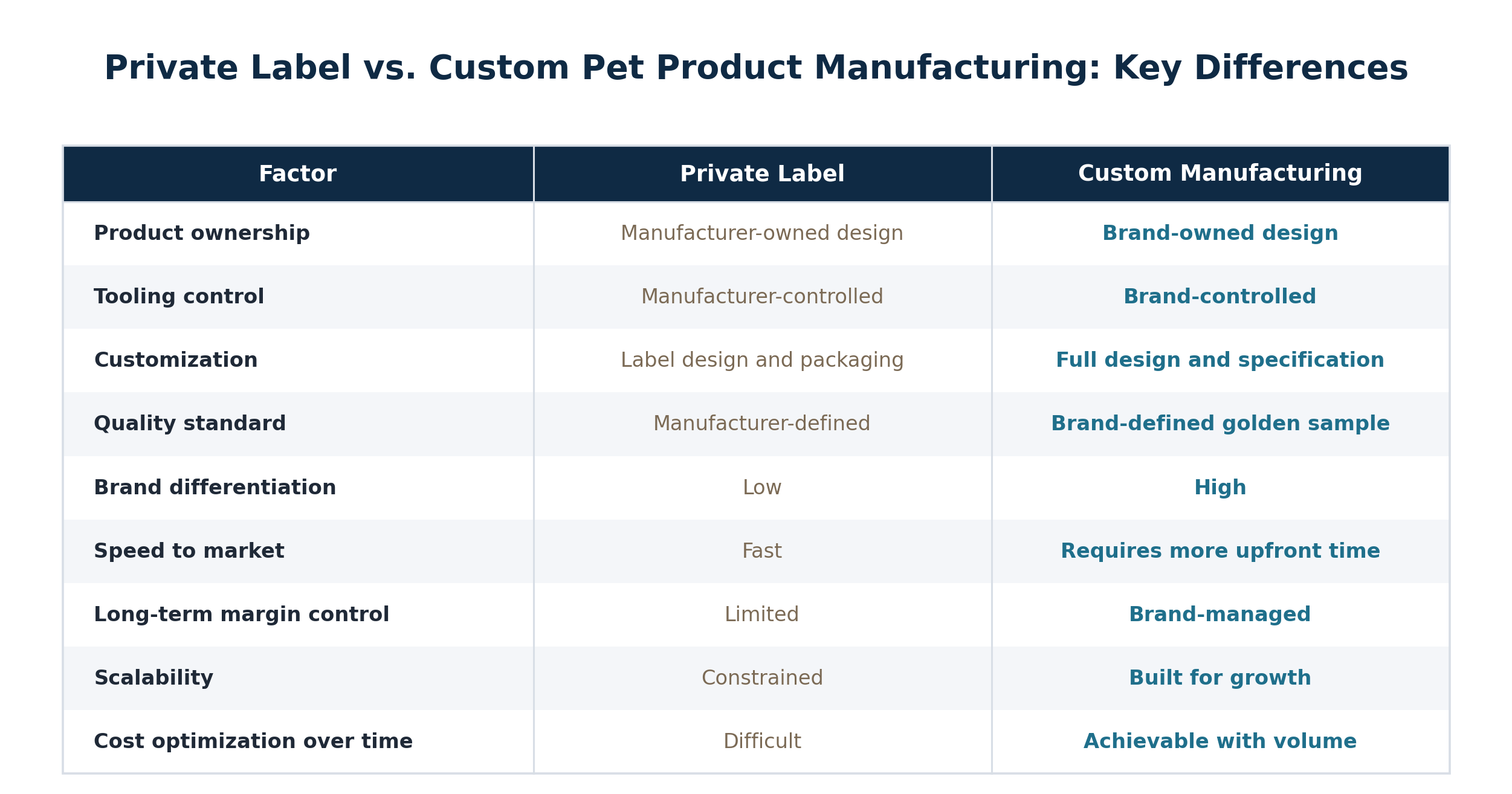
Chart of Private Label vs. Custom Pet Product Manufacturing: Key Differences

What Custom Pet Product Manufacturing Actually Looks Like

Custom manufacturing gives pet brands full ownership of the product design, tooling, and production standard. The brand specifies materials, tolerances, construction methods, and quality expectations. The manufacturer produces to a defined standard, validated through a finalized golden sample before mass production begins.

In Linton’s model, custom manufacturing for dogs, cats, and pets across every care category is not a hands-off factory arrangement. It includes:

  • Concept development and competitive market research to avoid catalog-based designs
  • Engineering feasibility review and material selection for pet safety and durability
  • Factory sourcing from a network of 700+ vetted manufacturers
  • Multiple prototype iterations through golden sample approval
  • In-house quality control following ANSI/ASQ Z1.4 2018
  • Global logistics management

This requires more upfront planning than private labeling. That is an honest tradeoff. What it provides in return is a product the brand owns, a production standard the brand can enforce, and a cost structure the brand can optimize over time.

When to Transition Away from Private Label

For most pet brands, the right time to transition is earlier than it feels comfortable. The signals that the move is overdue:

  • Margin pressure that does not respond to volume increases
  • Quality complaints appearing consistently across batches that supplier communication cannot resolve
  • Competing brands selling near-identical dog products or pet care products at the same or lower price points
  • No ability to differentiate based on product attributes rather than marketing spend alone

Outgrowing private labeling is not a failure. It is the natural progression of a brand that has validated demand and is ready to compete on the strength of its products. The cost of making this transition early, before private label has created structural constraints, is dramatically lower than making it after significant volume is established.

How Linton Helps Pet Brands Build Beyond Private Label

Linton helps established pet brands move from private label to brand-owned custom manufacturing by managing the full transition as one integrated process.

That process includes design finalization, engineering feasibility review, factory sourcing and vetting, prototype development through golden sample approval, in-house quality control, and logistics management. Rather than introducing a brand to a manufacturer and stepping back, Linton remains accountable through production execution, cost control, and repeatable manufacturing quality tied to the brand’s results.

The PupRing case study shows what this transition looks like in practice. Linton rebuilt PupRing’s product design, personalization workflow, and entire supply chain from scratch, replacing an inventory-heavy private label model with a true made-to-order manufacturing system. The result was a 5x improvement in engraving accuracy through a proprietary vectorization algorithm, elimination of upfront inventory costs, and production scale from 50 to 5,000 orders per day with positive cash flow on every order.

Linton’s model is built on shared success. The engagement is structured to align incentives with the brand’s long-term outcomes, not just the completion of a production run. If your pet brand is at the point where private labeling is limiting growth rather than enabling it, the conversation about transition is worth starting now. Schedule a consultation with the Linton team, or explore Linton’s manufacturing cost reduction program if you are currently carrying costs from a supplier relationship that no longer serves the brand’s scale.

How to Find a Jewelry Manufacturer for Your Brand

Key Takeaways

  • Finding a jewelry manufacturer starts with defining product category, production model, and quality expectations before any factory is contacted
  • Price is the last filter for evaluating a jewelry manufacturer, not the first
  • Sampling is not optional; the golden sample becomes the production standard for every run that follows
  • B2B platforms surface jewelry supplier names but do not handle the vetting work that protects production
  • The brands that build durable production relationships invest in clear standards, structured communication, and long-term factory alignment
  • For most brands, a manufacturing partner replaces months of factory discovery and vetting with a network that has already done the work

Finding a jewelry manufacturer sounds like a sourcing problem until you have done it once. Then it reveals itself as a production management problem with a sourcing front end. For founders launching their first custom jewelry line, or growing DTC brands moving past private label, the factory decision is one of the highest-leverage choices in the business. Get it right and the brand compounds. Get it wrong and the brand spends a year cleaning up margin damage.

Linton has managed production across 700-plus vetted factories and 200-plus product categories, including custom jewelry manufacturing for DTC and Amazon brands. This guide walks through what the process actually requires, the most common mistakes founders make, and when it makes more sense to skip the discovery work entirely.

If you are ready to move a jewelry concept into production, schedule a consultation with the Linton team.

Explore Jewelry Manufacturing

Start by Defining What Your Brand Needs From a Jewelry Manufacturer

Most failed factory searches start with “find me a jewelry manufacturer.” They should start with five answers:

  1. Jewelry category. Personalized engraved products, fashion jewelry accessories, branded merchandise, pet jewelry, or other custom formats. Each requires different factory capabilities.
  2. Production model. Make-to-order vs. bulk inventory. 1-piece MOQ vs. high-volume wholesale runs. DTC fulfillment vs. warehouse delivery.
  3. Quality, retail price, and margin targets. A unit cost that fits margin only matters if the quality also fits the brand.
  4. Current and projected volume. Many factories have production minimums that only make sense at certain scales.
  5. Manufacturing techniques required. Laser engraving, casting, stamping, embroidery, full-color printing, or combinations. Jewelry manufacturing is not one category. It is many.

What to Look for in a Jewelry Manufacturer Beyond Price

The five criteria that actually predict whether a factory will perform at scale:

  • Category-specific experience. Documented production history in your specific jewelry type, not general capability claims. The right question is not “do you make jewelry,” it is “have you produced this jewelry piece, at this volume, with this finish standard.”
  • Production capacity. Confirmed capacity for both current order volume and projected growth. A factory that performs at launch volume can become a bottleneck six months later.
  • QC standards and processes. How quality is managed at each stage of the manufacturing process. In-house QC with a defined standard generally outperforms self-reported quality or one-time third-party inspection.
  • Communication infrastructure. Who handles day-to-day communication, how time zones are managed, and what happens when an issue arises mid-run. Slow or vague pre-production communication often predicts larger problems during production.
  • Sample process. A credible manufacturing partner will provide production samples before bulk. A jewelry manufacturer that rushes past sampling is signaling how it will handle the full run.

Where Brands Typically Look for Jewelry Manufacturers

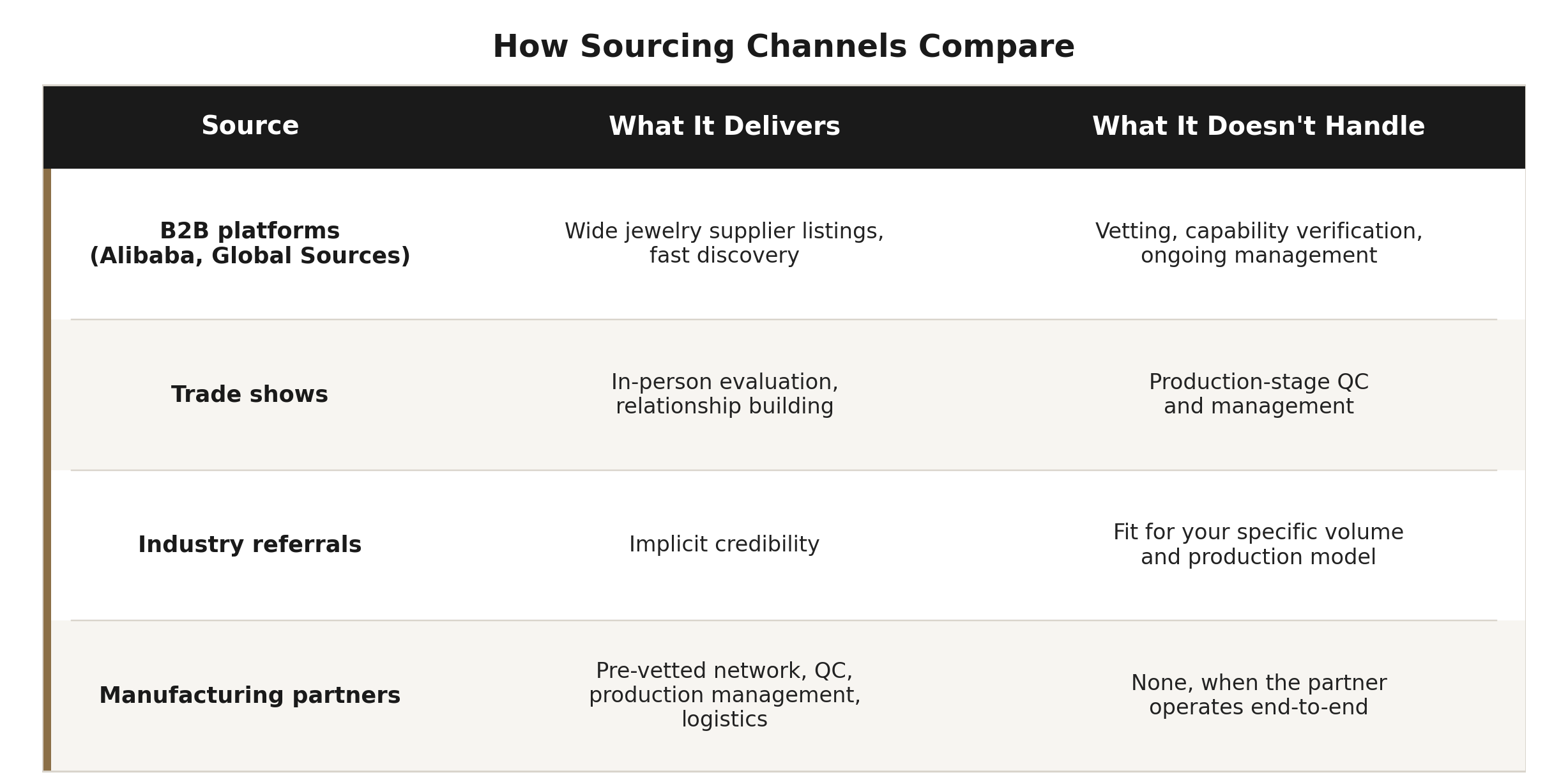
Each option has a role. None of them replace the vetting work that follows discovery.

Chart showing Where Brands Typically Look for Jewelry Manufacturers


How to Vet a Jewelry Manufacturer Before Committing

Five steps that protect production before the first PO:

  1. Request a factory profile. Certifications, category-specific production history, capacity documentation, and references for comparable projects. Ask for examples of best sellers they have produced for other brands in your category.
  2. Test communication. Slow or vague responses pre-production tend to predict bigger problems during production.
  3. Order samples. A golden sample meeting exact specifications becomes the production benchmark for every run that follows. Skipping this to save two weeks routinely costs two months of rework.
  4. Map the QC process. When inspections happen (pre-production, in-line, final audit), who conducts them, and the remediation process for defects. Linton’s in-house QC follows ANSI/ASQ Z1.4 2018 across all three stages.
  5. Lock down IP agreements. Non-disclosure and design ownership agreements in place before any jewelry design files are shared.

Questions to Ask a Jewelry Manufacturer Before Moving Forward

These questions surface the differences between factories that look the same on a website:

  • What jewelry categories have you produced at volume, and can you provide references for comparable projects?
  • What is your minimum order quantity, and does your production model support our fulfillment approach?
  • How is quality controlled at each stage of jewelry production, and what standard do you follow?
  • What is your defect policy, and what is the remediation process if a run does not meet spec?
  • Who is the point of contact during a production run, and how is communication handled?
  • What are your standard lead times, and how do they shift with order volume changes?

A factory that answers these clearly is not necessarily the right factory. A factory that cannot answer them is almost never the right factory.

Private Label vs. Custom Jewelry Manufacturing

A common decision point for jewelry brands is whether to work with a private label jewelry manufacturer or commission custom manufacturing. The two models lead to very different outcomes:

  • Private label manufacturing uses pre-existing supplier designs sold under the brand’s name. It enables fast launches and lower upfront costs but limits long-term differentiation in a crowded jewelry industry.
  • Custom jewelry manufacturing produces brand-owned SKUs built to the brand’s specifications. It requires more upfront coordination but supports differentiation, IP ownership, and margin stability as the brand scales.

For brands competing on personalization or branded design, custom is almost always the right long-term model. For brands testing a category or launching a small line, private label can be a valid entry point.

Common Mistakes Brands Make When Finding a Jewelry Manufacturer

Many founders underestimate how much of factory success comes down to upfront discipline rather than negotiation skill. The mistakes below show up most often in brands placing their first or second production run:

  • Evaluating on price alone. The lowest quote rarely accounts for defect rates, rework, or delays that erode the savings before product ships.
  • Skipping the sample stage. Brands that compress sampling consistently discover quality problems after bulk production, when the cost to fix is far higher than the time saved.
  • Assuming one factory handles all jewelry categories equally. A manufacturer producing fashion jewelry pieces at volume is not automatically equipped to produce precision laser-engraved pendants.
  • Sharing designs before IP agreements are in place. Particularly damaging for personalized and branded products.
  • Treating manufacturing as a transaction. Transactional relationships tend to produce transactional outcomes.

Brands working through repeat manufacturing problems often find that Linton’s manufacturing cost reduction program identifies the specific gaps driving those outcomes.

When a Manufacturing Partner Makes More Sense Than a Direct Factory Relationship

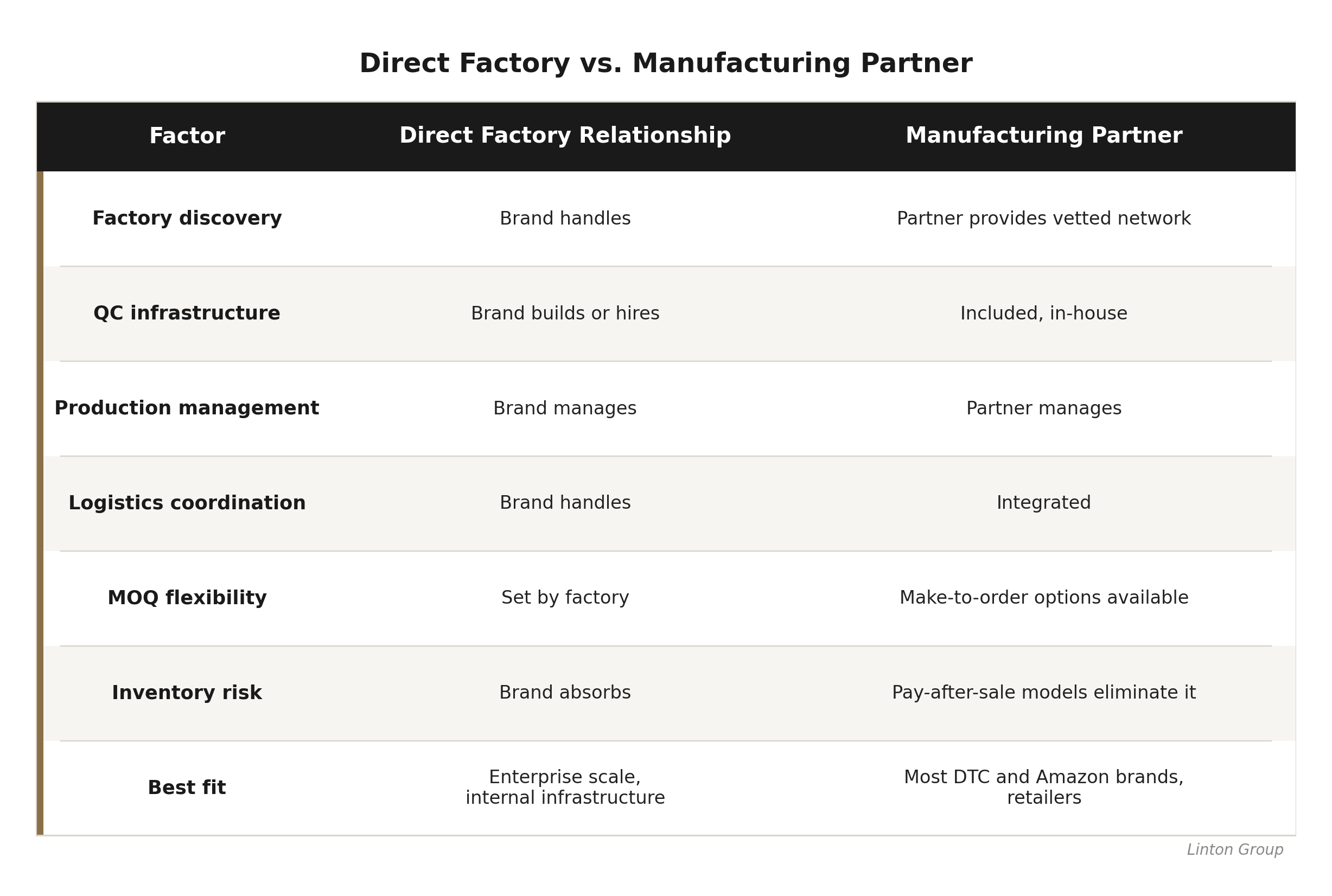
A direct factory relationship makes sense when a brand has internal manufacturing expertise, established QC capability, and the volume to justify building those systems. A manufacturing partner makes more sense in most other cases.

Chart showing When a Manufacturing Partner Makes More Sense Than a Direct Factory Relationship


For brands offering personalized custom jewelry, a make-to-order partner also enables 1-piece MOQ fulfillment, which a direct factory relationship rarely supports.

How Linton Helps Brands Find and Manage the Right Jewelry Manufacturer

Linton manages custom jewelry manufacturing as part of its end-to-end product development and manufacturing service. The model replaces factory discovery and vetting with a network and management system that is already in place:

  • Factory sourcing from 700-plus vetted factories with documented, category-specific production experience
  • In-house QC following ANSI/ASQ Z1.4 2018, applied at pre-production, in-process, and final audit stages
  • Make-to-order manufacturing for personalized jewelry brands with 1-piece MOQ and pay-after-you-sell fulfillment
  • Full lifecycle support from jewelry design and prototyping through production, golden sample approval, and logistics
  • DTC fulfillment from factory to end customer

Working with Linton as a custom jewelry manufacturer means entering production with the relationships, QC infrastructure, and production management systems already in place. Brands avoid spending months building that infrastructure independently.

If you are ready to move into production, schedule a consultation.

Overseas Manufacturing: The Real Pros and Cons for Consumer Brands

Key Takeaways

  • Overseas manufacturing remains the most cost-effective production path for most consumer product categories, but the savings are real only when quality and oversight are actively managed
  • The cons most brands experience (defect rates, communication gaps, IP exposure) are management problems, not factory problems
  • Periodic visits and after-the-fact inspections do not catch production issues in time to protect margins and product quality
  • In-house quality control following a defined standard is the single largest predictor of whether overseas production succeeds at scale
  • Brands without internal manufacturing infrastructure capture the cost advantages of overseas production more reliably through a managed partner than through direct factory relationships

Overseas manufacturing has built more profitable consumer brands than any other production model, and it has also bankrupted more of them. The difference comes down to how the manufacturing process is managed, not where it happens. Linton has overseen overseas production across 700-plus vetted factories and 200-plus product categories, with field offices positioned across key manufacturing regions in China. This guide is a straight breakdown of overseas manufacturing pros and cons, written for U.S. consumer brands with real production at stake.

If you are weighing whether to move into overseas production or rethink an existing manufacturer relationship, schedule a consultation with the Linton team.

Schedule a Consultation

The Real Advantages of Overseas Manufacturing

Overseas manufacturing delivers four structural advantages that domestic manufacturing alternatives generally cannot match at scale:

Significantly lower production cost. Skilled labor cost differences between the United States and major overseas manufacturing markets remain substantial. For most consumer product categories, manufacturing overseas delivers meaningful margin improvement at scale, and the cost advantage compounds across every unit shipped.

Broader factory access. The range of capabilities, materials, and category specializations available from overseas manufacturers, particularly across China, far exceeds what is accessible through local manufacturing. A brand producing kitchen tools, soft goods, plush toys, and metal accessories can find category-specific factories for each. Domestic manufacturing equivalents are either limited or commercially impractical for most consumer brands.

Mature raw material supply chains. Overseas manufacturers typically operate near established raw material clusters. This reduces lead times and lowers component sourcing complexity. A factory five hours from its primary raw material source moves faster than one importing components from a different continent.

Volume scalability. Overseas factories are built for high-volume production. Pricing improves as order size grows, and production capacity expands without the constraints that limit smaller domestic manufacturers.

Where Overseas Manufacturing Gets Complicated

The cons of overseas manufacturing are well documented. Most are real, and most are predictable:

  • Quality inconsistency. Without in-line inspections and a defined QC standard, defect rates scale with order volume. A 3 percent defect rate that feels manageable at 1,000 units becomes a serious margin problem at 50,000. Product quality issues caught at the warehouse cost far more to fix than the same issues caught at the manufacturer.
  • Communication barriers. Language differences, time zone gaps, and variations in business norms create misalignment on specs, timelines, and expectations. A manufacturer that says yes to a spec it does not understand will still produce. It just will not produce what the brand requested.
  • Limited oversight. Brands relying on periodic factory visits or third-party QC discover production problems after goods have shipped. By then, the margin damage is locked in.
  • Intellectual property exposure. Without structured agreements with the overseas manufacturer, proprietary design details are vulnerable to duplication. This risk increases for brands in differentiated categories.
  • Logistics, tariff uncertainty, and compliance complexity. Landed cost, lead time buffers, shipping costs, tariff uncertainty, import compliance, and packaging specs add layers brands consistently underestimate. The cost of getting these wrong shows up in cargo holds, customs delays, and FBA rejection rates, not in the original quote.

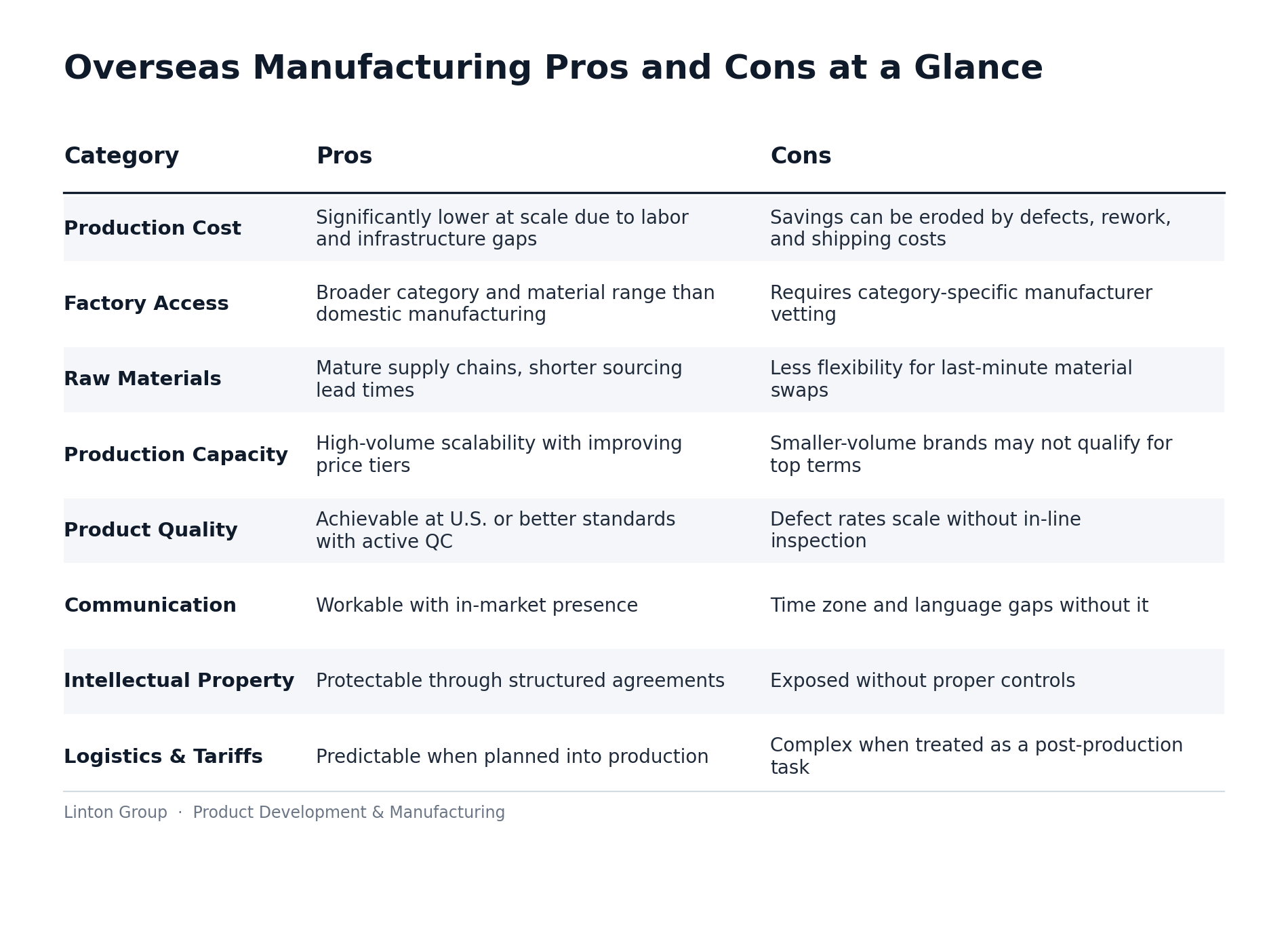
Overseas Manufacturing Pros and Cons at a Glance

chart of overseas manufacturing pros and cons

The pros on this list are structural. The cons are operational. Operational problems get fixed by operational systems, which means every con is addressable with the right management model and in-market partner relationships.

What Separates Successful Overseas Manufacturing From Expensive Mistakes

Most overseas manufacturing failures are not factory failures. They are management failures. The manufacturer produces what the production system tells it to produce, and when that system has no in-line QC, no defined quality standard, and no in-market oversight, the factory cannot self-correct on the brand’s behalf.

Brands that treat overseas production as transactional run into the same predictable problems: rising defect rates, compressed margins, production delays that compound across reorders, and unresolved spec drift between runs.

A properly managed overseas production program has five components:

  1. Manufacturer vetting by category, not by price. Process capability, production capacity, and documented history in the brand’s specific product category. Pricing is the last filter, not the first.
  2. In-house QC at every production stage. Linton’s QC team follows ANSI/ASQ Z1.4 2018 as the quantifiable benchmark for every inspection. After-the-fact third-party inspection is not equivalent to embedded in-line QC.
  3. Field presence in key manufacturing regions. Linton’s field offices across China sit close to the supplier clusters they support, which removes the time-zone lag and translation gaps that erode quality remotely.
  4. Accumulated order volume leveraged for better terms. A manufacturing partner managing production for many brands at scale negotiates pricing, payment terms, and priority production access that single brands cannot.
  5. Logistics and tariff planning built into production. Container scheduling, HTS classification, tariff exposure, and FBA-compliant carton specs handled in production planning, not after the fact.

Is Overseas Manufacturing the Right Move for Your Brand?

Overseas manufacturing is generally the right decision when these conditions are met:

  • Production volume is meaningful (typically several thousand units per run or annual)
  • The product competes on either product quality or unit economics
  • The category does not require local manufacturing for regulatory reasons
  • The brand has access to either internal manufacturing expertise or a managed partner

What overseas manufacturing requires is either significant in-house infrastructure or a trusted partner with in-market presence, active QC, and manufacturer relationships that go beyond a Google search. Brands trying to manage overseas production from a U.S. desk, using freelance inspectors and quarterly factory visits, consistently absorb the cons without capturing the full upside.

For brands without dedicated internal resources, a managed production partner removes most of the cons without sacrificing the cost and scale advantages. Linton’s product design and development program builds production into the design stage, and the manufacturing cost reduction program identifies where existing overseas production is leaving margin on the table.

When to Bring in a Manufacturing Partner

The right time to engage a manufacturing partner is before tooling, supplier commitments, and production volumes are locked in. A partner brought in at the design and manufacturer selection stage shapes outcomes for the life of the product. A partner brought in after margins have compressed and defect rates are climbing is mostly doing damage control.

If you are evaluating overseas manufacturing for the first time, or rethinking a factory relationship that is no longer working, schedule a consultation with the Linton team. Learn more about how Linton operates across U.S. and Asia field offices on the About Linton page.

Pet Product Manufacturing: From Concept to Commercial Sale

Key Takeaways

  • Pet product manufacturing is not complete when a sample looks good under normal conditions. It is complete when the design withstands real pet use (chewing force, moisture exposure, repeated physical stress) and can be produced consistently at commercial volume within target cost.
  • Material decisions made during early sampling directly determine non-toxic compliance, structural durability, and defect rates at scale. Different grades of nylon, hardware alloys, and coating formulations that appear equivalent in a prototype behave very differently in production.
  • Prototyping must validate pet use conditions, not just functional demos. Each prototype phase should answer a specific question about safety, durability, or assembly feasibility before tooling is committed.
  • Design for manufacturability analysis must happen before tooling and supplier commitments are made, not after.
  • A finalized golden sample is the shared production standard that makes quality control objective and enforceable across every run.
  • Most pet product manufacturing failures trace back to treating product development and manufacturing execution as separate phases rather than one integrated system.

A pet product concept and a commercially scalable, brand-owned pet product are separated by a manufacturing process, not a design file.

Pet product manufacturing covers the full process of engineering a product to withstand real pet use, meet applicable material safety standards, and remain cost-feasible to produce at commercial volumes. The material, structural, and assembly decisions made during early development determine whether a product holds up under daily pet use at scale, what it costs to produce, and whether quality can be maintained consistently. Those decisions carry downstream cost consequences that compound, and reversing them after tooling commitments are made is significantly more expensive than validating them during sample development.

This guide is for founders, brand owners, DTC operators, and Amazon private-label sellers in the pet industry who are developing original pet accessories, toys, personalized products, or pet care items and need to understand what commercially viable manufacturing actually requires. Linton has delivered 1,200+ product development projects across 200+ product categories, including pet accessories, personalized products, and pet care items developed with safety requirements and manufacturing feasibility evaluated together from the start. If your concept is ready for structured development, schedule a consultation with the Linton team.

Explore Pet Product Development

What Pet Product Manufacturing Actually Requires

Pet product manufacturing is not just production. It is the full process of engineering a product to withstand real pet use, meet applicable safety standards, and remain cost-feasible to produce consistently at commercial volumes.

Pet products carry specific material and safety requirements that other consumer categories do not. Non-toxic materials, structural durability under chewing force and physical stress, hardware strength under repeated load, and coating or finish safety must all be validated before mass production begins. These are design requirements, not inspection checkboxes, and they must be integrated into sample development from the first prototype forward.

Decisions made during early development (material selection, construction method, hardware integration, assembly design) directly determine unit cost, tooling investment, defect rates, and how the product holds up under daily pet use at scale. A pet product that performs under controlled demo conditions but was not engineered with real pet use and manufacturing constraints in mind will surface those gaps at the worst possible stage: after tooling is cut, after suppliers are committed, or after safety and durability failures start generating returns.

Why Pet Products Fail at the Manufacturing Stage

The most consistent failure pattern in pet product manufacturing is designing for visual appeal or controlled demonstration without evaluating how the product will perform under actual pet use across production volumes.

Material substitutions that appear equivalent create safety and durability differences that only become visible at scale. Different grades of nylon vary significantly in tensile strength and abrasion resistance under repeated physical stress. Hardware alloys that prototype identically may differ in fatigue resistance under sustained load. Coating formulations that perform identically in initial testing may have different adhesion characteristics under repeated contact with moisture, pet saliva, or outdoor conditions. These differences are identifiable during structured prototype testing. They become safety risks and return problems when they surface after production.

Hardware integration, load path design, and assembly tolerance decisions made during early development compound the same way. A product with attachment points not validated under realistic pulling force, or hardware selected for prototype convenience rather than production durability, will generate consistent failure patterns. Most pet product manufacturing failures are not random. They are the predictable result of treating pet product development as a design and sourcing exercise and manufacturing as a downstream concern.

The Pet Product Manufacturing Process

A structured pet product manufacturing process follows a defined sequence. Safety requirements and manufacturing feasibility must be evaluated together throughout, not handed off sequentially. The cost of fixing problems decreases significantly at every earlier stage they are caught.

Define Safety Requirements, Target Cost, and Volume Before Building

Before the first sample is built, establish material safety requirements, target unit cost, production volume, and applicable compliance standards. Evaluate material availability, commercial pricing, hardware sourcing, and supplier lead times early to confirm the design is commercially viable at target volumes. This step frames every subsequent structural and material decision. Skipping it means discovering commercial constraints after they are already locked in.

Material Selection and Construction Engineering

Select materials based on real pet use conditions: chewing force, moisture exposure, UV exposure, and repeated physical stress rather than prototype convenience or visual appearance. Evaluate non-toxic compliance, structural durability, coating safety, and production efficiency as integrated considerations, not sequential steps. Construction methods, hardware choices, and assembly sequences must be chosen with production tolerances, defect risk, and pet safety in mind from the start. Pet product development and manufacturing feasibility are one concurrent evaluation, not two separate phases.

Prototyping and Sample Development

Build functional prototypes to validate structural performance, material behavior under simulated pet use conditions, ergonomics, and owner experience. Manage multiple prototype iterations to refine fit, function, safety, finish, and manufacturability before tooling is committed. Test prototypes against realistic pet use scenarios (chewing force, tugging load, moisture exposure, and outdoor conditions) rather than just visual or functional demonstrations. Document all dimensions, tolerances, material specifications, and hardware references precisely so each iteration builds directly toward a production-ready design.

Each prototype phase answers a specific question about the product: safety under stress, durability under repeated load, assembly feasibility, or cost. A prototype is a manufacturing validation tool. The cost of answering those questions during prototyping is a fraction of what they cost once tooling is committed.

Design for Manufacturing and Assembly Analysis

Evaluate the design for manufacturing (DFM) and design for assembly (DFA) to identify simplifications that reduce tooling cost and defect risk without compromising pet safety or durability. Review supplier dependencies, hardware lead times, and production risk to validate that the design is commercially viable at target volumes. Material selection, engineering, factory sourcing, and production planning must be evaluated together as one integrated system at this stage.

Golden Sample Approval

A finalized golden sample is the shared production standard that makes quality control objective and enforceable. It defines agreed-upon expectations for tolerances, material consistency, hardware accuracy, and finish quality for both the brand and the factory. Every QC inspection across every production run is measured against it. The golden sample does not replace factory accountability. It creates the measurable benchmark that makes accountability possible and consistent.

Cost Planning in Pet Product Manufacturing

Cost optimization in pet product manufacturing must happen during sample development, before tooling and supplier decisions are finalized. This is the phase where cost-driving decisions are still reversible.

Material grade, hardware count, personalization or engraving complexity, finishing requirements, and packaging design all affect unit economics and landed cost for pet products. Tooling costs differ significantly across construction types: injection-molded components, stamped or cast hardware, engraved or printed accessories, and sewn soft goods each carry different tooling investment profiles and per-unit cost structures.

The PupRing case study illustrates what integrated cost planning produces: Linton rebuilt PupRing’s supply chain to support true made-to-order manufacturing, eliminating upfront inventory requirements entirely, improving laser engraving accuracy by 5x through a proprietary vectorization algorithm, and enabling scale from 50 orders per day to 5,000 orders per day with positive cash flow per order. That cost structure was built into the manufacturing system from the start, not discovered after production was underway.

Quality Control in Pet Product Manufacturing

Quality control for pet products must be defined during sample development, not added as a final shipment check. Safety and durability benchmarks must be documented before the first production run so they can be enforced consistently across every run that follows.

A complete QC program covers four stages: pre-production material verification before the run begins; first-article evaluation after tooling produces initial parts; in-line inspections during the active production run; and final pre-shipment audits against the approved golden sample. Linton’s in-house QC team follows ANSI/ASQ Z1.4 2018 standards and manages inspections at each stage. QC is not outsourced to third-party inspectors at shipment time. It is embedded in production management throughout.

Effective QC for pet products is not a one-time checkpoint. Pet product safety failures and field durability failures are directly connected to whether material and structural standards were defined and enforced at the factory level across every production stage, or whether oversight was compressed into a single final inspection after production cost was already committed.

Common Pet Product Manufacturing Mistakes

The following patterns appear consistently in pet product development projects that run into production and safety problems:

  • Treating the first functional sample as a production-ready design rather than a starting point for manufacturing validation
  • Selecting materials based on visual performance without evaluating non-toxic compliance, chew resistance, or commercial availability at production volumes
  • Skipping DFM analysis and discovering hardware or tooling constraints after supplier commitments are made
  • Separating pet product design and manufacturing into sequential phases, which delays identification of safety and structural problems until they are expensive to fix
  • Underestimating how hardware integration, coating adhesion, and assembly tolerances affect field failure rates and product return risk

Most pet product manufacturing failures trace back not to individual errors but to treating product development and manufacturing execution as separate activities. The structural and safety problems that result are predictable and avoidable with a manufacturing-integrated development process from the start.

How Linton Supports Pet Product Manufacturing

Linton manages pet product manufacturing as an integrated process spanning product design, material engineering, factory sourcing, prototyping, quality control, and production planning from the first concept through golden sample approval and into mass production.

With access to 700+ vetted factories across pet product categories including soft goods, hardware accessories, plastic components, engraved or printed personalized products, and electronic pet devices, and overseas sourcing teams carrying 100+ years of combined experience, Linton provides favorable pricing, reliable sourcing, and prioritized production attention from manufacturers with demonstrated experience across pet industry categories.

Linton’s in-house QC team follows ANSI/ASQ Z1.4 2018 and manages inspections throughout prototyping and production. Learn more about product design and development and custom product manufacturing to understand how this applies to your pet product.

When to Work With a Manufacturing Partner on Pet Products

The right time to engage a manufacturing partner is before tooling, supplier commitments, and production costs are locked in, not after they surface as problems. Brands benefit from a manufacturing partner when internal teams lack the combined expertise in material safety, structural engineering, factory management, and quality control that pet products require.

Partnership is a safety, margin protection, and time-to-market decision. The earlier a manufacturing partner is engaged in pet product development, the lower the cost of revisions and the higher the likelihood of reaching market with a product that is safe, durable, and scalable.

Schedule a consultation with the Linton team to discuss your pet product manufacturing project.

Outdoor Product Manufacturing: From Concept to Market Ready Gear

Key Takeaways

  • Outdoor product manufacturing requires engineering a product to withstand real field conditions (UV exposure, moisture cycling, mechanical load, and repeated physical stress), not just controlled lab testing.
  • Material substitutions that appear equivalent on paper create significant performance gaps and warranty risk at production volumes. Different aluminum grades, nylon weave weights, and hardware alloys perform very differently under sustained outdoor use.
  • Prototyping must be stress-tested against real field conditions, not just functional demonstrations. Each sample phase should validate structural performance before tooling is committed.
  • Design for manufacturability and structural engineering must happen concurrently, not in sequence.
  • A finalized golden sample is the objective production standard that protects both the brand and the factory across every run.
  • Most outdoor product manufacturing failures trace back to separating product design from manufacturing execution rather than treating them as one integrated system.

A gear concept that looks right on a render and a gear product that holds up in the field are separated by a manufacturing process, not a design file.

Outdoor product manufacturing is the full process of engineering a product to withstand weather, mechanical stress, UV exposure, repeated load, and physical abuse while remaining cost-feasible to produce consistently at commercial scale. The structural and material decisions made during early development determine field performance, production cost, and whether quality can be maintained across runs. Those decisions cannot be corrected without significant cost once tooling is committed or production has begun.

This guide is for founders, brand owners, and product leaders developing outdoor gear, camping equipment, beach products, fitness accessories, or recreation tools who need to understand what commercially viable manufacturing actually requires. Linton has delivered 1,200+ product development projects across 200+ product categories, including outdoor gear, beach products, and recreation equipment developed with field performance and manufacturing feasibility evaluated together from the start. If your outdoor product concept is ready for structured development, schedule a consultation with the Linton team.

Explore Outdoor Product Design

What Outdoor Product Manufacturing Actually Requires

Outdoor product manufacturing is not just production. It is the full process of engineering a product to withstand the conditions it will actually face in the field (dirt, water, UV exposure, repeated mechanical load, physical impact, and continuous use across seasons) while remaining cost-feasible to produce at scale.

Outdoor products carry specific material and structural requirements that controlled testing environments do not fully surface. UV resistance, waterproofing, load tolerance, corrosion resistance, and ergonomic performance under physical exertion must all be validated under real-world conditions before mass production begins. These are design requirements that must be built into sample development from the start, not compliance items reviewed at the end.

Decisions made during early development (material selection, construction method, load path engineering, hardware choices) directly determine unit cost, tooling investment, defect rates, and field performance at scale. A design that performs adequately in a prototype under controlled conditions but was not engineered with structural manufacturing requirements in mind will surface those constraints at the worst possible stage: after tooling is cut, after suppliers are committed, or after field failures generate warranty claims and returns.

Why Outdoor Products Fail at the Manufacturing Stage

The most consistent failure pattern in outdoor product manufacturing is designing for visual appeal or controlled lab performance without evaluating how the product holds up under real outdoor use conditions across production volumes.

Material substitutions that appear equivalent create field performance gaps that only become visible at scale. Different aluminum alloy grades vary in strength-to-weight ratio and corrosion characteristics. Nylon weave weights that prototype identically behave differently under sustained load and abrasion. Hardware alloys that perform adequately in testing may corrode, fatigue, or fail structurally under the specific combination of moisture, UV, and mechanical stress the product encounters in actual outdoor use. These differences are identifiable during structured prototype testing. They become expensive warranty and return problems when they surface after production.

Structural geometry, stress concentration points, hardware integration, and assembly tolerance decisions made during early development compound forward. A design with load paths not evaluated under realistic field conditions, hardware attachment points not stress-tested, or assembly tolerances set for prototype convenience rather than production reality will generate consistent failure patterns across every production run. Most outdoor product manufacturing failures are the predictable result of treating outdoor product design as an aesthetic and functional exercise and manufacturing as a downstream concern.

The Outdoor Product Manufacturing Process

A structured outdoor product manufacturing process follows a defined sequence. Field performance requirements and manufacturing feasibility must be evaluated together throughout, not in sequence. The cost of fixing structural and material problems decreases significantly at every earlier stage they are identified.

Define Field Performance Requirements and Target Cost Before Building

Before the first sample is built, establish target field performance standards, expected use conditions, production volume, and unit cost goals. Evaluate material availability, commercial pricing, structural requirements, and supplier lead times early to confirm the design is commercially viable at target volumes. Starting here is not optional process overhead. It is the frame that makes every subsequent structural and material decision commercially valid.

Material Selection and Construction Engineering

Select materials based on real outdoor use: UV exposure, moisture cycling, mechanical load, abrasion resistance, and repeated physical stress rather than prototype convenience or visual appearance. Evaluate weight, packability, structural integrity, and production efficiency as integrated considerations. Construction methods, load path geometry, fastener selection, and assembly design must be chosen with production tolerances, defect risk, and field performance in mind from the start. Outdoor product design and structural engineering for manufacturing are one concurrent evaluation, not two separate phases.

Prototyping and Sample Development

Build functional prototypes to validate structural performance, material behavior under simulated outdoor conditions, ergonomics, and user experience. Manage multiple prototype iterations to refine fit, function, finish, and manufacturability before tooling is committed. Stress test prototypes against real field conditions rather than just functional demonstrations to identify failure points and structural risks before production begins.

Document all dimensions, tolerances, material specifications, and hardware references precisely so each iteration builds directly toward a production-ready design. Each prototype phase answers a specific question about the product: structural integrity under load, material durability under UV and moisture, assembly feasibility, or cost. A prototype is a field performance and manufacturing validation tool, not a preview of the finished product.

Design for Manufacturing and Assembly Analysis

Evaluate the design for manufacturing (DFM) and design for assembly (DFA) to identify simplifications that reduce tooling cost and defect risk without compromising field performance. Review supplier dependencies, hardware lead times, and production risk to validate that the design is commercially viable at target volumes. Material selection, structural engineering, factory sourcing, and production planning must be evaluated together as one integrated system at this stage

Golden Sample Approval

A finalized golden sample is the shared production standard that makes quality control objective and enforceable across every run. It defines agreed-upon expectations for tolerances, material consistency, hardware quality, and structural assembly accuracy for both the brand and the factory. Every QC inspection is measured against it. The golden sample does not replace factory accountability. It creates the benchmark that makes accountability measurable and consistent.

Cost Planning in Outdoor Product Manufacturing

Cost optimization in outdoor product manufacturing must happen during sample development, before tooling and supplier decisions are finalized. This is the phase where cost-driving decisions are still reversible.

Material grade, structural complexity, hardware count, finishing requirements, and packaging design all affect unit economics and landed cost for outdoor products. Tooling costs vary significantly based on construction type: injection-molded components, aluminum extrusions, sewn fabric goods, and structural hardware assemblies each carry different tooling investment profiles. Understanding those cost structures during sample development rather than after commitments are locked in is what protects margins.

The Water Buffalo beach chair case study is a concrete example: Linton’s structural redesign and manufacturing optimization cut COGS by nearly 80% from close to $100 per unit, achieved a 4.4-star Amazon rating, and scaled to 14+ containers in year one without sacrificing the field performance that made the product a strong seller to begin with. That cost structure was built through integrated development, not discovered after production was underway.

Quality Control in Outdoor Product Manufacturing

Quality control for outdoor products must be defined during sample development, not added as a final shipment check. Inspection criteria, structural performance benchmarks, and defect tolerances must be documented before the first production run so they can be enforced consistently across every run that follows.

A complete QC program covers four stages: pre-production material verification before the run begins; first-article evaluation after tooling produces initial parts; in-line inspections during the active production run; and final pre-shipment audits against the approved golden sample. Linton’s in-house QC team follows ANSI/ASQ Z1.4 2018 standards and manages inspections at each stage. QC is not outsourced to third-party inspectors at shipment time. It is embedded in production management throughout.

Field failure rates for outdoor products are directly connected to whether structural and material standards were defined and enforced at the factory level across every production stage, or whether oversight was compressed into a single checkpoint after production cost was already committed.

Common Outdoor Product Manufacturing Mistakes

The following patterns appear consistently in outdoor product development projects that run into production problems:

  • Treating the first functional prototype as a production-ready design rather than a starting point for manufacturing validation
  • Selecting materials based on prototype performance without evaluating weather resistance, UV degradation, or commercial availability at production volumes
  • Skipping DFM analysis and discovering structural or tooling constraints after supplier commitments are made
  • Separating outdoor product design and manufacturing into sequential phases, which delays identification of integration problems until they are expensive to correct
  • Underestimating how hardware choices, load path geometry, and assembly tolerances affect field failure rates and warranty risk

Most outdoor product manufacturing failures are structural and predictable. They result from a development process that did not integrate manufacturing requirements early enough to address them before they became locked-in constraints.

How Linton Supports Outdoor Product Manufacturing

Linton manages outdoor product manufacturing as an integrated process spanning product design, structural engineering, material selection, factory sourcing, prototyping, and production planning from the first concept through golden sample approval and into mass production.

With access to 700+ vetted factories across outdoor product categories including structured gear, soft goods, aluminum and plastic components, and hardware-intensive assemblies, and overseas sourcing teams carrying 100+ years of combined experience, Linton provides favorable pricing, reliable sourcing, and prioritized production attention from manufacturers with proven experience in outdoor product categories.

Linton’s in-house QC team follows ANSI/ASQ Z1.4 2018 and manages inspections throughout prototyping and production. Learn more about product design and development and manufacturing cost reduction to understand how this applies to your outdoor product.

When to Work With a Manufacturing Partner on Outdoor Products

The right time to engage a manufacturing partner is before tooling, supplier commitments, and production costs are locked in, not after they surface as problems. Brands benefit from a manufacturing partner when internal teams lack the combined expertise in structural engineering, material selection, factory management, and quality control that outdoor products require.

Partnership is a durability, margin protection, and speed-to-market decision. The earlier a manufacturing partner is engaged in outdoor product development, the lower the cost of revisions and the higher the probability of reaching market with a product that holds up in the field, scales profitably, and generates consistent repeat production.

Schedule a consultation with the Linton team to discuss your outdoor product manufacturing project.

Kitchen Product Manufacturing: From First Sample to Retail Ready Design

Key Takeaways

  • Kitchen product manufacturing is not complete when a sample looks and functions correctly. It is complete when the design can be produced consistently, within cost targets, at retail volume.
  • Material decisions made during early sampling (stainless steel grades, silicone durometer, plastic formulations) directly determine defect rates, food-contact compliance, and unit economics at scale.
  • Prototyping must validate behavior under real kitchen conditions: heat cycling, moisture exposure, sharp-edge contact, and repeated daily use. Each prototype phase should answer a specific manufacturing question before tooling is committed.
  • Design for manufacturability analysis must happen before tooling commitments are made, not after.
  • A finalized golden sample serves as the shared production benchmark for every manufacturing run that follows.
  • Most kitchen product manufacturing failures trace back to treating design and production as sequential phases rather than one integrated system.

Getting a kitchen product from first sample to retail shelf without a costly redesign along the way requires something most product teams underestimate: manufacturing decisions made before the tooling is cut.

Kitchen product manufacturing covers the full process of engineering a product to survive daily heat, moisture, sharp edges, and repeated mechanical stress while remaining cost-feasible to produce at scale. Whether the product is cookware, a countertop appliance, a cutting board, or a kitchen gadget, the design decisions that look like aesthetic or functional choices during early development are, in practice, cost and quality decisions that compound forward through every production run. Reversing them after tooling is committed costs far more than validating them during the sample phase.

This guide is for founders, brand owners, and product leaders developing kitchen equipment, cooking tools, or kitchen accessories who need to understand what a commercially viable manufacturing process actually requires. Linton has delivered 1,200+ product development projects across 200+ product categories, including kitchen tools, countertop appliances, and cookware built with manufacturing requirements integrated from day one. If your concept is ready to move into structured development, schedule a consultation with the Linton team.

Explore Kitchen Product Design

What Kitchen Product Manufacturing Actually Requires

Kitchen product manufacturing is not just production. It is the full process of engineering a product to survive the conditions of actual kitchen use (heat cycling, moisture exposure, sharp edges, and repeated mechanical load) while remaining cost-feasible to produce consistently at commercial volumes.

Kitchen products and cooking equipment carry material and compliance requirements that other product categories do not. Food-contact safety, thermal resistance, corrosion resistance, and ergonomic performance under real daily use must all be validated before a product enters mass production. These are not downstream checkboxes. They are engineering requirements that must be built into the design from the first sample forward.

The decisions made during early development (material choice, construction method, component count, assembly design) directly determine unit cost, tooling investment, defect rates, and production repeatability. A kitchen product that performs in a functional prototype but was not engineered with manufacturing constraints in mind will surface those constraints at the worst possible time: after tooling is cut, after supplier commitments are made, or after the first production run comes in below specification.

Why Kitchen Products Fail at the Manufacturing Stage

The most consistent failure pattern in kitchen product manufacturing is designing for visual appeal or functional demonstration without evaluating how the product will behave under real kitchen use conditions at production volumes.

Material substitutions that look equivalent on paper produce materially different outcomes at scale. Different grades of stainless steel vary in corrosion resistance and forming characteristics. Silicone durometer differences affect both feel and long-term performance under heat. Plastic formulations used in kitchen equipment that prototype identically may behave differently under thermal cycling across thousands of production units. These differences are manageable when identified during sample development. They become expensive production problems when they surface after tooling.

Assembly complexity, tolerance stacking, and part count decisions made during early development compound forward. A product with more components than necessary (whether it is a set of pans, a food preparation tool, or a countertop appliance) carries more opportunities for assembly error, more tooling investment, and more per-unit cost than required. Most kitchen product manufacturing failures are not caused by a single wrong decision. They are the result of treating design as a creative phase and manufacturing as a downstream operational function.

The Kitchen Product Manufacturing Process

A structured kitchen product manufacturing process follows a defined sequence. Food-contact compliance, material performance, and manufacturing feasibility must be evaluated together throughout, not in sequence. The cost of fixing problems decreases significantly at every earlier stage they are identified.

Define Target Cost, Volume, and Compliance Requirements Before Building

Before the first sample is built, establish target unit cost, production volume, retail channel requirements, and any food safety or material compliance standards that apply. Evaluate material availability, commercial pricing, and supplier lead times early to confirm the kitchen product design can be produced at target volumes within margin. This step is not preliminary. It is the frame that makes every subsequent decision commercially valid.

Material Selection and Construction Engineering

Select materials based on real kitchen use conditions: heat exposure, moisture cycling, sharp-edge contact, and repeated stress rather than prototype convenience. For cookware, this means evaluating metal grades, coating adhesion, and handle construction under sustained heat. For kitchen equipment with mechanical components, it means validating motor housing tolerances, food-safe material grades, and assembly sequences before tooling begins. Evaluate food-contact compliance, ergonomic performance, and production efficiency as integrated considerations, not sequential checkboxes. Construction methods, part geometries, and assembly sequences must be chosen with production tolerances and defect risk in mind from the start.

Prototyping and Sample Development

Build functional prototypes to validate usability, structural integrity, and material behavior under real kitchen conditions. Manage multiple prototype iterations to refine fit, function, finish, and manufacturability before tooling is committed. Document all dimensions, tolerances, material specifications, and component references precisely so each iteration builds directly toward a production-ready design.

Each prototype phase answers a specific question about the product (performance under heat, durability under repeated use, assembly feasibility, or cost) rather than acting as a preview of the finished product. Kitchen products expose more material and construction variables than most categories. Cookware faces different stress profiles than cutting boards, and countertop cooking equipment carries electrical and mechanical integration requirements that compound the validation workload. Each prototype iteration should be structured around a defined manufacturing question, not general refinement.

Design for Manufacturing and Assembly Analysis

Evaluate the design for manufacturing (DFM) and design for assembly (DFA) to identify simplifications that reduce tooling cost and defect risk without compromising performance. Review supplier dependencies, component lead times, and production risk to validate that the design is commercially viable at target volumes. Material selection, engineering, factory sourcing, and production planning must be evaluated together as one integrated system at this stage.

Golden Sample Approval

A finalized golden sample is the shared production standard that makes quality control objective and enforceable. It defines agreed-upon expectations for tolerances, material consistency, finish quality, and assembly accuracy for both the brand and the factory. Every QC inspection across every production run is measured against it. The golden sample does not replace factory accountability. It creates the benchmark that makes accountability measurable and consistent across every run.

Cost Planning in Kitchen Product Manufacturing

Cost optimization in kitchen product manufacturing must happen during sample development, before tooling and supplier decisions are finalized. This is the phase where cost-driving decisions are still reversible.

Material grade, construction complexity, part count, finishing requirements, and packaging design all affect unit economics and landed cost for kitchen products. Tooling costs vary significantly based on construction type: injection-molded plastic components, stamped metal parts, silicone molds, and electromechanical assemblies each carry different tooling investment profiles and defect risk characteristics. A manufacturer sourced without evaluating these cost structures early will quote against a design that may be more expensive to produce than the margin supports. Understanding those cost structures during development rather than after commitments are made is what protects margins.

The unit cost of a kitchen product at mass production is substantially determined by decisions made during the sample phase. Brands that engage manufacturing cost analysis after the design is locked in consistently find fewer options available for cost reduction than those who integrated those considerations from the first prototype. Linton’s manufacturing cost reduction program addresses this gap for brands already in production, but the most effective version of that work happens before tooling, not after.

Quality Control in Kitchen Product Manufacturing

Quality control cannot be added to kitchen product manufacturing as a final inspection step. It must be defined during the prototyping process so that specifications, inspection criteria, and defect tolerances are documented before the first production run.

A complete QC program covers four stages: pre-production material checks before the run begins; first-article evaluation after tooling produces initial parts; in-line inspections during the active production run; and final pre-shipment audits against the approved golden sample. Linton’s in-house QC team follows ANSI/ASQ Z1.4 2018 standards and manages inspections at each stage. QC is not outsourced to third-party inspectors at shipment time. It is embedded in production management throughout.

Effective QC for kitchen products is not a one-time checkpoint. It is a standardized system that ensures material accuracy, assembly consistency, and defect risk management across every run. The cost of catching a non-conforming component before production begins is a fraction of the cost of a defect identified by a customer or flagged at an FBA compliance check. For food preparation products and cooking equipment in particular, quality failures carry food-contact compliance exposure in addition to standard return and reputation risk.

Common Kitchen Product Manufacturing Mistakes

The following patterns appear consistently in kitchen product development projects that run into production problems:

  • Treating the first functional sample as a production-ready design rather than a starting point for manufacturing validation
  • Selecting materials based on prototype performance without evaluating food-contact compliance, thermal behavior, or commercial availability at production volumes
  • Skipping DFM analysis and discovering tooling constraints after supplier commitments are made
  • Separating design and manufacturing into sequential phases, which delays identification of integration problems until they are expensive to fix
  • Underestimating how finish quality, packaging requirements, and assembly tolerances affect defect rates and landed cost at scale

Most kitchen product manufacturing failures trace back to treating development and manufacturing as separate activities rather than one integrated system. The integration problems that result are predictable, consistent, and avoidable with a manufacturing-integrated development approach from the start.

How Linton Supports Kitchen Product Manufacturing

Linton manages kitchen product manufacturing as an integrated process spanning product design, material engineering, factory sourcing, prototyping, and production planning from the first sample through golden sample approval and into mass production.

With access to 700+ vetted factories across kitchen product categories including metals, plastics, silicone, glass, ceramics, and electromechanical components, and overseas sourcing teams carrying 100+ years of combined experience, Linton provides favorable pricing, reliable sourcing, and prioritized production attention from manufacturers with demonstrated experience across kitchen equipment and cooking product categories.

The Healthy Express electric tofu press case study illustrates what integrated development and manufacturing produces: a product engineered from concept through mass production including a fully automated pressing system, reliable internal electronics, and production-ready tooling that launched with consistent quality and a 4.7-star Amazon rating.

Linton’s in-house QC team follows ANSI/ASQ Z1.4 2018 and manages inspections throughout prototyping and production. Learn more about product design and development to understand how this applies to your kitchen product.

When to Work With a Manufacturing Partner on Kitchen Products

The right time to engage a manufacturing partner is before tooling, supplier commitments, and production costs are locked in, not after they surface as problems. Brands developing kitchen equipment, cookware, or food preparation products benefit from a manufacturing partner when internal teams lack the combined expertise in material engineering, production management, factory sourcing, and quality control that these categories require.

Partnership is a risk-reduction and margin-protection decision. The earlier a manufacturing partner is engaged in kitchen product development, the lower the cost of revisions and the higher the probability of reaching retail on time, within margin, and with a product that performs consistently across production runs.

Schedule a consultation with the Linton team to discuss your kitchen product manufacturing project.