Toy Tooling Costs: Why the Mold Decision Defines your Margin

Toy tooling is the most irreversible decision in your product’s cost structure

Most brands evaluate toy manufacturing partners on unit price. That is the wrong anchor. By the time unit price matters, the tooling decision has already locked in the majority of the product’s long-term margin structure, and most of that decision is irreversible.

Toy tooling is where manufacturing economics are set. Get it wrong and the cost follows every production run.


Why tooling dominates long-term unit economics.

A mold is not a purchase. It is a capital commitment that sets the geometry, tolerance, cycle time, and material compatibility of every unit that follows.

Three realities drive this:

    • Tool amortization sits inside every unit cost. The total mold investment is recovered across the volume it produces, so a mispriced or mis-scoped tool raises per-unit cost on every run.
    • Design changes after the tool is cut are expensive or impossible. Small geometry shifts can require new cavities, re-polishing, or a full rebuild.
    • Cycle time is baked into the tool. Poor gating, cooling, or cavity count decisions produce tools that run slower than they should, permanently raising unit cost through factory time.

If the tooling phase is treated as a line item rather than a structural decision, the margin consequences follow the product to retail.

Explore Toy Manufacturing

What must be resolved before steel is cut

Before a tool is cut, the brand should have clear, documented answers on:

  • Expected annual volume across 3 years, not year 1 alone
  • Cavity count modeled against that volume and the factory’s cycle time
  • Material and finish specifications validated against safety standards (ASTM F963, CPSC, EN71)
  • Design for Manufacturing (DFM) review completed against the specific molding method (injection, blow, or rotational)
  • Tolerance stack-up confirmed across all mating parts
  • First-off-tool evaluation protocol agreed with the factory
  • Tool ownership contractually defined

Most tooling disputes trace back to one of these being assumed rather than documented.

Where brands lose money in the tooling phase

Four patterns show up repeatedly in the work we review:

  1. Cavity count set for year 1 demand. Re-tooling for scale in year 2 is often more expensive than cutting the correct multi-cavity tool up front.
  2. DFM review skipped or rushed. Changes caught at first-off-tool are 10 to 50 times more expensive than changes caught at design review.
  3. Tool ownership left ambiguous. Brands discover they cannot move production because the factory holds the tool or the transfer terms were never negotiated.
  4. Tooling priced without unit-cost modeling. A cheaper tool can produce a more expensive part if cycle time, yield, or finishing requirements were not priced in.

None of these are design failures. They are structural failures in how the tooling phase was scoped.

Treat tooling as a capital decision, not a production step

The tooling phase is where margin structure, compliance exposure, and supplier leverage are decided at the same time. It should sit earlier in the timeline than most brands place it, and it should be governed with the discipline of a capital decision, rather than a production task.

The brands that build durable margin in toys are the ones that model tooling economics against 3-year volume, validate DFM before cut, and negotiate tool ownership before funds move.

When to bring a manufacturing partner in

Tooling is the point in the lifecycle where partner selection produces the largest return. Once the tool is cut, most of the strategic levers are gone.

If you are approaching the tooling phase, or reconsidering a tool already in production, that is the right moment to pressure-test the decision against unit economics, compliance pathway, and factory capability.

For the full manufacturing lifecycle context, read our toy manufacturing process guide.

How Linton Supports End-to-End Toy Manufacturing

Linton manages the complete toy manufacturing lifecycle as one integrated system: concept validation, engineering feasibility, factory sourcing, prototyping, in-house quality control following ANSI/ASQ Z1.4 2018, safety compliance management, and global logistics. Unlike traditional suppliers or sourcing agents, Linton operates as a full lifecycle manufacturing partner, with a shared success model where we only win when the product succeeds in market.

With 700-plus vetted factories across Asia and Africa, in-house QC teams operating from overseas offices, and production experience across 200-plus product categories, Linton gives toy brands the manufacturing infrastructure that would otherwise require building a full internal team. Whether you are launching a new toy line through product design and development or optimizing costs on an existing product through manufacturing cost reduction, every engagement includes active factory management, embedded quality control, and production accountability tied to the brand’s results.

Linton is not a factory broker. Learn more about the full scope of toys and games manufacturing support.

Electronics Prototype Development: From First Sample to Manufacturing-Ready Design

Key Takeaways

  • Electronics prototype development is not complete when a product works. It is complete when the design can be produced consistently, within cost targets, at commercial volume.
  • Electrical, mechanical, and firmware decisions made during prototyping directly determine tooling complexity, unit cost, and production repeatability.
  • Design for manufacturability analysis must happen before tooling commitments are made, not after.
  • Regulatory compliance requirements including FCC, CE, and RoHS must be integrated into the prototype phase, not managed as a post-production checklist.
  • A finalized golden sample serves as the shared production standard for every manufacturing run that follows.
  • Most electronics prototype failures trace back to treating electrical and mechanical engineering as separate phases rather than one integrated system.

A working electronic prototype and a manufacturing-ready design are not the same thing. The gap between them is where most electronics product development cost gets generated.

Electronics prototype development is the phase that determines whether a product concept can be produced profitably at commercial scale. Decisions made here affect tooling complexity, component sourcing viability, unit economics, and regulatory feasibility. Reversing those decisions after tooling or supplier commitments are locked in carries a cost most brands significantly underestimate until they are in the middle of it.

This guide is written for founders, brand owners, and product leaders who have an electronic product concept or an early sample and need to understand what a credible, manufacturing-ready development process actually requires. Linton has delivered 1,200+ product development projects across 200+ product categories, including electronics products that combine mechanical housings, printed circuit boards, and firmware systems.

Explore Electronics Manufacturing

What Electronics Prototype Development Actually Requires

Electronics prototype development is the structured process of converting a product concept into a design that can be produced consistently at commercial volume within the cost and quality parameters required for a viable electronic product. A proof-of-concept prototype validates that a product idea works. A manufacturing-ready prototype validates that it can be produced at scale.

The distinction matters because electronics prototyping carries complexity that most physical product categories do not. A single consumer electronic device integrates at least three engineering domains: the printed circuit board and firmware, the mechanical housing and assembly, and the interface between them. Each domain carries its own design requirements, sourcing dependencies, and manufacturing constraints. When those domains are treated as separate phases rather than one concurrent system, integration problems surface late, which is when they are most expensive to fix.

What separates a prototyping process that produces commercially viable designs from one that generates expensive revision cycles is how early manufacturing constraints are integrated into design decisions.

Why Most Electronics Prototypes Are Not Ready for Production

The most common failure pattern in electronics prototype development is treating the process as sequential: design the electronic product, then figure out manufacturing. That sequence produces consistent and predictable problems:

  • Component sourcing gaps. Electronic components selected for prototype performance frequently have long lead times, high minimum order quantities, or constrained commercial availability at production volumes.
  • PCB conflicts. PCB assembly processes that work in prototype quantities often require significant revision when evaluated against factory-scale production.
  • Tooling surprises. Mechanical housings designed for appearance without accounting for injection molding tolerances, assembly steps, or material behavior generate costly revisions after molds are cut.
  • Firmware bottlenecks. Firmware that performs adequately in lab testing often introduces throughput problems once actual pass/fail criteria and test fixture requirements are defined.

None of these are unusual. They are the standard cost of treating electronics prototyping as exploratory rather than structured. Identifying them before tooling and supplier commitments are made protects both timeline and budget. Linton’s product design and development program builds manufacturability analysis into every stage, before those commitments are locked in.

The Electronics Prototype Development Process

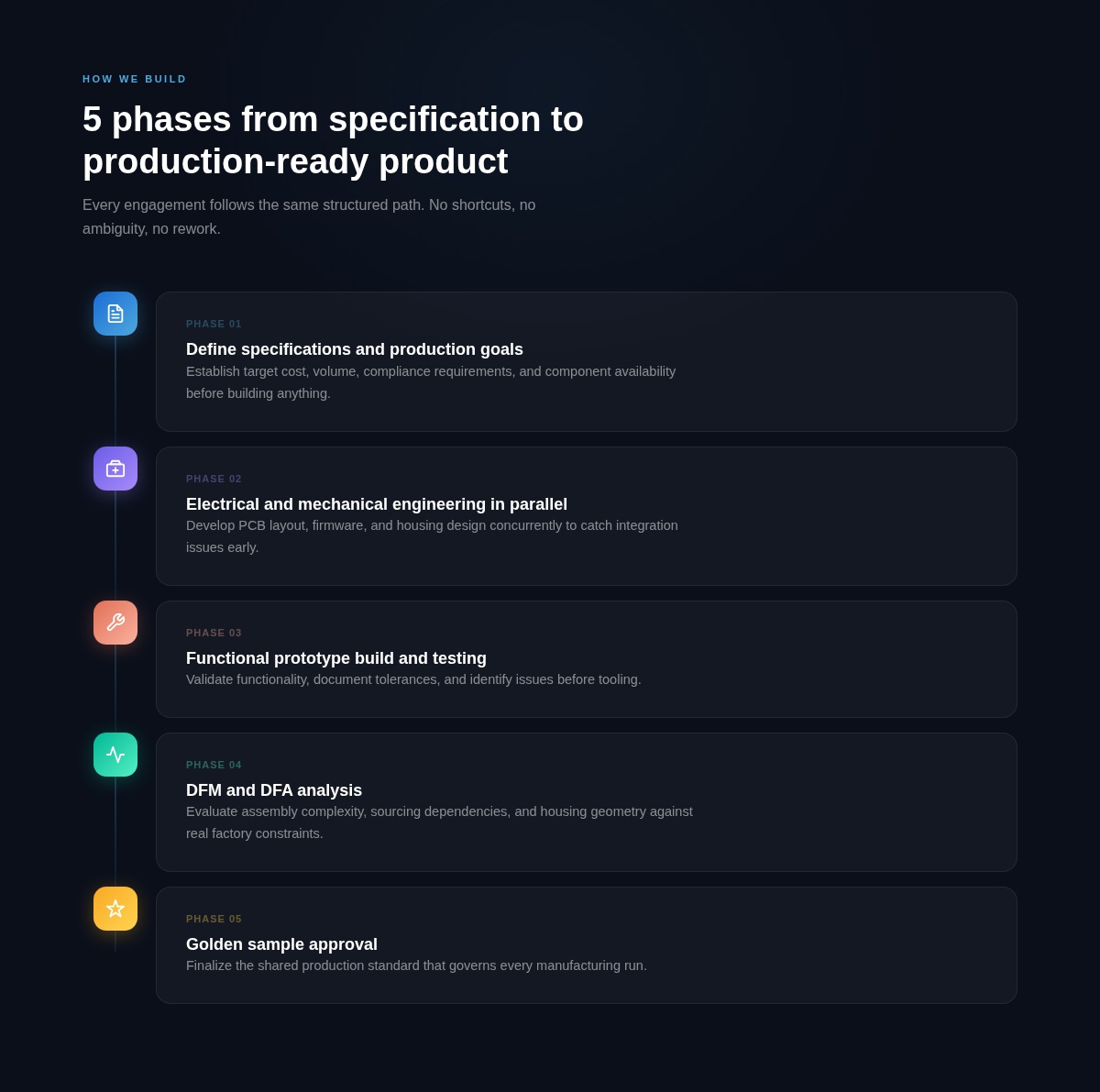
The electronics prototyping process follows a defined sequence. Compressing phases to save time is the most reliable way to generate production problems that become structural constraints rather than one-time corrections.

Chart reflecting phases of electronics prototype development process

A few phases deserve more context.

From concept to physical prototype. The first build in the development process should be a functional prototype that validates real-world performance, not just a digital model or a proof-of-concept mock-up. Functionality must be tested under conditions that reflect actual use before any tooling investment is made. Hardware development decisions made before this validation step tend to produce the most expensive corrections later.

Electrical and mechanical engineering in parallel. PCB layout, firmware architecture, and mechanical housing design must happen concurrently, not in sequence. The integration between these systems affects connector placement, heat management, assembly steps, and tooling requirements. Decisions in one domain directly constrain the other, and those constraints cannot be managed properly when the two disciplines operate as handoffs.

Golden sample approval. The golden sample is not a trust mechanism. It is the objective production benchmark that defines tolerances, material consistency, finish quality, and assembly accuracy for both the brand and the factory. Every inspection across every production run is measured against it. Linton’s in-house QC team follows ANSI/ASQ Z1.4 2018 standards and uses the approved golden sample as the benchmark for all inspections throughout production.

Cost Planning During Prototype Development

Cost optimization in electronics manufacturing must happen during the prototyping process, before tooling and supplier decisions are finalized. This is the phase where cost-driving decisions are still reversible.

Electronic component selection, housing design, assembly complexity, and firmware architecture all have direct implications for unit economics. Tooling costs vary significantly based on housing geometry and part complexity. Assembly costs vary based on the number of discrete steps and whether processes can be automated at target volumes. The cost structure of an electronic device at mass production is largely determined by decisions made during electronics prototyping.

Understanding that cost structure before those decisions are locked in is the difference between a product that achieves its target margins and one that requires a costly redesign at scale. Read more on why product development without manufacturing expertise costs more than you think.

Regulatory Compliance and Certification Planning

Certification requirements must be built into the prototype phase, not managed as a post-production checklist. For electronic products targeting US and European markets, applicable certifications typically include:

  • FCC Part 15 for unintentional emitters in the US market
  • CE marking for EU market access
  • RoHS compliance for restricted substance management across components and materials
  • UL or ETL certification depending on product category and distribution channel

Each of these has design-stage implications. PCB design and shielding affect FCC compliance. Electronic component selection must be validated against RoHS restricted substance lists before sourcing begins. Housing design may be governed by product safety standards that need to be understood before molds are cut. Treating these requirements as a final checklist produces the same outcome every time: issues that are straightforward to address during electronics prototyping become expensive to fix after tooling is committed.

Quality Control Planning Starts at Prototype, Not Production

Quality control for electronic products cannot be added after production begins. It must be defined during the prototyping process so that specifications, inspection criteria, and defect tolerances are documented before the first production run. A complete QC program covers four stages:

  • Pre-production checks verify materials and electronic components against specifications before production begins
  • First-off-tool evaluation confirms tooling produces parts within the approved tolerance range before full production is approved
  • In-line inspections check PCB assembly accuracy, solder quality, and finish consistency during the active production run
  • Final pre-shipment audits confirm finished goods against the approved golden sample before shipment is released

Linton’s in-house QC team follows ANSI/ASQ Z1.4 2018 standards and manages inspections at each stage. Quality control is not outsourced to third-party firms at shipment time. It is embedded in production management from the start. Learn more about product prototype development and how this connects to scalable manufacturing.

Common Mistakes in Electronics Prototype Development

The following patterns appear consistently across electronic product development projects that run into production problems:

  • Treating the functional prototype as a finished product rather than a tool for validating production readiness
  • Skipping DFM analysis and discovering tooling issues after molds are cut
  • Selecting electronic components based on prototype performance without evaluating commercial availability at production volumes
  • Underestimating firmware complexity and its downstream impact on production testing throughput
  • Separating electrical and mechanical engineering into sequential phases, which masks integration problems until they are expensive to resolve

What ties these patterns together is the absence of a manufacturing perspective during hardware development. Electronics prototype development done correctly integrates manufacturing, sourcing, and quality requirements into design decisions from the first physical prototype forward.

How Linton Supports Electronics Prototype Development

Linton manages electronics prototype development as one integrated process spanning electrical engineering, mechanical design, electronic component sourcing, firmware architecture, and production planning from first physical prototype through golden sample approval.

With 700+ vetted factories and overseas sourcing teams carrying 100+ years of combined experience, Linton provides access to favorable pricing, reliable sourcing, and prioritized production attention from manufacturers with proven experience across consumer electronics categories. The Healthy Express electric tofu press case study illustrates this directly: Linton led the product from mechanical and electrical engineering through manufacturability analysis and production execution, enabling a successful market launch in a new product category.

Linton’s in-house QC team follows ANSI/ASQ Z1.4 2018 standards and manages inspections throughout the prototyping process and production. Unlike sourcing agents or contract manufacturers that treat production as a handoff, Linton operates as a manufacturing partner accountable throughout the entire development lifecycle.

A structured prototyping process that integrates manufacturing requirements from the start is the most reliable protection for cost, timeline, and product quality. Schedule a consultation with the Linton team to discuss your electronics prototype development project.

Toy Manufacturing Process: From Concept to Retail Shelf

Key Takeaways

  • Toy manufacturing combines engineering, compliance, and quality control, and each requires active oversight, not assumptions
  • A creative concept and a manufacturing-ready design are not the same thing
  • Tooling is one of the largest upfront capital commitments in toy production, making design accuracy critical before it begins
  • Safety compliance (ASTM F963, CPSC, EN71) must be integrated into manufacturing decisions, not managed as a final step
  • Factory selection is a long-term brand decision, not a pricing exercise
  • The golden sample defines the production standard for every run that follows
  • Most toy manufacturing failures stem from treating production as a fragmented process rather than a single integrated system

Bringing a toy to market requires more than a strong product concept. The toy manufacturing process demands coordinated execution across product design, engineering feasibility, material selection, factory management, safety compliance, and quality control, with each decision affecting the one that follows.

This guide is written for brand owners, product inventors, and Amazon sellers who have a toy or game concept and need a realistic, structured path from design to scalable production. It assumes you are past ideation. The goal here is to understand what professional toy manufacturing actually involves before those decisions become expensive to reverse.

Explore Toy Manufacturing

What Makes Toy Manufacturing Uniquely Complex

Toys are regulated consumer products. That distinction shapes every decision in the manufacturing process.

Unlike most physical product categories, toys are subject to mandatory safety standards that govern materials, construction methods, age-grading, warning labels, and testing documentation:

  • ASTM F963 — the primary toy safety standard in the United States
  • CPSC testing requirements — mandatory testing and Children’s Product Certificate documentation for products intended for children under 12
  • EN71 — the applicable standard across the European Union

These requirements apply before a product is imported, not after a quality issue surfaces at retail. Brands entering toy manufacturing without experience in these requirements frequently encounter the same pattern: production moves forward, compliance gaps surface late, and the cost of resolving them after tooling and manufacturing investment is significantly higher than addressing them at the design stage.

Validate Your Concept and Feasibility Before Production Begins

Before factory engagement begins, a concept must be evaluated against the manufacturing realities that will determine whether it can be produced profitably and at scale. A proper feasibility analysis covers:

  • Unit economics at target volume
  • Estimated tooling costs
  • Material availability and pricing
  • Lead time requirements
  • Preliminary compliance mapping against applicable standards

Brands that skip this stage regularly discover that a product concept that works in theory does not work at the cost structure required for sustainable margins. Identifying this before committing to suppliers and tooling protects both the timeline and the budget. Linton’s product design and development program begins with exactly this kind of feasibility review, before any factory or tooling commitment is made.

Finalize Product Design for Manufacturing

A creative concept and a manufacturing-ready design are different things. This gap is where a significant portion of toy manufacturing cost gets generated.

A manufacturing-ready toy design accounts for:

  • Material specifications that can be sourced consistently at production volume
  • Tolerances that align with the selected production method, since injection molding, blow molding, rotational molding, and soft goods construction each have different requirements
  • Assembly steps that minimize defect risk at scale
  • All relevant safety restrictions on materials and components

Changes made after tooling is cut carry a cost that most brands underestimate until they are in the middle of it. Designs that do not account for real factory conditions go through expensive revision cycles, often after tooling is already in progress.

Prototype Development and Iteration

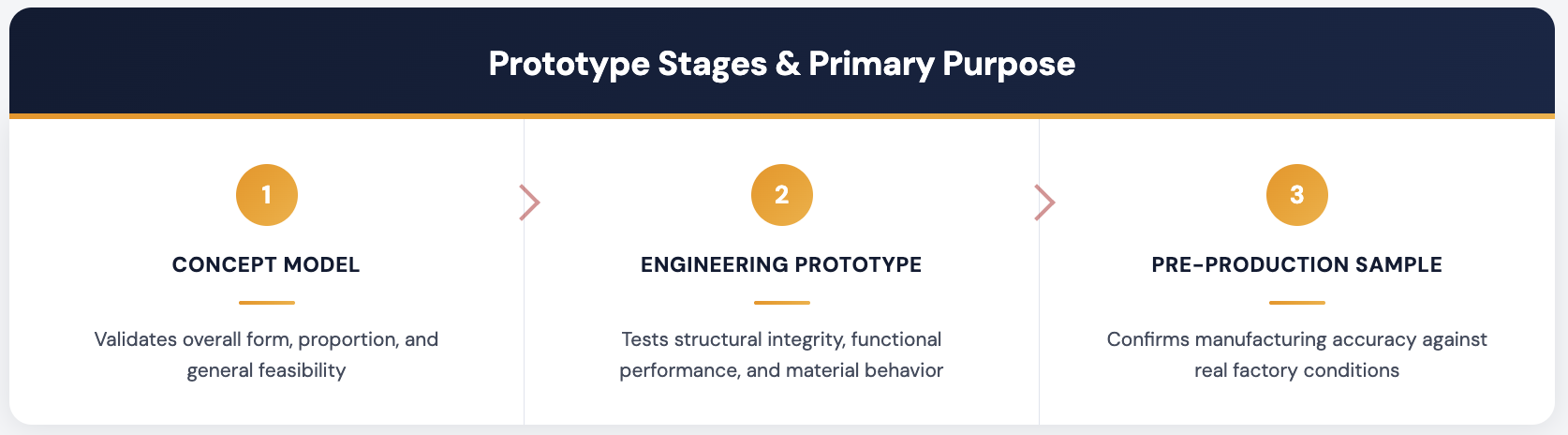
Prototyping exists to surface problems before they become tooling or production problems. The toy manufacturing process typically moves through three distinct stages:

Prototype Stages & Primary Purpose


Brands that compress or eliminate prototype iterations in the interest of speed routinely discover the costs they avoided on the front end are paid back, with interest, in tooling revisions or production rework. This is a particular risk in the toy category, where plastic toys, plush toys, soft toys, and educational toys each carry different durability and compliance requirements.

Tooling and Mold Development

Tooling is one of the most significant capital decisions in the toy manufacturing process, and it is largely irreversible once committed.

For plastic toys, injection molding tooling involves manufacturing steel molds built to the exact specifications of the approved product design. What most brands do not fully plan for:

  • First-off-tool parts must be evaluated against design specs before full production is approved
  • Any design changes after tooling is cut generate additional cost and delay proportional to the scope of the change
  • Molds are built to the design they receive, not the design the brand intended

This is the most concrete reason why a fully validated, manufacturing-ready design must be in place before tooling begins. Brands working with Linton on product design and development go through a complete design-for-manufacturability review before any tooling investment is made.

Factory Selection and Vetting

Finding a toy factory is not the same as vetting one. Professional toy factory evaluation looks beyond unit price to assess:

  • Experience manufacturing the specific product type, since plastic toys, plush toys, action figures, and educational toys are not interchangeable manufacturing categories
  • Safety certification status and compliance history
  • Quality control infrastructure and in-line inspection processes
  • Communication reliability and responsiveness
  • Production capacity at scale

Online platform sourcing does not provide reliable visibility into most of these factors. Linton’s toys and games manufacturing program draws from a network of 700-plus vetted factories, each assessed against category-specific standards rather than pricing alone.

Establishing a Golden Sample and Production Standard

Once a pre-production sample is approved, it becomes the golden sample: the shared, quantifiable production standard that governs every manufacturing run that follows.

The golden sample defines the objective benchmark for tooling accuracy, material consistency, finish quality, and assembly standards. It protects both the brand and the factory by removing subjectivity from the quality control process. Every inspection is measured against it, not against informal memory of what the product was supposed to look like.

Linton’s in-house QC team follows ANSI/ASQ Z1.4 2018 and uses the approved golden sample as the benchmark for all inspections across production runs, creating consistent, repeatable output as order volumes scale.

Quality Control Across the Production Run

Quality control in toy manufacturing is not a final inspection. It is a structured system embedded throughout production. A complete QC program covers four stages:

  • Pre-production checks — material and component verification before production begins
  • First-off-tool evaluation — confirms tooling accuracy and process conformance once initial parts are produced
  • In-line inspections — ongoing checks during the active production run for assembly accuracy and finish quality
  • Final pre-shipment audit — structured sampling of finished goods against the approved golden sample before shipment approval

The stakes for QC failures in toy manufacturing are higher than in most product categories. A defective toy reaching a consumer carries safety liability, not just a return cost, making embedded and continuous quality control a structural requirement of professional toy production.

If you are evaluating your current QC setup or approaching a first production run, schedule a consultation to understand what a complete quality system should look like for your product.

Safety Compliance and Certification

Compliance in toy manufacturing must be planned at the design stage. Managing it as a final step is one of the most expensive mistakes a brand can make. ASTM F963, CPSC requirements, and EN71 each specify requirements at the material, component, and finished-product level, which means:

  • Material selection must be validated against restricted substance lists before sourcing
  • Production processes must align with applicable construction and safety standards
  • Packaging and labeling must meet age-grading and documentation requirements before import

Import rejections, product liability exposure, and retail compliance failures are the practical consequence of treating safety certification as a post-production checklist item.

Logistics, Packaging, and Import Coordination

Packaging requirements, HTS classification, import documentation, and shipping decisions are part of the toy manufacturing process, not a separate downstream task. Getting this wrong after production is complete means absorbing the consequences in margin, not just in time. Early coordination covers:

  • Carton dimensions and packaging specifications that affect FBA compliance and import cost
  • Certification documentation required for customs clearance
  • HTS classification and applicable duty rates
  • Shipping method decisions that affect landed cost and delivery reliability

Common Mistakes Toy Brands Make in Manufacturing

The most consistent pattern in toy manufacturing failures is not one bad decision. It is the absence of centralized oversight across the full production system. The gaps that appear most frequently:

  • Selecting toy factories based on unit price without category-specific vetting
  • Finalizing product design before completing a manufacturing feasibility review
  • Treating compliance as an end-of-process checklist rather than a design-stage input
  • Relying on final-stage inspection rather than embedded quality control across the full run

Any one of these can be costly. In combination, they tend to produce the kind of production problems that become structural issues rather than one-time corrections, including rising COGS, inconsistent quality, and import complications. Brands dealing with rising costs on existing products often find that Linton’s manufacturing cost reduction program identifies and resolves the specific gaps driving those outcomes.

How Linton Supports End-to-End Toy Manufacturing

Linton manages the complete toy manufacturing lifecycle as one integrated system: concept validation, engineering feasibility, factory sourcing, prototyping, in-house quality control following ANSI/ASQ Z1.4 2018, safety compliance management, and global logistics. Unlike traditional suppliers or sourcing agents, Linton operates as a full lifecycle manufacturing partner, with a shared success model where we only win when the product succeeds in market.

With 700-plus vetted factories across Asia and Africa, in-house QC teams operating from overseas offices, and production experience across 200-plus product categories, Linton gives toy brands the manufacturing infrastructure that would otherwise require building a full internal team. Whether you are launching a new toy line through product design and development or optimizing costs on an existing product through manufacturing cost reduction, every engagement includes active factory management, embedded quality control, and production accountability tied to the brand’s results.

Linton is not a factory broker. Learn more about the full scope of toys and games manufacturing support.

When to Work With a Manufacturing Partner

The right time to engage a manufacturing partner is before tooling, supplier commitments, and production costs are locked in, not after they surface as problems. The decisions made at the design and factory selection stage shape product quality, production cost, and brand credibility at retail for years.

If your toy or game concept is moving toward production, the decisions made in the next 90 days will determine whether manufacturing is a competitive advantage or a constraint. Schedule a consultation to get a clear-eyed assessment of where things stand and what the right path forward looks like.


Ben Kong joins “The State of E-commerce 2026 — LIVE” as a featured panelist

E-commerce margins are under pressure. AI is reshaping buyer behavior. Logistics costs remain unpredictable. And most brands are still making product decisions without manufacturing data.

That is the reality heading into 2026. And it is exactly why Linton Group Founder and CEO Ben Kong is joining a live roundtable of industry operators to break down what is actually happening across the e-commerce landscape — and what brands need to do about it.

The Event

BlueTuskr is hosting The State of E-commerce 2026 — LIVE, a virtual roundtable on March 26, 2026 at 1:00 PM ET. The format is direct: no slides, no sales pitches, no scripted presentations. Just operators and specialists sharing what they are seeing across thousands of brands, millions in ad spend, and complex supply chains.

The session is hosted by Andrew Maff, Founder and CEO of BlueTuskr, and features leaders across sourcing, manufacturing, marketplace strategy, logistics, pricing, consumer behavior, and analytics.

Panelists include:

  • Ben Kong — Founder/CEO, Linton Group
  • Greg Potts — Sr. Director of Partnerships, Levanta
  • Jason Hanan — Co-Founder, AZ Seller Kit
  • David Milstein — Co-Founder/COO, SellCord
  • Peter-Paul Maan — Consumer Behavior Specialist, Intellivy
  • Orkun Duzgun — Strategic Account Manager, BidX
  • Jordan Schanzer — Founder, Flashpricer
  • Ephraim Ausch — CLO, Tactical Logistic Solutions
  • Meher Patel — Founder, Hector
  • Scott Needham — Founder/CEO, SmartScout
  • Colleen Quattlebaum — Director of Marketing, ConnectBooks

The event is sponsored by Amazon.

Why Linton is at this Table

Most conversations about e-commerce focus on the storefront — ads, listings, pricing, conversion. That matters. But the product itself is where margin is made or lost.

Linton operates at the manufacturing layer. We work directly with factories across Asia and Africa, managing product development, cost optimization, and production execution for e-commerce brands. With over 1,200 products delivered, 700+ vetted factories, and an average 22.6% reduction in cost of goods sold, we see the supply chain from a vantage point most marketing-focused operators do not.

That is the perspective Ben Kong brings to this panel.

When ad costs rise and marketplace fees compress margin, the lever most brands overlook is unit economics. What does it cost to produce the product? Where is there waste in tooling, materials, or MOQ structures? What happens when you run Design for Manufacturing (DFM) analysis before committing to production?

These are the questions Linton answers every day. And they are increasingly central to whether an e-commerce brand can sustain growth or get squeezed out.

What the Panel will Cover

The roundtable is structured around the forces reshaping digital commerce right now:

  • What is working in customer acquisition — and what is falling off
  • How AI is changing search behavior, buying patterns, and operational workflows
  • The future of Amazon and retail media networks
  • Margin, inventory, and logistics strategies that are holding up under pressure
  • The biggest risks and opportunities heading into the second half of 2026

For Linton, the throughline is clear. Brands that treat manufacturing as a strategic function, not a back-office task, are the ones building durable margin. That applies whether you are launching a new product, renegotiating factory terms, or re-engineering an existing SKU to improve unit economics.

Register Now

The session is designed for active e-commerce brands and operators. If you are building physical products and selling online, this is a conversation worth joining.

Register for The State of E-commerce 2026 — LIVE

Date: March 26, 2026 Time: 1:00 PM ET Format: Live virtual roundtable Cost: Free

Sports Equipment Manufacturing Process Explained

Key Takeaways

  • Sports equipment manufacturing requires performance-grade materials, structured prototyping, and embedded quality control, and the stakes of getting it wrong compound at scale
  • Material selection is foundational to both product performance and production cost and cannot be deferred to the factory
  • A manufacturing-ready design for athletic gear is different from a finalized concept sketch
  • Factory vetting matters more in sports equipment than in general consumer goods because subtle production variables directly affect real-world performance
  • The golden sample defines the production benchmark and is what QC inspections are measured against
  • Cost optimization comes from material selection, tooling efficiency, and volume negotiation, not from lowering quality standards

Sports equipment manufacturing is a performance and cost challenge at the same time. The quality of a product directly affects how athletes experience it, what reviewers say about it, and whether the brand behind it earns repeat business. Manufacturing mistakes in this category, whether wrong materials, unvetted factories, or absent quality systems, produce consequences that are visible to end users in ways they rarely are with general consumer goods.

This guide walks through the full sports equipment manufacturing process, from design and materials selection through factory vetting, production management, quality control, and logistics. It is written for brand owners, DTC founders, and Amazon sellers who are ready to move a sports or fitness product into scalable, actively managed production.

Explore Sports Product Development

Why Sports Equipment Manufacturing Demands a Specialized Approach

Sports equipment is both a consumer product and a performance product. That combination raises the stakes at every production stage.

Performance requirements, real-world durability demands, materials science complexity, and regulatory considerations create additional risk compared to general consumer goods manufacturing. A product that fails during athletic use creates more than a return. It creates a negative review, a warranty claim, and a question about whether the brand behind it can be trusted. Brands that approach sports equipment manufacturing the same way they would a general consumer product regularly discover these gaps after production is already committed.

Specialized manufacturing oversight in this category is an investment in brand protection, not just operational efficiency. Linton’s sports product development program is built specifically around the performance, durability, and production management requirements that athletic gear demands.

Define Product Requirements Before Production Begins

The clearest predictor of expensive design iterations and factory miscommunication is starting production without fully defined product requirements. Before design work begins, the following inputs need to be established:

  • Performance specifications and intended use conditions
  • Target weight and dimensional constraints
  • Materials requirements and restricted materials lists
  • Durability standards and expected product lifespan
  • Cost targets at production volume
  • Certification or compliance requirements for target markets

Requirements that are vague at the start tend to generate clarity at the worst possible time, after tooling is cut or factory commitments are made. Linton’s product design and development process begins by establishing these inputs before any design or sourcing work proceeds.

Design and Engineering for Manufacturability

There is a meaningful difference between a product concept and a manufacturing-ready design for athletic gear.

A manufacturing-ready design for sports equipment includes:

  • Fully defined materials specifications built to match production realities, not prototype conditions
  • CAD models developed to production tolerances
  • Clear requirements for joining techniques, hardware, and assembly sequencing
  • Engineering feasibility validation against the specific manufacturing method being used

Construction methods that work at the prototype stage sometimes do not translate cleanly to high-volume production. Identifying that gap at the design stage, before factory engagement begins, is the purpose of engineering for manufacturability.

Material Selection for Performance and Cost

In sports equipment, material decisions are production decisions. The two cannot be separated.

Material choices determine product performance, durability under real-world use, and production cost at scale. Common material categories in the sporting goods industry include:
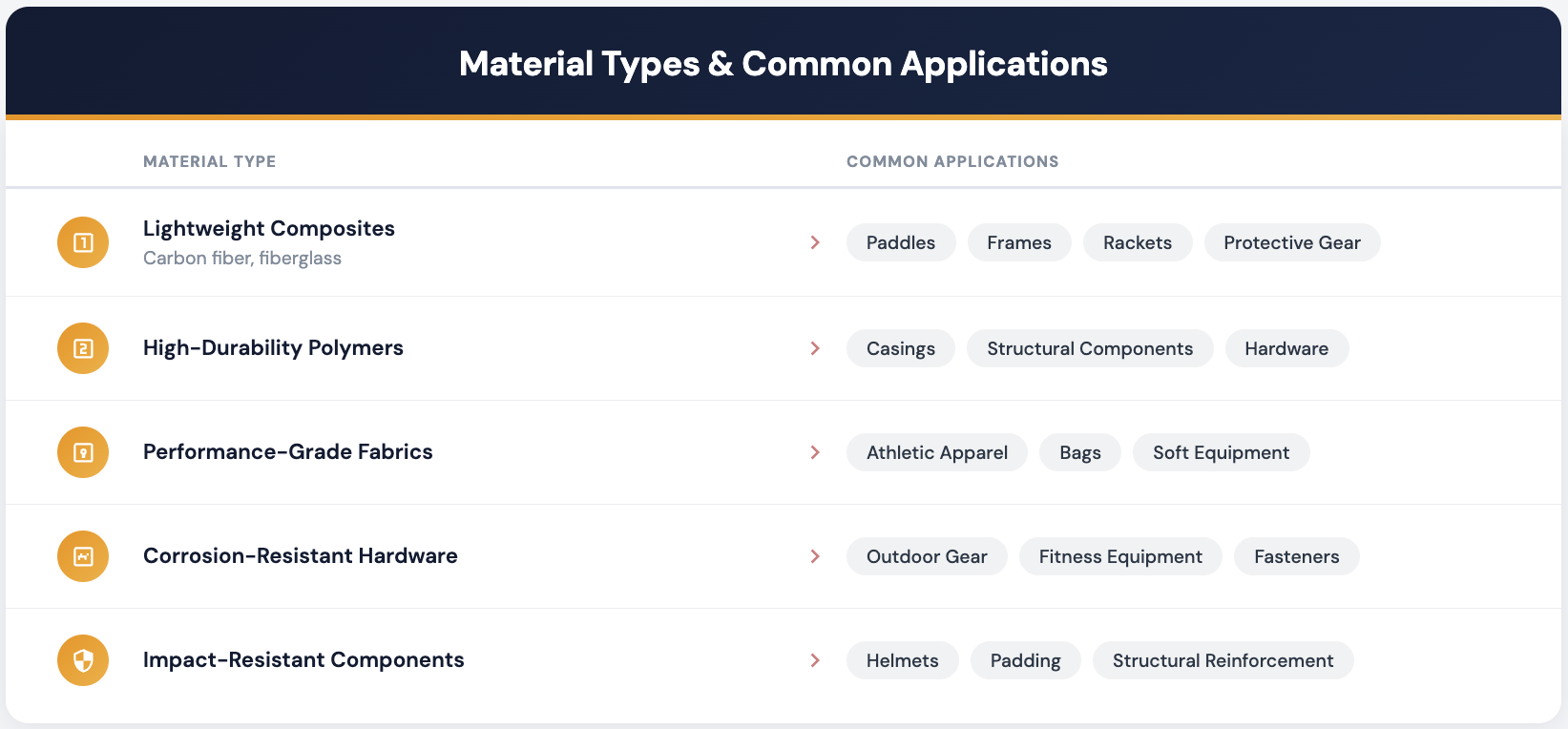

Material decisions made at the prototype stage sometimes perform differently at production volume.

Validating that cost and performance hold at scale, not just in a sample run, is a necessary step before full production commitment. For brands dealing with margin pressure on existing products, Linton’s manufacturing cost reduction program frequently identifies material optimization as the clearest path to meaningful COGS improvement.

Prototyping and Performance Testing

Prototyping in sports equipment manufacturing exists to resolve materials and design issues before tooling and factory investment are made. The process typically moves through three stages:

  • Functional models that test structural and performance behavior under simulated conditions
  • Field-test samples that validate the product under real athletic use
  • Engineering samples that confirm manufacturing accuracy against design specifications

Skipping or compressing this process is one of the most consistent causes of post-launch product failures in the sports category. Problems that surface in prototype testing cost a fraction of what they cost in a production run, or worse, in a field failure after retail launch.

Factory Sourcing and Vetting for Sports Equipment

Finding a factory that can quote a sports product is not the same as finding one qualified to produce it reliably at scale. Professional factory evaluation for sports equipment looks at:

  • Category-specific manufacturing experience, since athletic accessories, gym equipment, outdoor gear, and paddles are different production environments
  • Materials processing capability for the exact materials the product requires
  • Production capacity at target volumes, including peak-season flexibility
  • QC infrastructure and in-line inspection processes
  • Communication reliability throughout the production relationship

Online platform sourcing provides limited visibility into most of these factors. Linton’s sports product development program draws on a network of 700-plus vetted factories, each assessed against the specific production requirements of performance athletic gear rather than price per unit alone.

Establishing a Golden Sample and Production Standard

Once a pre-production sample is approved, it becomes the golden sample: the professional production benchmark that all subsequent QC inspections are measured against.

The golden sample defines objective expectations for materials, construction tolerances, finish quality, and agreed performance specifications. It protects both the brand and the factory by making quality standards objective and enforceable rather than dependent on verbal agreements.

Linton’s in-house QC team follows ANSI/ASQ Z1.4 2018 and uses the approved golden sample as the benchmark for every production run, creating consistent, repeatable output as order volumes grow.

Quality Control Throughout Production

Quality control in sports equipment manufacturing must be embedded across the production process, not applied only at the end. A complete QC system for athletic gear covers:

  • Incoming material verification — confirms materials meet specifications before production begins
  • First-article inspection — evaluates initial production output before the full run proceeds
  • In-line inspections — monitors assembly accuracy and finish quality during the active run
  • Final pre-shipment audit — samples finished goods against the approved golden sample before shipment is approved

Defect risk in performance sports products is especially costly. A product that fails during athletic use generates warranty claims, negative reviews, and brand damage that compounds over time. Linton’s QC model is in-house, which means the team managing quality has ongoing factory relationships, full production visibility, and accountability tied to the brand’s outcomes across every run. If your current production lacks this level of oversight, schedule a consultation to understand what a complete QC system looks like in practice.

Managing Production Costs Without Sacrificing Performance

Cost reduction in sports equipment manufacturing is a precision exercise, not a concession. The goal is to lower the cost of goods while maintaining or improving the product performance that defines the brand. Sustainable cost improvements typically come from:

  • Material selection optimization at production volume
  • Tooling efficiencies identified through manufacturing feasibility review
  • Process refinement that reduces assembly time and defect rate
  • Volume-based negotiation with vetted factory partners

Linton’s work with CRBN Pickleball demonstrates this in practice. By transitioning suppliers and reinforcing the product’s internal construction, Linton reduced COGS by 19.67% while improving durability, allowing CRBN to scale a top-rated Amazon SKU without compromising its premium positioning. Read the full story and other case studies on Linton’s website, or learn more about how the manufacturing cost reduction program is structured.

Logistics, Compliance, and Shipping for Sports Equipment

Logistics planning for sports equipment brands must begin during manufacturing, not after production is complete. The decisions that affect landed cost and import clearance include:

  • Certifications required for target retail channels and export markets
  • Packaging dimensions, carton specs, and FBA compliance requirements
  • Customs documentation and HTS classification
  • Shipping method selection based on delivery timelines and cost targets

Early logistics coordination protects margins, prevents import delays, and allows brands to scale inventory reliably into retail and FBA channels.

Common Mistakes Sports Brands Make in Manufacturing

Most sports equipment manufacturing problems stem from fragmented oversight, not any single bad decision. The pattern that appears most consistently:

  • Factory selection driven by unit price without category-specific vetting
  • Materials under-specified at the design stage, producing performance gaps at production volume
  • Structured performance testing replaced by informal review
  • QC managed as a final-stage checkpoint rather than a continuous embedded system

Each of these creates cost on its own. When they occur together, the resulting production issues tend to compound as volume increases, and what started as a margin question becomes a brand quality question.

How Linton Supports Sports Equipment Manufacturing

Linton manages the full sports equipment manufacturing lifecycle as one integrated system, from design feasibility through factory sourcing, production management, in-house QC, compliance, and logistics. As a full lifecycle partner rather than a transactional vendor, Linton integrates design, engineering, sourcing, manufacturing, and QC into a single system, ensuring performance, cost control, and scalability are aligned from the start.

With 700-plus vetted factories, four overseas offices with in-house QC teams following ANSI/ASQ Z1.4 2018, and production experience across 200-plus product categories including pickleball, outdoor fitness, and athletic accessories, Linton gives sports brands the manufacturing infrastructure of an enterprise operation without requiring internal teams to manage it.

Whether you are bringing a new product to market through product design and development, optimizing costs on an existing product through manufacturing cost reduction, or looking for a partner with category-specific experience in sports product development, every engagement is built around cost control, product performance, and repeatable production success.

When to Work With a Manufacturing Partner

The right moment to engage a manufacturing partner is before factory commitments are made, not after quality issues or margin pressure create urgency. Sports equipment manufacturing decisions made at the design and factory selection stage determine product quality and production cost for years.

If your sports equipment brand is preparing to move into production, or is already producing and dealing with margin or quality gaps, the best next step is a direct conversation. Schedule a consultation to get a clear-eyed look at where your current process stands and what the path forward looks like.


 

What Is Quality Control in Manufacturing?

Key Takeaways

  • Quality control is a structured, ongoing system that verifies every production run meets agreed-upon product specifications across materials, tolerances, finish quality, and functionality
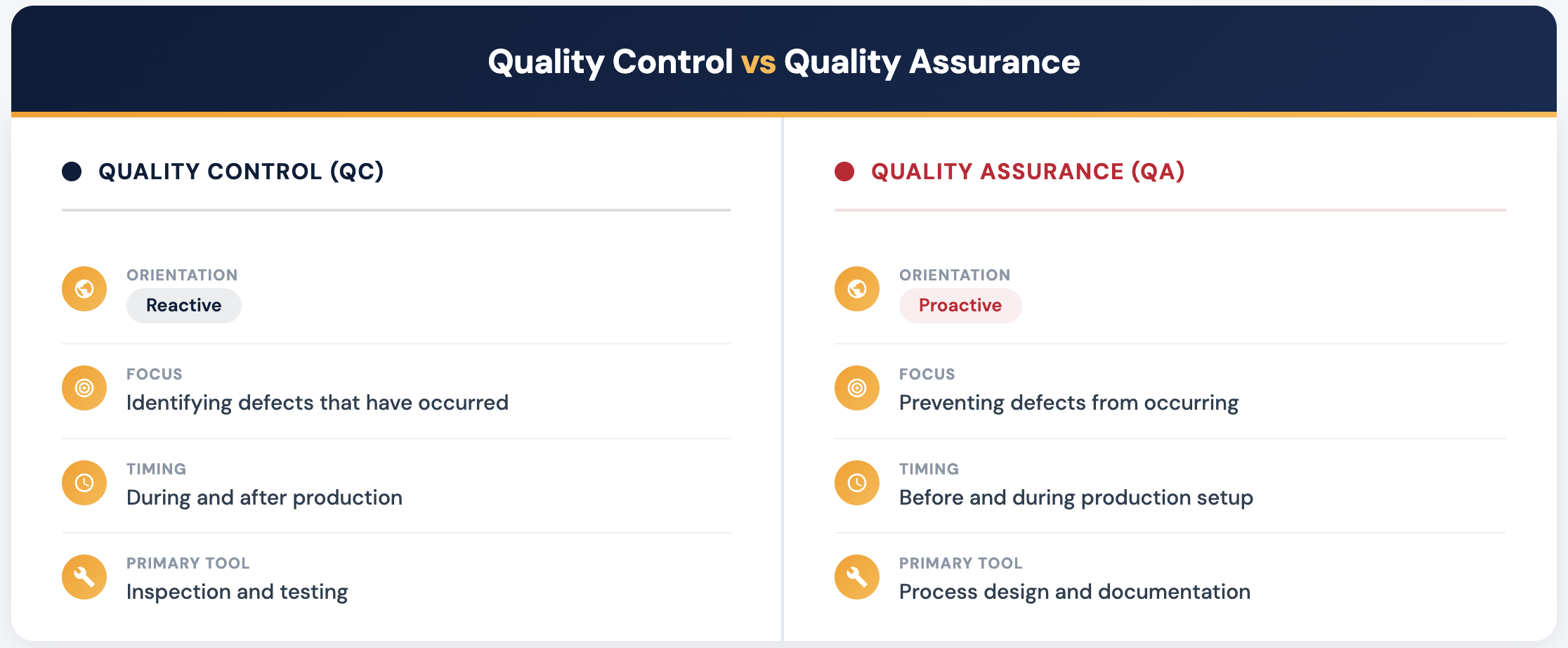
  • Quality control and quality assurance are different: QC catches defects that have occurred; QA prevents them from occurring
  • The golden sample defines the objective production benchmark that every QC inspection is measured against
  • AQL (Acceptable Quality Limit) statistical sampling sets standardized, defensible thresholds for defect rates at production volume
  • In-house QC and outsourced QC are not equivalent, and ongoing factory relationships with embedded oversight produce fundamentally different outcomes
  • Quality failures are rarely one-time events; they are symptoms of a fragmented process
  • Catching a defect in the factory costs a fraction of what it costs when it reaches a customer

Quality control in manufacturing is the structured process of verifying that production output conforms to agreed-upon specifications across raw materials, tolerances, finish quality, and functionality at every stage of the production run. It is not a single inspection before a shipment leaves the factory. It is a layered system embedded throughout production, with defined checkpoints, standardized benchmarks, and documented results that create real accountability at the factory level.

For consumer product brands, how that system is structured has a direct effect on product quality, customer satisfaction, and long-term margin. This guide explains what quality control is, how it works in practice at each production stage, how it differs from quality assurance, and why the structure of a QC program determines whether quality holds as volume scales or quietly degrades under the pressure of it.


Schedule a Consultation

Quality Control vs. Quality Assurance: What Is the Difference?
Quality control and quality assurance are often used as interchangeable terms. They are not.

Both are necessary in a complete quality system. QA defines the standards production must meet, including the processes and documentation that establish what acceptable looks like before manufacturing begins. QC verifies whether production is actually meeting those standards, run by run.

Brands that rely solely on final-stage inspection are absorbing the full cost of a production run before any defects are identified. A QA-plus-QC system catches the most expensive failures before that cost is committed to a non-conforming run.

Why Quality Control Matters for Consumer Product Brands

Quality control is a financial issue before it is an operational one.

Catching a defective component or assembly error at the factory may cost a few dollars in rework or replacement. The same defect identified in a customer’s hands costs return shipping, a replacement unit, a negative review, and potential removal from retail or FBA availability. At scale, the difference between embedded QC and reactive defect management compounds quickly into a material COGS difference.

Consistent quality control directly affects Amazon review scores, return rates, repeat purchase rates, and long-term brand reputation. None of those recover quickly once they start sliding. Quality failures are rarely isolated incidents. They are symptoms of a process that lacks standardization, continuous oversight, or both. The pattern repeats because the conditions that produced the first failure have not been changed. Brands looking to understand where their process is breaking down often start by reviewing Linton’s case studies to see how quality and cost issues have been resolved across real production engagements.

What Quality Control in Manufacturing Actually Looks Like

A professional QC program for consumer product manufacturing includes four structured stages, each targeting a different category of risk at a different point in production:

  • Pre-production checks: Incoming raw materials and components are verified against specifications before the production run begins, catching non-conformances before they become defects in the finished product
  • First-article inspection: Initial production output is evaluated before the full run is approved, confirming that tooling accuracy and process conformance meet the agreed production standard
  • In-line production inspections: Ongoing checks during the active run monitor assembly accuracy, finish quality, and materials conformance as production progresses, catching deviations before they affect large quantities
  • Final pre-shipment audit: Finished goods are sampled against the approved golden sample using a standardized protocol before shipment is approved

This layered approach is what separates a QC program that actually protects margins from one that only creates the appearance of oversight. The cost of catching a defect decreases at every earlier stage it is identified, which is why professional quality control is designed to front-load that detection rather than compress everything into a final review after production cost is already spent.

The Role of the Golden Sample in Quality Control

The golden sample is the shared, quantifiable production standard that makes quality control objective and enforceable. It defines agreed-upon expectations for tooling accuracy, material consistency, tolerances, finish quality, and assembly standards between the brand and the factory. Instead of relying on informal expectations or verbal agreements about what acceptable means, every QC inspection is measured against a documented, approved physical reference. This removes subjectivity from quality judgments and replaces it with a standard both parties have agreed to uphold, which is what makes consistent output across production runs achievable.

Linton follows ANSI/ASQ Z1.4 2018 and uses the approved golden sample as the benchmark for all inspections across every production run. This is built into every engagement, whether a brand is entering production for the first time through product design and development or optimizing an existing product through manufacturing cost reduction.

Common Quality Control Methods in Manufacturing

Several structured approaches are used in consumer product manufacturing. Each addresses different types of production risk, and a complete QC program typically draws on more than one.

  • AQL (Acceptable Quality Limit) sampling: A statistical framework that defines the maximum acceptable defect rate for a production run and calculates the sample size required to validate it. Rather than inspecting every unit, AQL sampling provides statistically defensible confidence in product quality at high volume. It is the most widely used framework in global consumer product manufacturing.
  • First-article inspection: Verifies that initial production output conforms to design specifications before the full run proceeds
  • In-line inspection: Monitors production during the active run, identifying process deviations before they compound into widespread defects
  • Final pre-shipment audit: Assesses finished goods against the approved golden sample before they leave the factory

The right combination depends on product complexity, production volume, and the defect risk profile of the specific category. Effective QC is not about applying every available method. It is about applying the right ones for the product and the production environment.

In-House vs. Outsourced Quality Control

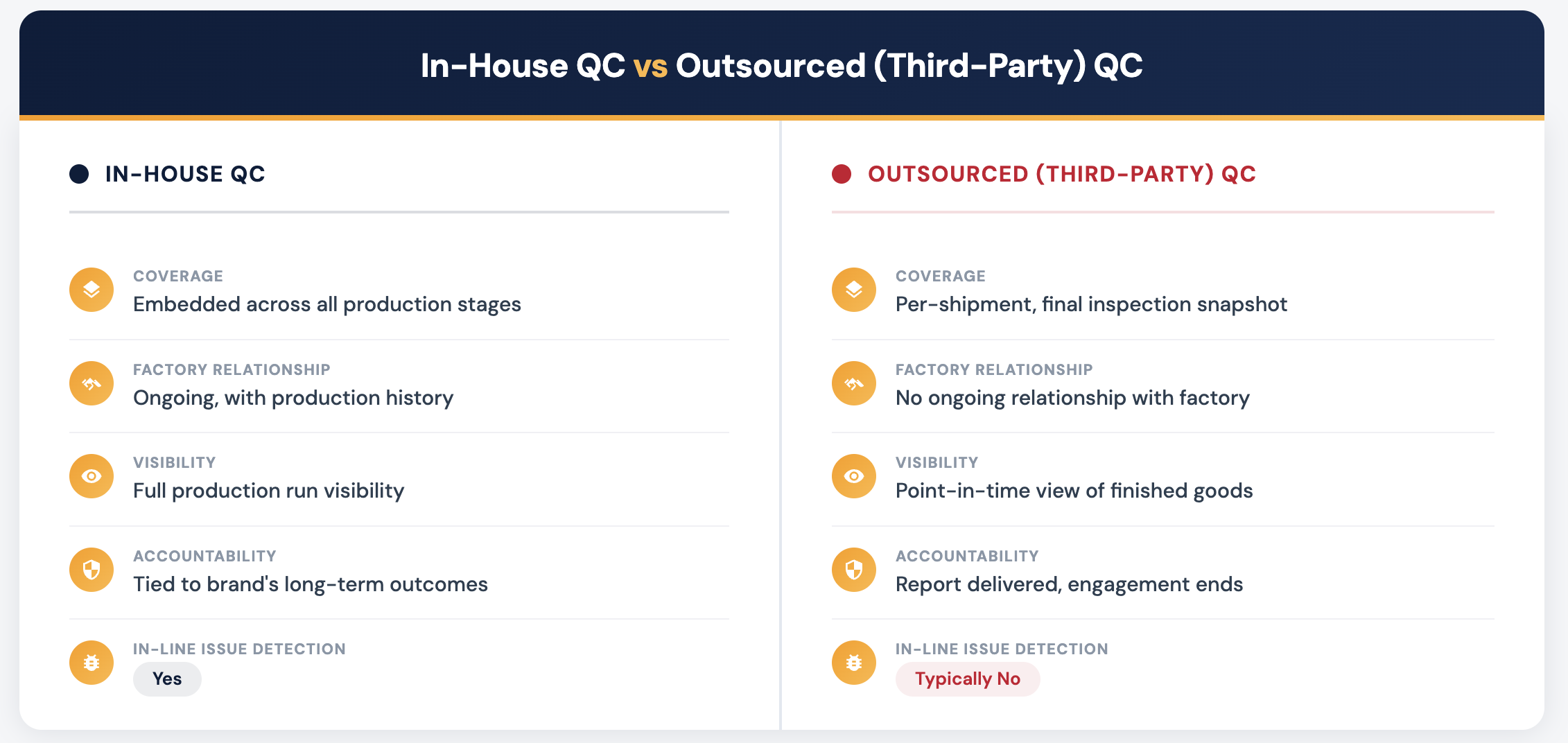
Not all quality control is structured the same way, and the distinction between in-house and outsourced QC has real consequences for brands managing production at volume.


Outsourced inspection is better than no inspection, but it has structural limitations. A third-party inspector arrives at the factory, conducts a defined protocol, and issues a report with no visibility into in-line production and no ongoing stake in the brand’s outcomes.

In-house QC teams embedded in an ongoing manufacturing relationship operate entirely differently. They have production history, established standards, and accountability tied to the brand’s results across every run. Linton’s QC team is in-house, follows ANSI/ASQ Z1.4 2018, and covers every stage of production rather than just final shipment. You can see how this plays out across real engagements in Linton’s case studies.

The Cost of Poor Quality Control

The real cost of inadequate QC extends well beyond the defective units themselves. Brands managing production without an embedded system regularly absorb costs across multiple categories:

  • Returns, replacements, and the negative reviews that follow
  • Rework costs at the factory, when recovery is even possible
  • Import rejections that create landed-cost exposure and disrupt inventory planning
  • FBA non-compliance penalties for inconsistent product quality
  • Long-term brand damage that compounds with every repeat failure

The consistent root cause is a QC process that is reactive, outsourced, or limited to a final checkpoint rather than embedded throughout production. Proactive quality control costs less than managing the consequences of not having it, and the margin difference tends to grow as volume increases. Brands dealing with these symptoms often find that Linton’s manufacturing cost reduction program addresses both the cost gaps and the quality system gaps driving them.

How Linton Manages Quality Control Across Manufacturing

Linton’s in-house QC team manages quality across every stage of the production relationship, from pre-production material checks through final pre-shipment audits, following ANSI/ASQ Z1.4 2018.

The approved golden sample serves as the benchmark for all inspections, ensuring production standards are objective, consistent, and enforceable across every run. When deviations occur, they are addressed within the ongoing factory relationship rather than escalated to a third party after goods have already shipped. Linton’s QC is not a separate service layer; it is integrated into every manufacturing engagement, whether that begins with product design and development for a new product or with a cost and quality audit on an existing one.

That means brands working with Linton get enterprise-level production oversight without building an internal team to manage it.

When Quality Control Becomes a Strategic Priority

Brands typically treat quality control as a strategic issue once one of three things happens: defect rates rise noticeably, a production issue reaches a customer, or order volume increases to the point where informal processes can no longer absorb variation.

The more productive question is what a QC system should look like before those situations develop. Who manages it, at what stages, against what standard, and with what accountability built in are the decisions that determine whether product quality holds as volume scales or erodes under the pressure of it.

If your brand is managing manufacturing without an embedded, standardized quality control system, the risk is not hypothetical. It is the gap between the production you are assuming and the production you are actually receiving. Schedule a consultation to talk through where your current process stands and what a more structured approach would look like.


Ready to bring your product to market — or reduce your manufacturing costs? Linton Group provides end-to-end product design & development and manufacturing cost reduction services for consumer brands. Let’s talk.