Key Takeaways
- Private label enables fast launches but limits long-term brand control
- Contract manufacturing supports brand-owned products and scalable execution
- Many brands outgrow private labeling as margins tighten and competition increases
- Early model choices directly affect product quality, pricing power, and growth
- The right approach depends on brand maturity, volume, and long-term goals
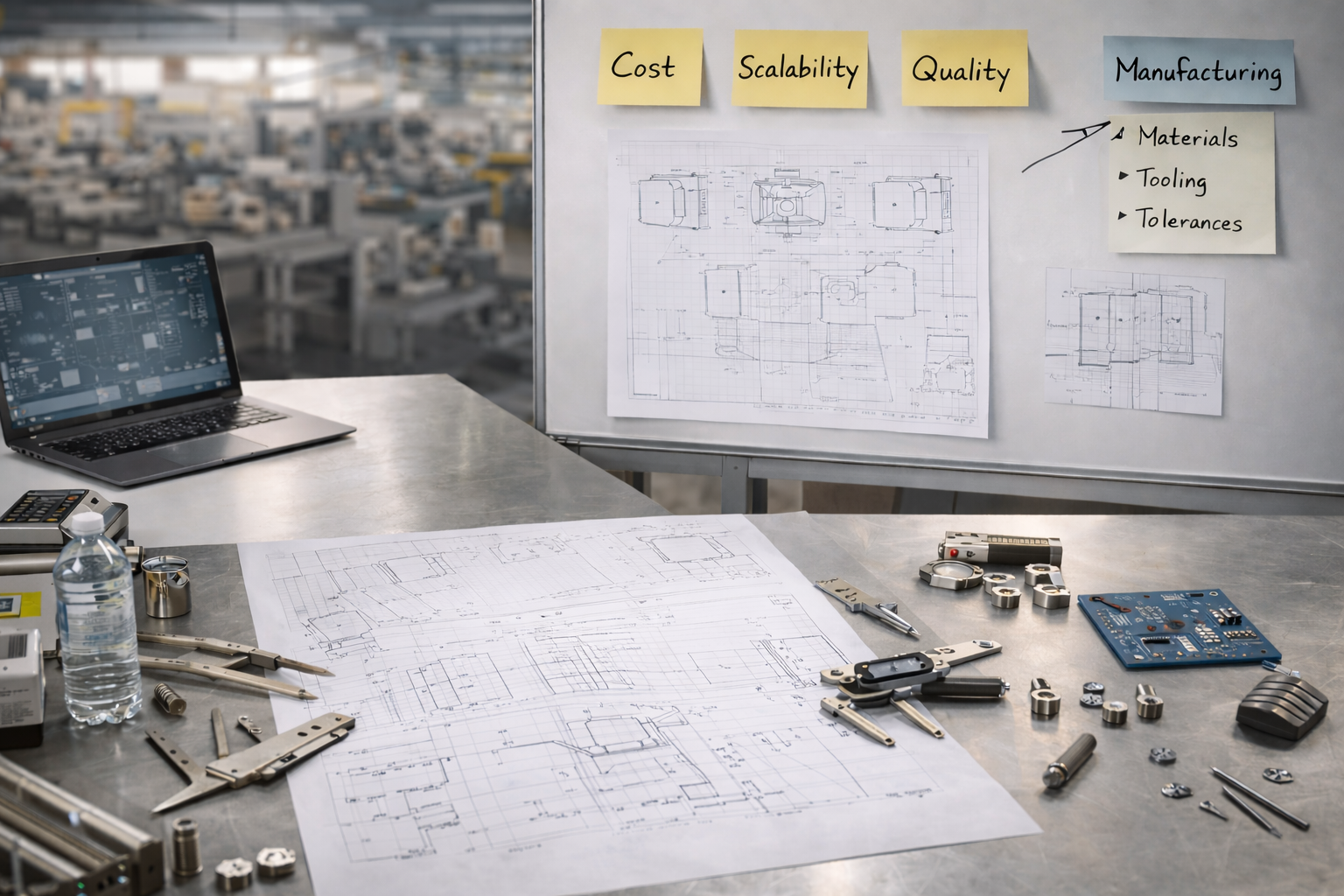
Choosing between contract manufacturing and private label is a long-term brand decision, not just a production choice. Private label can enable fast launches and early validation, while contract manufacturing requires more upfront planning, but these models lead to very different outcomes as brands scale.
This guide explains when private label works, and when it stops working, so consumer brands can choose an approach that supports sustainable growth. Here, contract manufacturing refers to brand-owned product production supported by vetted factories, manufacturing-integrated oversight, in-house quality control, and logistics coordination, not transactional, hands-off factory relationships.
Why Manufacturing Model Choice Impacts Brand Growth
The model a brand chooses shapes far more than how products are produced.
It determines how much control a brand has over product design, packaging, branding, pricing, and quality standards. Early “easy” decisions can quietly cap long-term growth by limiting differentiation and margin flexibility.
As brands scale, production decisions become a strategic inflection point. The right model enables consistency, leverage, and control. The wrong one can lock brands into shrinking margins, uneven quality, and increased exposure to competitors.
What Is Private Label Manufacturing?
Private label allows a brand to sell products based on pre-existing designs produced by a third-party supplier and sold under the brand’s name.
This approach is often used because it enables:
- Faster time to market
- Lower upfront development costs
- Simplified production setup
In most cases, private labeling includes branding, packaging, and labeling customization, but the underlying product design and specifications are shared, limiting long-term differentiation and control. This can be effective for testing demand or launching a limited product offering quickly.
Where Private Label Starts to Break Down
As brands grow, private labels often introduce structural constraints.
Because products are not truly owned, brands may face:
- Limited differentiation from competitors selling similar items
- Margin pressure as pricing becomes harder to defend
- Inconsistent quality across production runs
- Reduced control over materials and specifications
Over time, these challenges make it harder to protect brand identity and maintain consistent quality. What once felt efficient can become a bottleneck to growth.
What Is Contract Manufacturing?
Contract manufacturing enables brands to produce products they fully own while working with specialized partners to execute production.
Unlike private label, this approach allows brand owners to control:
- Product design and specifications
- Materials and components
- Quality standards and inspections
- Production workflows and timelines
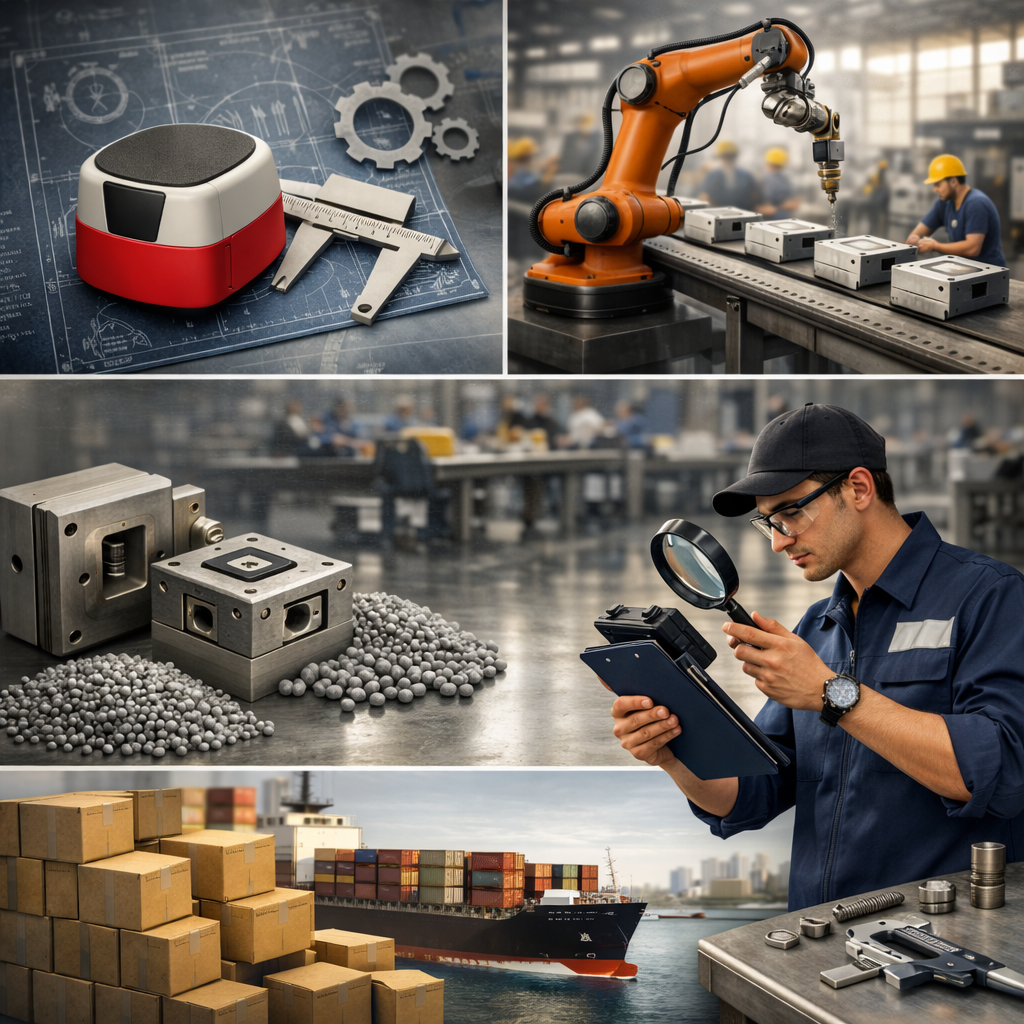
In Linton’s model, contract manufacturing is not a hands-off arrangement. It includes design finalization, engineering feasibility, factory vetting, in-house quality control, and active production management. While this requires more upfront coordination, it creates long-term stability and leverage.
Contract Manufacturing vs Private Label: Key Differences
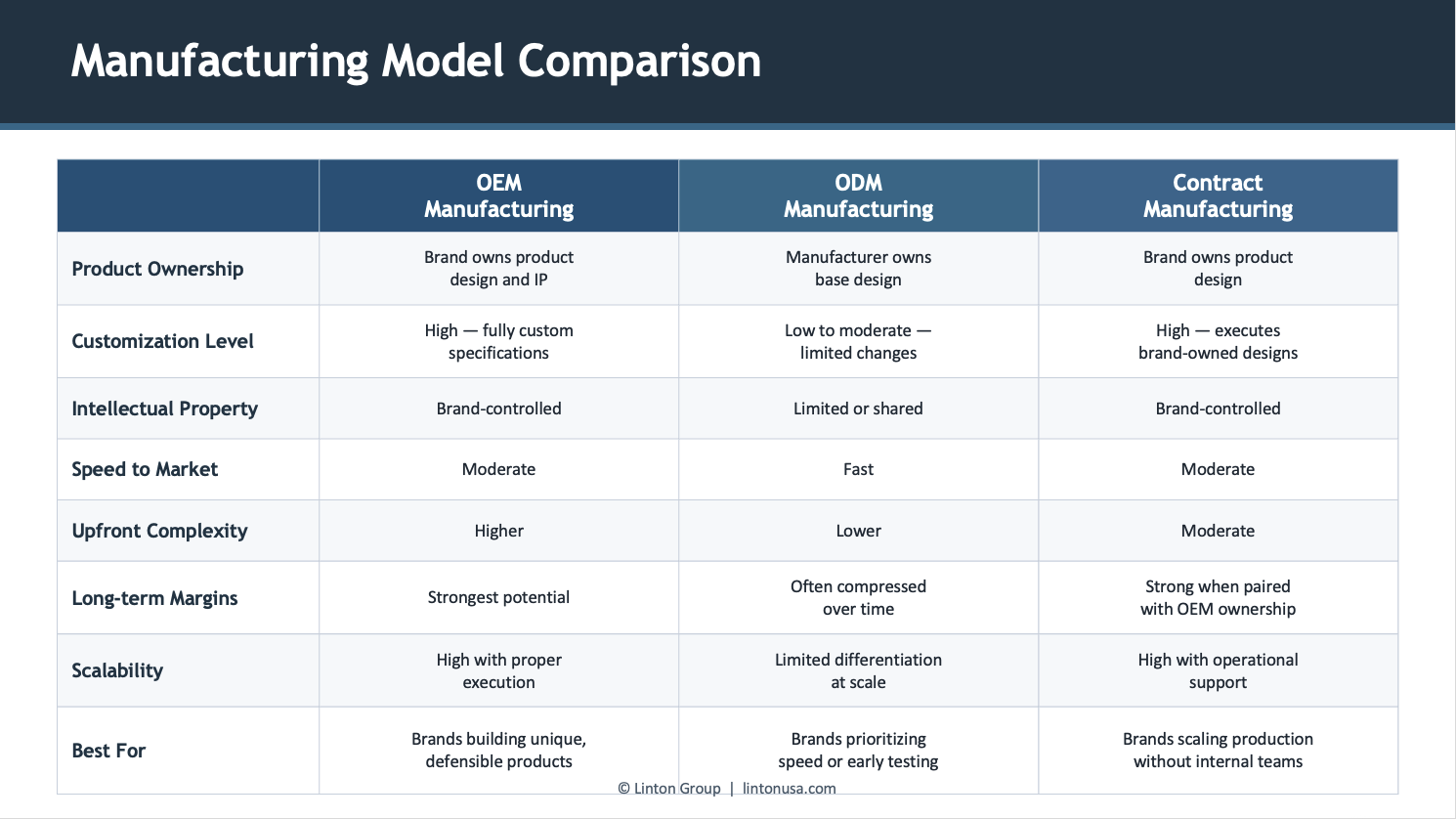
The table below compares private label and contract manufacturing across the factors that matter most to growing brands.
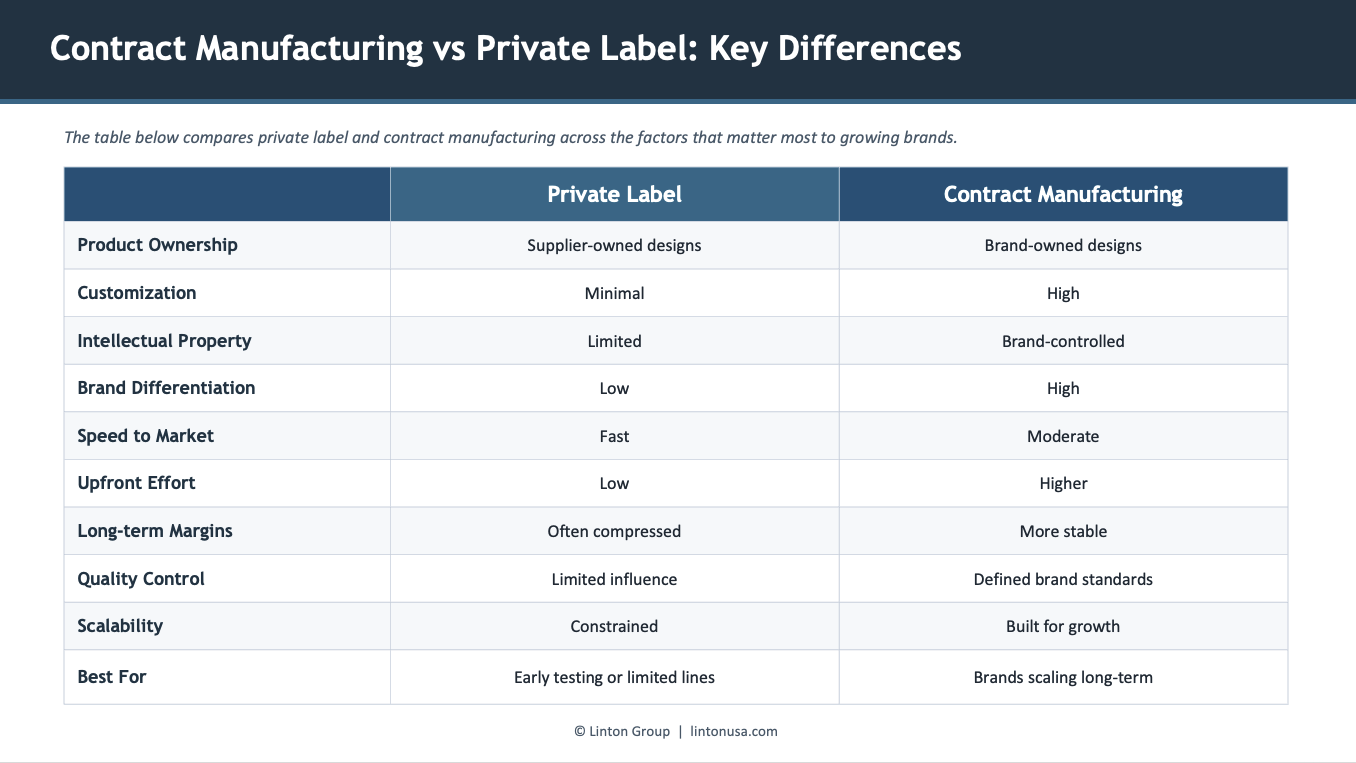
The right choice depends less on convenience and more on how well the model supports differentiation, margin stability, and repeatable execution over time.
When Private Label Makes Sense
Private label can be a reasonable short-term strategy in specific scenarios.
It often works best when brands are:
- Testing a new product idea or category
- Launching a limited product line
- Validating demand before investing in custom development
For early validation, this approach can reduce risk and speed up launch timelines. However, it is rarely suited for brands pursuing long-term differentiation or category leadership.
When Brands Outgrow Private Label
Most successful consumer brands eventually outgrow private label.
Common signals include:
- Margin pressure despite increasing volume
- Quality variability across suppliers
- Difficulty standing out in crowded categories
- Limited control over product specifications
Outgrowing private label is not a failure, it’s a natural evolution as brands mature, expand product lines, and demand greater control over outcomes.
How Contract Manufacturing Supports Long-Term Brand Control
Contract manufacturing enables original product development and long-term brand ownership.
By controlling design, materials, quality standards, and production processes, brands can:
- Standardize quality across runs
- Reduce defect risk as volume increases
- Protect intellectual property
- Maintain pricing power
This level of control supports consistent execution as brands scale.
How Linton Helps Brands Transition Beyond Private Label
Linton helps consumer brands move beyond private label by managing the transition to brand-owned, managed contract manufacturing.
Their approach integrates:
- Product design and engineering feasibility
- Factory and partner vetting
- In-house quality control
- Active production management and logistics
Rather than acting as a factory broker, Linton operates as a long-term manufacturing partner — responsible for execution, cost control, and repeatable success.
Choosing the Right Manufacturing Model for Your Brand
The right model depends on your brand’s goals, volume, differentiation needs, and internal resources.
What works early may not support long-term growth. Evaluating contract manufacturing vs private label objectively, with experienced guidance, helps brands avoid costly pivots and choose an approach that scales with them.
Ready to Choose the Right Manufacturing Model?
If you’re deciding between private label and contract manufacturing, the choices you make now will shape your margins, product quality, and brand strength for years to come.
Ready to bring your product to market — or reduce your manufacturing costs? Linton Group provides end-to-end product design & development and manufacturing cost reduction services for consumer brands. Let’s talk.
Reviewed by the Linton Team
Linton is an end-to-end product development and manufacturing partner with 1,200+ projects delivered across 200+ product categories. Our team helps consumer brands design, source, and manufacture products through a network of 700+ vetted factories.