


OEM vs. ODM vs. Contract Manufacturing: Which Model Fits Consumer Product Brands?
Key Takeaways
- Choosing the wrong manufacturing model can limit control and compress margins
- OEM, ODM, and contract manufacturing differ most in ownership, customization, and scalability
- Speed-focused decisions often create long-term product and margin risk
- Switching manufacturing models later is expensive and disruptive
- The best model depends on volume, complexity, and growth goals
Once a brand moves from product development into production, choosing a manufacturing model becomes a critical strategic decision. OEM, ODM, and contract manufacturing are often treated as definitions, but they function as fundamentally different execution models that shape product ownership, margins, quality control, and scalability.
This article breaks down OEM vs. ODM vs. contract manufacturing for brand-owned consumer products (not catalog-based private label or transactional sourcing) and explains how each model impacts control, risk, and long-term growth, before those decisions become expensive to reverse.
Why Choosing the Right Manufacturing Model Matters
Your manufacturing model determines far more than where your product is made.
It affects who owns the design, who controls specifications, how quality is enforced, and how easily production can scale. Brands that choose a model based on speed or upfront cost alone often face hidden tradeoffs later, including margin pressure, inconsistent quality, and weakened differentiation.
The wrong manufacturing model can lock brands into:
- Limited product and specification control
- Weak intellectual property protection
- Compressed margins as competitors sell similar products
- Costly pivots once production workflows are established
These risks compound as production volume grows, making early decisions foundational to long-term success.
What Is OEM Manufacturing?
OEM (Original Equipment Manufacturing) allows brands to manufacture products they fully own, using custom designs, specifications, and materials while leveraging specialized manufacturers for production.
Under the OEM model, the brand owns the product design and intellectual property. The manufacturer produces the product according to the brand’s specifications but does not own the design itself.
OEM manufacturing is typically used when brands:
- Want to build a unique, defensible product
- Require full control over materials, specifications, and product quality
- Are planning long-term growth with repeat production
Because OEM products are built from the ground up, successful execution depends on early alignment between design, engineering, sourcing, manufacturing feasibility, and quality control.
OEM offers the highest level of ownership and customization, but it also requires more upfront coordination around engineering, tooling, quality control, and production management.
Linton enables OEM-style ownership by managing engineering feasibility, factory execution, in-house quality control, and global logistics, without requiring brands to build internal manufacturing teams.
What Is ODM Manufacturing?
ODM (Original Design Manufacturing) involves selecting from a manufacturer’s pre-existing product designs and making limited modifications before branding and selling the product.
In this model, the manufacturer typically owns the base design. Brands may customize surface-level elements such as branding, colors, or minor features, but the underlying product is not exclusive. ODM can be appropriate for short-term validation or low-risk testing, but it is rarely a sustainable foundation for brands seeking long-term differentiation, defensibility, and margin control.
ODM manufacturing is often chosen when brands:
- Want to move quickly to market
- Are testing a new product category
- Want to minimize upfront development effort
While ODM can reduce development time, it introduces long-term tradeoffs. Limited differentiation, weaker intellectual property ownership, and exposure to copycat competition often lead to margin compression and commoditization as more brands sell similar products.
What Is Contract Manufacturing?
Contract manufacturing focuses on how production is executed, rather than who owns the product design.
In this model, brands own the product design and specifications, while a contract manufacturing partner manages tooling and factory execution, with quality control and logistics oversight structured to protect brand standards at scale. Contract manufacturing is commonly used once designs are finalized and production volume is established.
Rather than competing with OEM or ODM, contract manufacturing often acts as the execution layer that enables those models to scale.
For many growing brands, contract manufacturing provides OEM-style ownership without requiring:
- Internal manufacturing teams
- Overseas offices
- Direct factory management
This allows brands to maintain control while scaling production efficiently.
OEM vs. ODM vs. Contract Manufacturing: Key Differences
To make the differences clearer, the table below compares OEM, ODM, and contract manufacturing across the factors that most directly impact control, cost, and scalability.
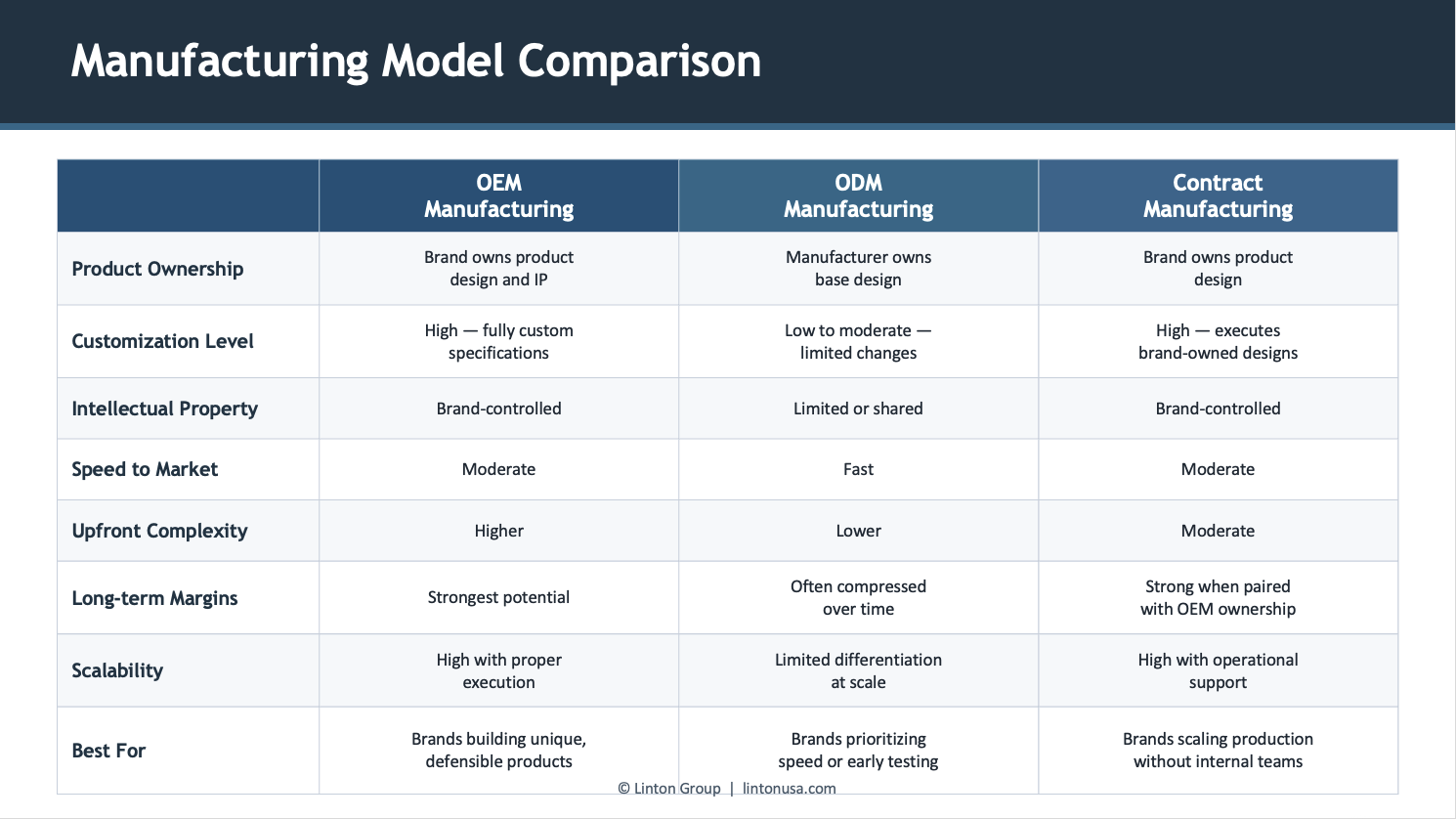
Important: These models are not mutually exclusive. Many successful brands combine OEM ownership with contract manufacturing execution to preserve control while scaling efficiently.
Which Manufacturing Model Is Best for Consumer Product Brands?
There is no universal “best” manufacturing model.
The right choice depends on product category, production volume, customization needs, and long-term growth goals. Brands planning repeat production and long-term differentiation often prioritize models that preserve ownership and control, even if they require more upfront coordination.
OEM-style ownership is typically favored by brands protecting intellectual property and planning to scale. ODM may work for early market testing, but it often limits defensibility as competition increases.
Common Mistakes Brands Make When Choosing a Manufacturing Model
Many brands choose manufacturing models based on short-term convenience without fully understanding the long-term implications.
Common mistakes include:
- Confusing ODM speed with sustainable product ownership
- Underestimating how quickly ODM products become commoditized
- Choosing manufacturers based on price alone
- Assuming switching models later will be easy
Once tooling, suppliers, and production workflows are in place, changing manufacturing models often requires expensive redesigns and operational disruption.
How Linton Helps Brands Choose and Execute the Right Manufacturing Model
Linton helps consumer product brands evaluate OEM, ODM, and contract manufacturing models through a manufacturing-integrated approach that prioritizes ownership, feasibility, and scalability from the start.
Rather than treating design, engineering, sourcing, manufacturing, quality control, and logistics as separate steps, Linton evaluates them together as one system. This allows brands to choose the right model, then execute it reliably at scale.
Linton is not a factory broker or a design-only firm. They manage the full production system, aligning decisions across every stage to reduce risk, control costs, and support repeatable success.
When to Work With a Manufacturing Partner
Brands typically need expert manufacturing guidance when:
- Production volume begins to scale
- Margins come under pressure
- Quality issues emerge
- Internal teams reach operational limitsAt this stage, manufacturing becomes a strategic growth function, not a tactical sourcing task. A manufacturing partner acts as an extension of the brand’s operations — protecting product quality, margins, and long-term success.
Ready to Choose the Right Manufacturing Model?
If you’re evaluating OEM vs. ODM vs. contract manufacturing, the decisions you make now will shape your product’s success for years to come.
Ready to bring your product to market — or reduce your manufacturing costs? Linton Group provides end-to-end product design & development and manufacturing cost reduction services for consumer brands. Let’s talk.
Reviewed by the Linton Team
Linton is an end-to-end product development and manufacturing partner with 1,200+ projects delivered across 200+ product categories. Our team helps consumer brands design, source, and manufacture products through a network of 700+ vetted factories.
Wondering if your product could be built better, faster, or at a lower cost?
Related Posts

Toy tooling is the most irreversible decision in your product’s cost structure Most brands evaluate toy manufacturing partners on unit price. That is the wrong anchor. By the time unit price matters, the tooling decision has already locked in the majority of the product’s long-term margin structure, and most of that decision is irreversible. Toy […]
Read More
Key Takeaways Electronics prototype development is not complete when a product works. It is complete when the design can be produced consistently, within cost targets, at commercial volume. Electrical, mechanical, and firmware decisions made during prototyping directly determine tooling complexity, unit cost, and production repeatability. Design for manufacturability analysis must happen before tooling commitments are […]
Read More
Key Takeaways Toy manufacturing combines engineering, compliance, and quality control, and each requires active oversight, not assumptions A creative concept and a manufacturing-ready design are not the same thing Tooling is one of the largest upfront capital commitments in toy production, making design accuracy critical before it begins Safety compliance (ASTM F963, CPSC, EN71) must […]
Read More