


Electronics Prototype Development: From First Sample to Manufacturing-Ready Design

Key Takeaways
- Electronics prototype development is not complete when a product works. It is complete when the design can be produced consistently, within cost targets, at commercial volume.
- Electrical, mechanical, and firmware decisions made during prototyping directly determine tooling complexity, unit cost, and production repeatability.
- Design for manufacturability analysis must happen before tooling commitments are made, not after.
- Regulatory compliance requirements including FCC, CE, and RoHS must be integrated into the prototype phase, not managed as a post-production checklist.
- A finalized golden sample serves as the shared production standard for every manufacturing run that follows.
- Most electronics prototype failures trace back to treating electrical and mechanical engineering as separate phases rather than one integrated system.
A working electronic prototype and a manufacturing-ready design are not the same thing. The gap between them is where most electronics product development cost gets generated.
Electronics prototype development is the phase that determines whether a product concept can be produced profitably at commercial scale. Decisions made here affect tooling complexity, component sourcing viability, unit economics, and regulatory feasibility. Reversing those decisions after tooling or supplier commitments are locked in carries a cost most brands significantly underestimate until they are in the middle of it.
This guide is written for founders, brand owners, and product leaders who have an electronic product concept or an early sample and need to understand what a credible, manufacturing-ready development process actually requires. Linton has delivered 1,200+ product development projects across 200+ product categories, including electronics products that combine mechanical housings, printed circuit boards, and firmware systems.
Explore Electronics Manufacturing
What Electronics Prototype Development Actually Requires
Electronics prototype development is the structured process of converting a product concept into a design that can be produced consistently at commercial volume within the cost and quality parameters required for a viable electronic product. A proof-of-concept prototype validates that a product idea works. A manufacturing-ready prototype validates that it can be produced at scale.
The distinction matters because electronics prototyping carries complexity that most physical product categories do not. A single consumer electronic device integrates at least three engineering domains: the printed circuit board and firmware, the mechanical housing and assembly, and the interface between them. Each domain carries its own design requirements, sourcing dependencies, and manufacturing constraints. When those domains are treated as separate phases rather than one concurrent system, integration problems surface late, which is when they are most expensive to fix.
What separates a prototyping process that produces commercially viable designs from one that generates expensive revision cycles is how early manufacturing constraints are integrated into design decisions.
Why Most Electronics Prototypes Are Not Ready for Production
The most common failure pattern in electronics prototype development is treating the process as sequential: design the electronic product, then figure out manufacturing. That sequence produces consistent and predictable problems:
- Component sourcing gaps. Electronic components selected for prototype performance frequently have long lead times, high minimum order quantities, or constrained commercial availability at production volumes.
- PCB conflicts. PCB assembly processes that work in prototype quantities often require significant revision when evaluated against factory-scale production.
- Tooling surprises. Mechanical housings designed for appearance without accounting for injection molding tolerances, assembly steps, or material behavior generate costly revisions after molds are cut.
- Firmware bottlenecks. Firmware that performs adequately in lab testing often introduces throughput problems once actual pass/fail criteria and test fixture requirements are defined.
None of these are unusual. They are the standard cost of treating electronics prototyping as exploratory rather than structured. Identifying them before tooling and supplier commitments are made protects both timeline and budget. Linton’s product design and development program builds manufacturability analysis into every stage, before those commitments are locked in.
The Electronics Prototype Development Process
The electronics prototyping process follows a defined sequence. Compressing phases to save time is the most reliable way to generate production problems that become structural constraints rather than one-time corrections.
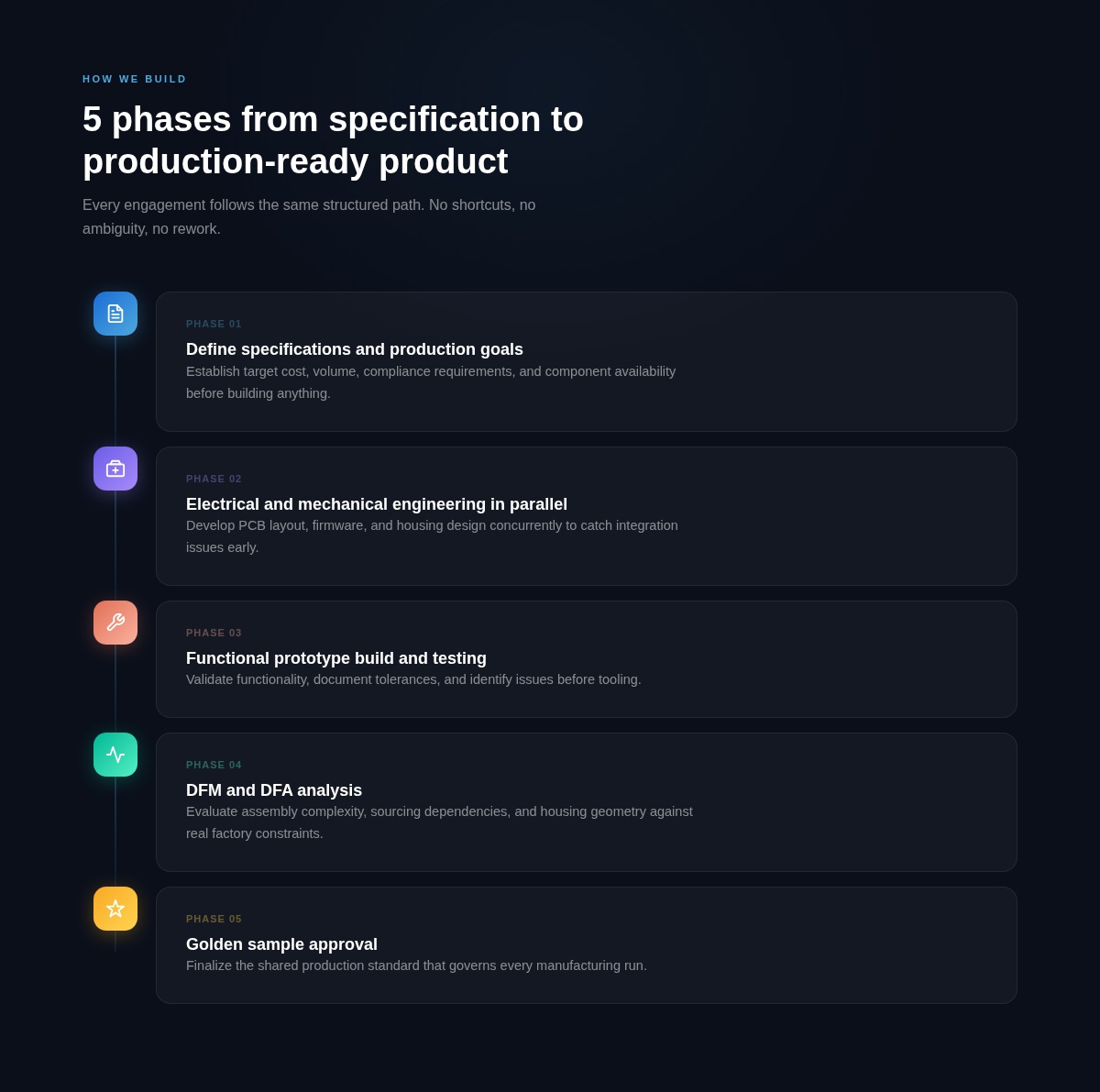
A few phases deserve more context.
From concept to physical prototype. The first build in the development process should be a functional prototype that validates real-world performance, not just a digital model or a proof-of-concept mock-up. Functionality must be tested under conditions that reflect actual use before any tooling investment is made. Hardware development decisions made before this validation step tend to produce the most expensive corrections later.
Electrical and mechanical engineering in parallel. PCB layout, firmware architecture, and mechanical housing design must happen concurrently, not in sequence. The integration between these systems affects connector placement, heat management, assembly steps, and tooling requirements. Decisions in one domain directly constrain the other, and those constraints cannot be managed properly when the two disciplines operate as handoffs.
Golden sample approval. The golden sample is not a trust mechanism. It is the objective production benchmark that defines tolerances, material consistency, finish quality, and assembly accuracy for both the brand and the factory. Every inspection across every production run is measured against it. Linton’s in-house QC team follows ANSI/ASQ Z1.4 2018 standards and uses the approved golden sample as the benchmark for all inspections throughout production.
Cost Planning During Prototype Development
Cost optimization in electronics manufacturing must happen during the prototyping process, before tooling and supplier decisions are finalized. This is the phase where cost-driving decisions are still reversible.
Electronic component selection, housing design, assembly complexity, and firmware architecture all have direct implications for unit economics. Tooling costs vary significantly based on housing geometry and part complexity. Assembly costs vary based on the number of discrete steps and whether processes can be automated at target volumes. The cost structure of an electronic device at mass production is largely determined by decisions made during electronics prototyping.
Understanding that cost structure before those decisions are locked in is the difference between a product that achieves its target margins and one that requires a costly redesign at scale. Read more on why product development without manufacturing expertise costs more than you think.
Regulatory Compliance and Certification Planning
Certification requirements must be built into the prototype phase, not managed as a post-production checklist. For electronic products targeting US and European markets, applicable certifications typically include:
- FCC Part 15 for unintentional emitters in the US market
- CE marking for EU market access
- RoHS compliance for restricted substance management across components and materials
- UL or ETL certification depending on product category and distribution channel
Each of these has design-stage implications. PCB design and shielding affect FCC compliance. Electronic component selection must be validated against RoHS restricted substance lists before sourcing begins. Housing design may be governed by product safety standards that need to be understood before molds are cut. Treating these requirements as a final checklist produces the same outcome every time: issues that are straightforward to address during electronics prototyping become expensive to fix after tooling is committed.
Quality Control Planning Starts at Prototype, Not Production
Quality control for electronic products cannot be added after production begins. It must be defined during the prototyping process so that specifications, inspection criteria, and defect tolerances are documented before the first production run. A complete QC program covers four stages:
- Pre-production checks verify materials and electronic components against specifications before production begins
- First-off-tool evaluation confirms tooling produces parts within the approved tolerance range before full production is approved
- In-line inspections check PCB assembly accuracy, solder quality, and finish consistency during the active production run
- Final pre-shipment audits confirm finished goods against the approved golden sample before shipment is released
Linton’s in-house QC team follows ANSI/ASQ Z1.4 2018 standards and manages inspections at each stage. Quality control is not outsourced to third-party firms at shipment time. It is embedded in production management from the start. Learn more about product prototype development and how this connects to scalable manufacturing.
Common Mistakes in Electronics Prototype Development
The following patterns appear consistently across electronic product development projects that run into production problems:
- Treating the functional prototype as a finished product rather than a tool for validating production readiness
- Skipping DFM analysis and discovering tooling issues after molds are cut
- Selecting electronic components based on prototype performance without evaluating commercial availability at production volumes
- Underestimating firmware complexity and its downstream impact on production testing throughput
- Separating electrical and mechanical engineering into sequential phases, which masks integration problems until they are expensive to resolve
What ties these patterns together is the absence of a manufacturing perspective during hardware development. Electronics prototype development done correctly integrates manufacturing, sourcing, and quality requirements into design decisions from the first physical prototype forward.
How Linton Supports Electronics Prototype Development
Linton manages electronics prototype development as one integrated process spanning electrical engineering, mechanical design, electronic component sourcing, firmware architecture, and production planning from first physical prototype through golden sample approval.
With 700+ vetted factories and overseas sourcing teams carrying 100+ years of combined experience, Linton provides access to favorable pricing, reliable sourcing, and prioritized production attention from manufacturers with proven experience across consumer electronics categories. The Healthy Express electric tofu press case study illustrates this directly: Linton led the product from mechanical and electrical engineering through manufacturability analysis and production execution, enabling a successful market launch in a new product category.
Linton’s in-house QC team follows ANSI/ASQ Z1.4 2018 standards and manages inspections throughout the prototyping process and production. Unlike sourcing agents or contract manufacturers that treat production as a handoff, Linton operates as a manufacturing partner accountable throughout the entire development lifecycle.
A structured prototyping process that integrates manufacturing requirements from the start is the most reliable protection for cost, timeline, and product quality. Schedule a consultation with the Linton team to discuss your electronics prototype development project.
Ben Kong
CEO | Linton Group
Ben brings over 26 years of experience in product design and overseas manufacturing. Having lived and operated businesses across China and North America, he founded Linton to help brands design and develop production-ready products through practical engineering and strong factory partnerships.
View Author PageWondering if your product could be built better, faster, or at a lower cost?
Related Posts

Key Takeaways Amazon does not inspect product quality on inbound FBA shipments; it enforces prep and labeling requirements and acts on defect metrics after customers complain Once inventory is checked into a fulfillment center, the seller cannot inspect, sort, or rework it without a removal order The only window to fix a defective batch at […]
Read More
Key Takeaways AQL (Acceptable Quality Level, or Acceptance Quality Limit) is an acceptance-sampling standard used to determine whether a production lot meets an agreed quality threshold by inspecting a sample rather than every unit. The sample size and accept/reject numbers come from standardized tables in ANSI/ASQ Z1.4 and ISO 2859-1, not from the factory’s judgment […]
Read More
Key Takeaways Contract manufacturing in China works when a product has finished specifications, a realistic order volume, and defined quality standards, and becomes risky without them Vetting a factory means more than checking a business license. It requires a physical or remote audit and a pilot run measured against written acceptance criteria IP protection comes […]
Read More