


Go-to-market checklist for a physical product: what to plan while the factory is still building


Key Takeaways
- A go-to-market checklist belongs in the same weekly meeting as the engineering review, not after it. By the time the product is on a vessel, most launch decisions are already locked.
- The checklist exists to hit 3 numbers: strong first-order demand, a stable average selling price, and a reorder placed before the first order sells out.
- Retail and ecommerce launches need different checklists. Retail spends on packaging, planograms, and point-of-purchase displays. Ecommerce spends on seeding, reviews, and paid media.
- Every marketing asset needs a sample, and every sample has a lead time. Build the sample count into the production plan or the photography waits for the container.
- The reorder decision comes earlier than most brands expect. Factory lead time plus ocean transit means the second purchase order is placed while the first is still selling.
Every product development team has a version of the same story. The product solved a real problem, hit its specification, cleared final inspection, and arrived at the warehouse with nobody waiting for it. The design was finished. The launch was not.
A product can be the best answer to a pain point in its category and still fail if the brand cannot get the word out and deliver on time. Design and engineering decide whether the product works. The go-to-market checklist decides whether anyone finds out.
This checklist is for brands running a physical product through development and manufacturing. It is built around the factory timeline, because that timeline sets the deadline for every launch decision whether or not the brand plans for it.
Why the launch plan runs in parallel with development
The product development process is well documented: concept, design, prototype, Golden Sample, tooling, mass production. Each stage has a gate, a deliverable, and a meeting.
The launch plan rarely gets the same structure. It usually starts when the product is nearly finished, which is when the options are narrowest. The packaging is already specified. The first order quantity is already set by the MOQ (minimum order quantity). The ship date is already on the calendar. What is left is execution on a plan nobody wrote.
The fix is a second meeting. If the team already meets once or twice a week on design, engineering, and manufacturing, add a go-to-market session alongside it, with its own checklist and its own owner. The 2 tracks share dates, so they need to share a calendar.
The 3 numbers a launch plan is built to hit
Every item on the checklist should trace back to 1 of 3 outcomes.
- High initial order demand. Enough demand in the first weeks to justify the first purchase order and validate the price.
- A stable average selling price. Demand that comes from positioning and reach, not from discounting the unit economics were never modeled to absorb.
- Inventory turns and reorders with the factory. A first order that sells through on schedule, and a second order placed early enough that the shelf never goes empty.
The third is the least discussed and the most expensive to miss. A factory reorder carries the same production lead time as the first order, minus tooling. Add ocean transit and customs clearance, and the second purchase order needs to be placed at roughly the halfway point of the first order’s sell-through. A launch that runs hotter than planned is a stockout, not a win, unless the reorder trigger was on the checklist from the start.
Retail and ecommerce need different checklists
There is no single checklist for every launch, and the channel decision changes most of what follows.
For a retail launch, most of the energy outside the product itself goes to packaging, in-store planograms, signage, and point-of-purchase displays, plus the retailer’s own compliance requirements for case pack, labeling, and shipping. Several of these are manufacturing decisions in disguise. The packaging spec has to be final before the packaging tooling is cut, and a change in case pack changes the carton, the pallet, and the freight quote.
For ecommerce, the options open up considerably: paid media, pre-launch seeding with validation samples, pre-launch reviews, and limited-quantity launch colorways exclusive to early adopters. Each of these has a sample requirement and a date attached to it, and a limited colorway is a separate SKU with its own MOQ.
Most brands end up in both channels eventually. The order matters. Decide the launch channel before Golden Sample approval, because it changes what gets sampled and how many.
The checklist, mapped to the production timeline
The table below is the working structure. The right-hand column is the checklist; the left-hand column is the deadline the factory sets for it.
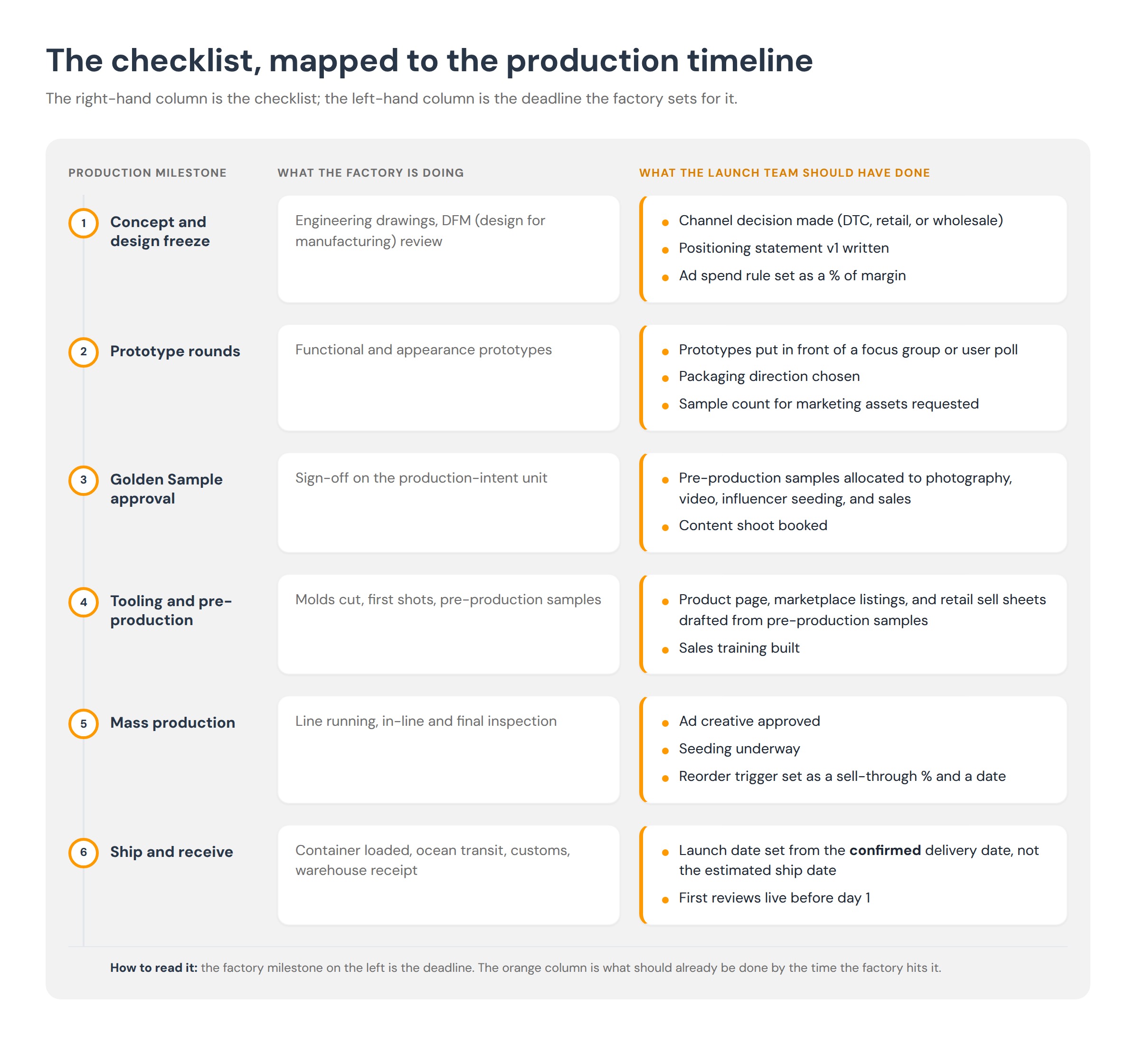
1. Decide how the product will be sold and distributed
DTC, retail, wholesale distribution, or a sequence of them. This single decision sets the packaging, the case pack, the size of the first order, and the margin structure the rest of the plan has to live inside. Make it before Golden Sample approval, not after.
2. Keep working the positioning while the product is still changing
Positioning statements, taglines, and feature claims should evolve with the product. A feature that survived the DFM review is a feature you can sell. A feature cut for cost should come out of the copy before the copy is written. This creative work is cheap to iterate during prototyping and expensive to change after the packaging is printed.
3. Plan the training and instructional content early
Retail and wholesale channels need sales training. Anything with setup or assembly needs consumer instructional video. Both need a finished-looking unit and production time, so budget them like any other launch asset and schedule them against the pre-production sample date.
4. Set the ad budget as a rule, not a number
Decide what % of the launch budget, or what % of unit margin, goes to paid acquisition. Tie the rule to landed cost, not FOB price. Once landed cost and retail price are fixed, the contribution margin caps what paid media can spend per unit sold. Knowing that cap before launch is what prevents the discount spiral that erodes average selling price in month 2.
5. Request samples for marketing assets as a quantity with a date
Almost every launch needs samples before there is anything to sell: product page photography, user testimonials, and influencer seeding all consume units. Count them. Put the number on the checklist with a date, and put the same number in the production plan so the factory can build it into the pre-production run. Skip this step and the content shoot waits for the container, which adds 4 to 6 weeks of dead time after the goods land.
6. Have sales samples and materials ready before the goods are on the water
Wholesale and retail buyers need samples and sell sheets weeks before the product lands, and a marketplace listing needs its images before the inventory is receivable. The working rule: every marketing asset is finished before the vessel departs. If a sample has to be pulled early to make that happen, that is a conversation with the factory during pre-production, not after.
7. Use the prototype rounds to test the story
Focus groups and user polls are inexpensive while prototypes exist and nearly useless once the product is in a carton. Use the prototype stages to test the claims, the price, and the story behind the product, and feed what you learn back into the positioning work in item 2.
Keep the list moving
The checklist will grow through every prototype round and pre-production meeting. That is the point. The brands that hit the ground running at launch are the ones that treated go-to-market as a development track with its own gates, not a task list that started when the container was booked.
Linton runs product design, development, and manufacturing with the client’s launch date as the fixed point, which means sample allocation, packaging timing, and the reorder window are on the production plan from the first factory brief. If you are planning a launch and want the manufacturing side built around it, schedule a consultation.
Frequently Asked Questions
When should a physical product launch plan start?
At design freeze, in parallel with engineering. The channel decision, the ad spend rule, and the sample count all need to be settled before Golden Sample approval, because they change what the factory builds and when.
How many samples does a product launch need?
Enough to cover photography, video, influencer or seeding programs, retail buyer samples, and sales training, plus spares. The exact count depends on the channel, but the number belongs in the production plan as a line item so the factory pulls them from the pre-production run rather than from the first shipment.
How is a go-to-market checklist different for retail versus ecommerce?
Retail launches spend on packaging, planograms, signage, point-of-purchase displays, and retailer compliance, most of which have to be locked before packaging tooling is cut. Ecommerce launches spend on seeding, reviews, paid media, and launch-exclusive variants, each of which has its own sample requirement and, for variants, its own MOQ.
When should the reorder be placed?
Earlier than most brands expect. Production lead time plus ocean transit and customs usually means the second purchase order goes in at roughly the halfway point of the first order’s sell-through. Set the trigger as a sell-through % and a date before the first order ships.
What is the most common launch mistake?
Starting the launch plan after the product is finished. By then packaging, first-order quantity, and ship date are fixed, and the launch team is executing against constraints it never had a chance to influence.
Elbert Lee
Sr Product Executive | Linton Group
Elbert helps brands turn product concepts into reality, combining 20+ years of overseas manufacturing expertise with full-cycle product development for some of the world’s largest brands.
View Author PageWondering if your product could be built better, faster, or at a lower cost?
Related Posts

Key Takeaways Injection molding cost splits into a one-time mold and a per-part price, and the mold is usually the largest upfront expense. Mold cost ranges from about $3,000 for simple molds, per Icomold, to $100,000 or more for hardened steel production tools, per Linton’s rapid molding guide. A $20,000 tool adds $2.00 to each […]
Read More
Key Takeaways Design for manufacturing (DFM) is not a final engineering check. Cost, materials, process, tooling, tolerance, and appearance are linked from the first design decision, and treating DFM as a late gate is how expensive tooling and unsourceable materials get locked in. A design is the combined result of competitor products, end-user experience, trends, […]
Read More
Key Takeaways Amazon does not inspect product quality on inbound FBA shipments; it enforces prep and labeling requirements and acts on defect metrics after customers complain Once inventory is checked into a fulfillment center, the seller cannot inspect, sort, or rework it without a removal order The only window to fix a defective batch at […]
Read More