


Rapid Molding: The Bridge Between a 3D Print and a Steel Injection Mold

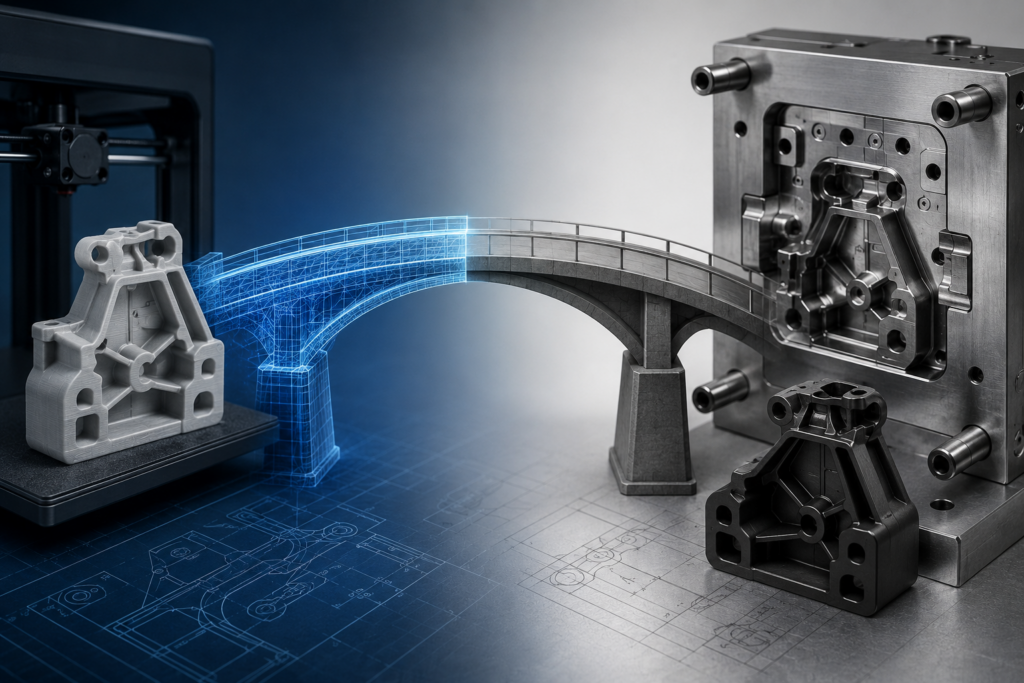
Most brands hit the same wall at the same point. You have a 3D-printed sample that looks right on your desk, and you believe in the product. But the next step on paper is a hardened steel injection mold: a $20,000 to $100,000-plus commitment with a 2 to 3 month lead time, locked in before a single customer has paid for the product. That is a large bet on an idea that has not been proven in the real world. Linton has delivered over 1,200 product development projects across 200+ product categories, and rapid molding is one of the most useful tools we put in front of brands trying to validate a plastic product without spending their runway on production tooling. This guide explains how rapid molding works, where it fits, and where it does not.
Key Takeaways
- Rapid molding is the step between a prototype and mass production. It produces real molded parts faster and cheaper than a steel injection mold, so you can validate a product before committing to production tooling.
- There are two common approaches: silicone (RTV) molds for appearance and fit, and aluminum (bridge) tooling that runs on a real injection molding machine with production-grade resins.
- Rapid tooling is a bridge, not a destination. Tool life is limited and parts can shift slightly when you move to steel, so the transition has to be planned from the start.
What Rapid Molding Actually Means
When people say “rapid mold” or “bridge tooling,” they are usually describing one of two approaches. Both get you real molded parts faster and cheaper than cutting a production steel injection mold. They make very different trade-offs.
Silicone Molds (RTV / Urethane Casting)
You start with a master pattern, often the same 3D print you already have, and pour silicone around it to create a flexible mold. You then cast parts in urethane resins that mimic the look and feel of production plastics. This is the fastest and cheapest route, with parts in hand in days. The limits are real: a silicone mold wears out after a few dozen pulls, and cast urethane is not a true injection-molded thermoplastic. It is best for appearance models, fit checks, and very small quantities where look and feel matter more than production-accurate material.
Aluminum Molds (Rapid / Bridge Tooling)
Instead of hardened steel, the mold is CNC-machined from aluminum. Aluminum cuts faster and easier than steel, so the tool is ready in roughly 1 to 3 weeks instead of 2 to 3 months, at a fraction of the cost. The advantage that matters most: an aluminum tool runs on a real injection molding machine with real production resins like ABS, PP, or nylon. The parts that come out are genuine injection-molded parts. An aluminum tool can comfortably produce hundreds to low thousands of shots, which is enough for a crowdfunding run, a market test, or bridge production while your steel injection mold is being built.
Most of the time the progression looks like this: 3D-printed prototype, then a rapid mold for a small validated batch, then a steel injection mold once the idea has proven itself. Each step costs more and commits you to more, so you only move forward when the previous step has earned it.
3D Print vs. Rapid Mold vs. Steel Injection Mold, at a Glance
Each stage answers a different question. A 3D print asks whether the product looks and fits right. A rapid mold asks whether it sells and holds up. A steel injection mold asks whether you can make it at scale, profitably, for years. Here is how they compare on the factors that actually drive the decision.
| 3D-Printed Sample | Rapid Mold (silicone / aluminum) | Steel Injection Mold | |
|---|---|---|---|
| Best for | Proving form, fit, and look early | Validating the market and de-risking the big spend | Committed, ongoing high-volume production |
| Lead time | Hours to a few days | Days (silicone) to ~1 to 3 weeks (aluminum) | ~2 to 3 months to cut the mold |
| Upfront cost | Lowest | Moderate, a fraction of a steel mold | Highest ($20,000 to $100,000+) |
| Per-part cost | High per unit, tiny quantities | Higher than mass production | Lowest per unit at volume |
| Material accuracy | Often a stand-in, not final plastic | Close: aluminum runs real resins; urethane only approximates | Exact production material and process |
| Typical volume | 1 to a handful | Tens (silicone) to hundreds/low-thousands (aluminum) | Thousands to millions |
| Surface & tolerance | Layer lines, looser tolerances | Near-production, minor differences | Production-grade finish and tolerances |
| Design changes | Trivial: reprint | Affordable, especially in aluminum | Slow and expensive; can mean re-cutting |
| Tool durability | N/A (no tool) | Limited: silicone dozens, aluminum hundreds/low-thousands | Very high: hundreds of thousands of shots |
| Pros | Fast, cheap, strong for early iteration | Real molded parts, real material, fast and affordable | Lowest unit cost, best quality, runs for years |
| Cons | Not real production parts; can mislead on material | Not long-term; parts may shift moving to steel; higher per-unit | Large upfront cost, long lead time; costly to change |
The logic is clear once it is laid out: you do not skip steps to save time, you move through them to avoid an expensive mistake. The 3D print and the rapid mold are how you earn the confidence to commit to the steel injection mold. For a fuller breakdown of where tooling sits inside total project cost, see our guide on product development costs.
Where Rapid Molds Earn Their Keep
The point is to spend a little to learn a lot before spending a lot. A few situations where we reach for this approach:
Crowdfunding fulfillment. If you are launching on Kickstarter or Indiegogo, you need to put real product in backers’ hands without first sinking six figures into tooling. An aluminum tool lets you produce a clean first run, fulfill your campaign, and use that revenue and feedback to justify the production tool.
Market testing. Sometimes the only way to know whether a product sells is to sell it. A small batch from a rapid mold gets you onto shelves, into a pilot retail program, or in front of a focus group with a product that looks and functions like the real thing, rather than a prototype with a promise attached.
De-risking the steel-mold investment. This is the quiet one. Molding even a few hundred parts surfaces problems you cannot see on a 3D print: how the material flows, where it warps, whether a wall is too thin, whether the assembly actually snaps together. Finding those issues in a $5,000 aluminum tool is a learning opportunity. Finding them in a $60,000 steel injection mold is an expensive mistake.
Investor and trade show samples. A production-representative part you can hand someone changes the conversation. It is the difference between pitching a concept and demonstrating a product.
Bridge production. If your steel injection mold is still being cut but you have orders to fill, an aluminum tool keeps you in the market instead of going dark for two months.
The Benefits of Rapid Molding
- Lower upfront cost. A rapid tool is typically a fraction of the cost of a production steel injection mold, which keeps your capital free for the parts of the business that actually grow it.
- Weeks, not months. In a market where being first matters, that gap is often the whole game.
- Real parts in real material. Aluminum tooling in particular gives you injection-molded parts in production-grade resin, the closest thing to your final product short of the final product.
- Cheaper iteration. Aluminum is far easier to modify than steel. If a test run reveals a needed change, adjusting a rapid tool is quick and affordable. Changing a steel injection mold can mean starting over.
- Validation before commitment. Most importantly, you get to prove the idea with customers, backers, and retailers before you commit to the production tooling spend.
The Risks and Limits of Rapid Molding
We would rather you hear this from us than learn it the hard way. Rapid molding is a useful tool, but it has real limits, and pretending otherwise sets brands up for disappointment.
Tool life is limited. Silicone molds degrade after a few dozen parts. Aluminum is softer than steel and wears under high volume or with abrasive, glass-filled materials. These tools are not built to run forever, which is exactly why they are a bridge, not a destination.
Parts may not be identical to your production parts. Surface finish, tolerances, and shrinkage can differ between a rapid tool and the eventual steel injection mold, and silicone-cast urethane parts can differ meaningfully from injection-molded thermoplastic. A part that fits perfectly off the aluminum tool may need small adjustments when it moves to the steel mold.
Not every geometry transfers cleanly. Some designs that mold fine in a forgiving rapid process reveal flow, packing, or cooling issues at production scale. Aluminum conducts heat differently than steel, which changes how the material behaves. Part of doing this well is anticipating where the steel-mold version will need to differ.
Higher per-part cost at small volumes. Rapid molding wins on upfront cost and speed, not on unit economics. Per-part pricing for a small batch is higher than mass production. The math works because you are paying for validation and speed, not for cheap parts.
The false-confidence trap. A clean small run can make an idea feel more production-ready than it is. We treat a successful rapid-mold batch as strong evidence, not as a guarantee, and we plan the move to the steel injection mold with clear expectations about what might still need to change.
How We Think About Rapid Molding at Linton
Rapid molding is not the right answer for every product, and we will tell you when it is not. If you already have proven demand and you are heading straight into high volume, paying twice, once for a rapid tool and once for the steel injection mold, may not make sense. But if you are validating an idea, funding a launch, testing a market, or de-risking a major tooling decision, this is often the smartest money you will spend in the whole development process.
What we bring to it is the judgment around the edges: choosing the right approach for your specific part and volume, designing the rapid tool so the lessons carry forward to production, sourcing and managing the molding through our network of 700+ vetted factories and our overseas offices, and planning the transition to the steel injection mold so it is a step forward rather than a surprise. That work sits inside Linton’s product design and development program, and for brands ready to run, our custom product manufacturing program carries the same part from validated batch to full production.
The goal is simple. Spend a little to learn a lot, and make the big commitment only once the idea has earned it.
If you are weighing whether to validate a plastic product before committing to full tooling, start a conversation with Linton before you cut a steel mold.
Ben Kong
Founder & CEO | Linton Group
Ben brings over 26 years of experience in product design and overseas manufacturing. Having lived and operated businesses across China and North America, he founded Linton to help brands design and develop production-ready products through practical engineering and strong factory partnerships.
View Author PageWondering if your product could be built better, faster, or at a lower cost?
Related Posts
Key Takeaways Injection molding cost splits into a one-time mold and a per-part price, and the mold is usually the largest upfront expense. Mold cost ranges from about $3,000 for simple molds, per Icomold, to $100,000 or more for hardened steel production tools, per Linton’s rapid molding guide. A $20,000 tool adds $2.00 to each […]
Read More
Key Takeaways Design for manufacturing (DFM) is not a final engineering check. Cost, materials, process, tooling, tolerance, and appearance are linked from the first design decision, and treating DFM as a late gate is how expensive tooling and unsourceable materials get locked in. A design is the combined result of competitor products, end-user experience, trends, […]
Read More
Key Takeaways A go-to-market checklist belongs in the same weekly meeting as the engineering review, not after it. By the time the product is on a vessel, most launch decisions are already locked. The checklist exists to hit 3 numbers: strong first-order demand, a stable average selling price, and a reorder placed before the first […]
Read More